The Emerald-spotted Wood Dove: A Jewel of the African Avifauna
The Emerald-spotted Wood Dove (Turtur chalcospilos) is a small but striking member of the Columbidae family, renowned for its subtle yet captivating beauty. This elegant bird, with its distinct emerald-green wing spots, is a common inhabitant of the woodlands and savannas across sub-Saharan Africa. Its presence adds a splash of color and a soothing coo to the diverse ecosystems it inhabits, making it a cherished species among birdwatchers and nature enthusiasts alike.
Taxonomy and Description
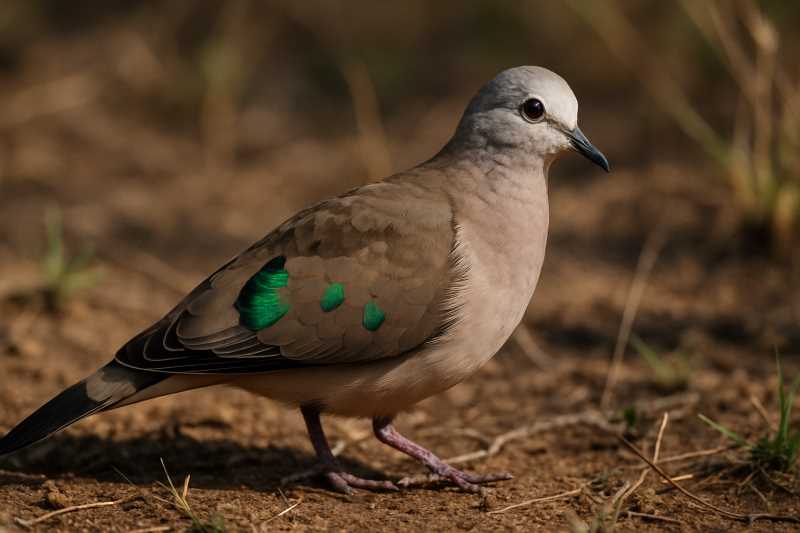
Belonging to the genus Turtur, the Emerald-spotted Wood Dove is closely related to other small doves and pigeons that share similar habitats. Its scientific name, Turtur chalcospilos, is derived from Greek, with ‘chalcospilos’ meaning ‘bronze spot’, a nod to the gleaming spots on its wings that can appear both emerald and bronze depending on the light.
Measuring about 20 to 22 centimeters in length and weighing between 70 to 100 grams, the Emerald-spotted Wood Dove is a small bird with a compact structure. Its plumage is predominantly a soft pinkish-brown, offering excellent camouflage in its natural habitat. The most distinguishing feature is the iridescent green spots on its wings, which shimmer in the sunlight and can appear almost metallic in quality. These are complemented by a white belly and a short, soft tail edged with white.
Distribution and Habitat
The Emerald-spotted Wood Dove is widespread across sub-Saharan Africa, from Senegal and the Gambia in the west to Ethiopia and Kenya in the east, extending down to South Africa. It favors open woodlands, savannas, and scrublands, often near water sources. Its adaptability has allowed it to thrive in a variety of habitats, including agricultural areas and gardens, as long as sufficient cover and food are available.
This dove is largely sedentary, though some populations may undertake local seasonal movements in response to rainfall and food availability. Its ability to adapt to different environments has helped it maintain a stable population, even as some regions face habitat changes due to human activity.
Behavior and Diet
The Emerald-spotted Wood Dove is typically a solitary or paired bird, though it may form small flocks at abundant food sources. It is known for its gentle, melodic cooing, which is a common sound in its habitat, especially during the early morning and late afternoon. The call is a soft, rhythmic ‘coo-coo-coo’, often repeated several times.
Foraging primarily on the ground, this dove feeds on a variety of seeds, fruits, and small insects. Its diet is opportunistic, varying with the availability of food sources in its environment. The bird’s feeding habits play a crucial role in seed dispersal, contributing to the health and regeneration of its ecosystem.
Reproduction and Lifespan
Breeding for the Emerald-spotted Wood Dove can occur year-round in regions where conditions are favorable, though it often coincides with the rainy season when food is plentiful. Courtship involves a series of displays, including bowing and soft cooing by the male to attract a mate.
Once paired, the female typically lays two creamy-white eggs in a flimsy platform nest constructed of twigs and grasses, usually situated in a shrub or low tree. Both parents share incubation duties over a period of about 13 to 15 days. After hatching, the chicks are fed regurgitated ‘crop milk’ by both parents and fledge approximately two weeks later.
The lifespan of the Emerald-spotted Wood Dove in the wild is not extensively documented, but like many small birds, it is thought to be around 3 to 5 years. Predation by birds of prey, snakes, and other wildlife poses a constant threat, but their cryptic plumage and cautious behavior help mitigate these risks.
Conservation Status
Currently, the Emerald-spotted Wood Dove is classified as Least Concern by the International Union for Conservation of Nature (IUCN). Its wide distribution and ability to adapt to different habitats have ensured its survival in the face of regional environmental changes. However, like many species, it faces challenges from habitat loss due to agriculture, urbanization, and climate change. Continuous monitoring of its population and habitat is essential to ensure that this beautiful dove remains a vibrant part of Africa’s avian diversity.
Conclusion
The Emerald-spotted Wood Dove is a testament to the beauty and complexity of African ecosystems. Its shimmering wing spots and soothing call bring life to the woodlands and savannas it inhabits. As both a charismatic species for birdwatchers and an important ecological player in seed dispersal, the Emerald-spotted Wood Dove underscores the need for ongoing conservation efforts. Protecting its natural habitats will not only benefit this species but also the myriad of other organisms that share its environment, preserving the rich tapestry of life that defines the African continent.
Related posts