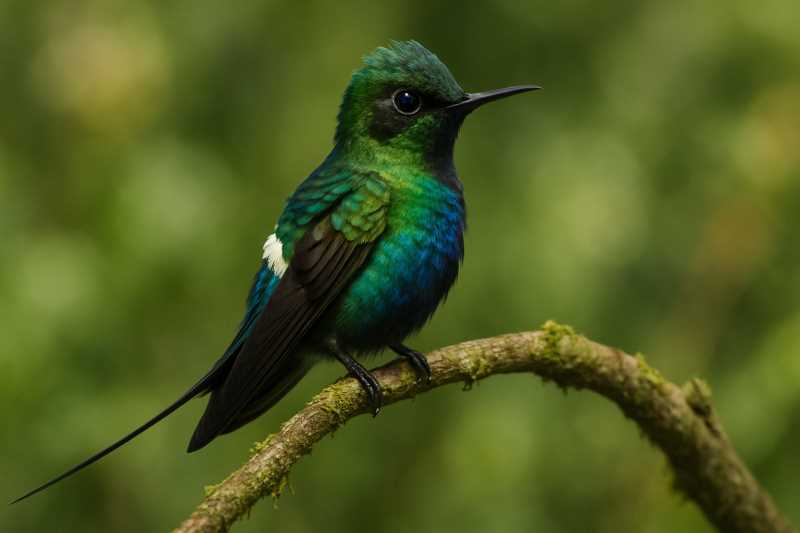
Letitia’s Thorntail: Rediscovering the Enigmatic Hummingbird
In the lush canopies of the South American rainforests, where biodiversity thrives, one of the rarest and most enigmatic hummingbirds flits among the foliage—the Letitia’s Thorntail (Discosura letitiae). This elusive species, known for its striking appearance and mysterious history, has captured the interest of ornithologists and conservationists alike. As efforts to preserve its habitat intensify, Letitia’s Thorntail symbolizes both the beauty and fragility of our planet’s ecosystems.
A Historical Enigma
Letitia’s Thorntail was first described in the 19th century by the renowned ornithologist John Gould. For decades, the species eluded researchers, with sightings being exceptionally rare. This scarcity led to the bird being categorized as a ‘data-deficient’ species, leaving much about its behavior, ecology, and population size shrouded in mystery.
The name ‘Letitia’s Thorntail’ honors Letitia, the wife of a prominent bird collector during Gould’s time, further adding a layer of historical intrigue. Unfortunately, the lack of consistent sightings led some to believe that the species might have been extinct or misidentified for other thorntail species.
Distinctive Characteristics
The Letitia’s Thorntail is a small hummingbird, measuring approximately 10-11 centimeters in length. It is distinguished by its iridescent green plumage, which shimmers with metallic hues in the sunlight, and its remarkably long, slender tail feathers that taper into wispy ends, resembling a thorn—hence the name ‘thorntail.’
Males and females exhibit subtle dimorphism; males typically flaunt brighter, more vivid plumage, while females possess slightly duller, yet equally mesmerizing, colorations. These aesthetic features not only make Letitia’s Thorntail one of the most visually striking hummingbirds but also a species of significant interest to researchers and bird enthusiasts.
Habitat and Ecological Role
Letitia’s Thorntail inhabits the dense, humid rainforests of the Amazon Basin, with a range primarily spanning parts of Ecuador, Peru, and Brazil. These regions provide the ideal environment for the thorntail, offering abundant nectar sources from a diverse range of flowering plants.
As a pollinator, Letitia’s Thorntail plays a critical role in the ecosystem. Its feeding habits contribute to the pollination of various plant species, fostering the rich biodiversity characteristic of its habitat. This role underscores the importance of preserving the thorntail’s natural environment, as its decline could have cascading effects on the broader ecological community.
Conservation Challenges and Efforts
Despite its captivating appearance and ecological significance, Letitia’s Thorntail faces numerous threats, primarily stemming from habitat destruction. Deforestation, driven by agriculture, logging, and infrastructure development, poses a direct risk to the bird’s survival. The fragmentation of its habitat not only reduces the available territory for foraging and breeding but also increases the species’ vulnerability to predators and environmental changes.
Conservationists are actively working to mitigate these threats through various strategies. Protected areas have been established to safeguard critical habitats, and reforestation projects aim to restore degraded areas. Additionally, community engagement initiatives focus on sustainable land-use practices, highlighting the importance of balancing economic development with ecological preservation.
The Role of Research and Citizen Science
Advancements in technology and methodology have allowed researchers to gain more insights into the life of Letitia’s Thorntail. Satellite imagery, remote sensing, and bioacoustic monitoring are among the tools employed to track populations and movements, providing valuable data to inform conservation strategies.
Furthermore, citizen science has emerged as a powerful tool in the conservation of Letitia’s Thorntail. Birdwatchers and nature enthusiasts contribute to observational data through platforms like eBird, aiding researchers in mapping the distribution and abundance of the species. This collaborative approach not only enhances scientific understanding but also fosters a sense of stewardship among the public.
A Symbol of Hope and Resilience
Letitia’s Thorntail stands as a testament to the wonders of the natural world and the challenges inherent in preserving it. As efforts to protect this enigmatic hummingbird continue, it serves as a symbol of hope and resilience, embodying the interconnectedness of life on Earth.
The journey to rediscover and conserve Letitia’s Thorntail is a reminder of the importance of safeguarding our planet’s biodiversity. By protecting this tiny, iridescent bird, we contribute to a larger narrative of ecological balance and sustainability—a legacy that will endure for generations to come.
Related posts