Introduction
The Short-tailed Emerald (Chlorostilbon poortmani) is a small hummingbird of the Andes in Colombia and western Venezuela. It belongs to the emerald hummingbirds, a group known for metallic green plumage and fast, agile flight. The species is resident rather than migratory and is often associated with forest edges, clearings and gardens as well as more natural montane habitats.
Physical Description
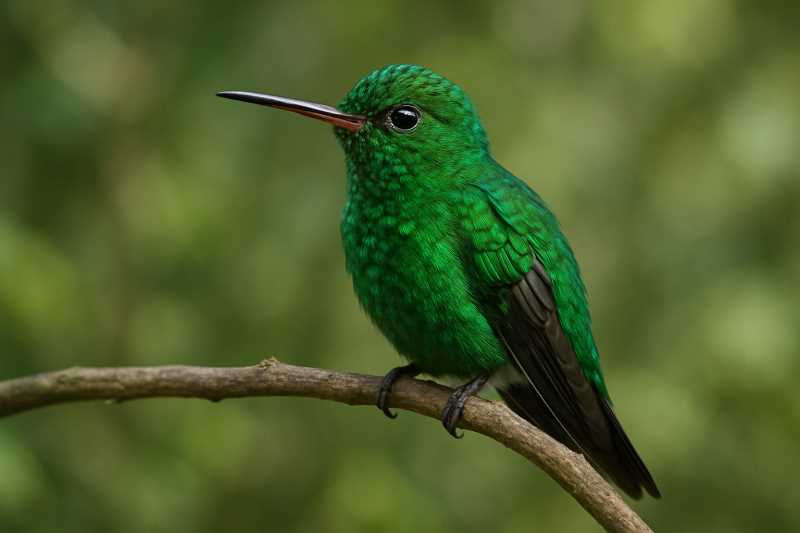
The Short-tailed Emerald is approximately 7–9 cm long and weighs about 3–4 g. Both sexes have a straight, slender black bill and a short, slightly forked tail, although the wings may extend beyond the tail when the bird is perched.
Adult males are predominantly bright, iridescent green. The forehead and underparts are especially vivid, while the crown, back and tail can show bronzy or golden-green tones. Females are less brightly coloured, with duller green upperparts, greyish underparts and a short tail with contrasting darker and paler markings.
The species includes geographic variation. The form C. p. euchloris is generally described as slightly larger and may have a more golden wash to the crown and underparts. Juveniles are duller than adults and may retain less clearly defined plumage characters while they mature.
Range and Habitat
The Short-tailed Emerald occurs in the Andes of central and eastern Colombia and western Venezuela. In Colombia, its distribution is concentrated in the Eastern Andes and adjacent mountain ranges, with records extending southwards into the western Meta and Huila regions. In Venezuela, it occurs in the western Andes, including Mérida and Táchira.
It uses humid montane forest, forest margins, open woodland, secondary growth, gardens, tree-lined farmland and shade plantations, including coffee and banana plantations. It is frequently associated with flowering vegetation and may be seen along streams, roadsides and woodland clearings. Most records come from roughly 750–2,200 metres above sea level, although the species has been recorded at lower and higher elevations in parts of its range.
The species is resident, with no regular long-distance migration known. Taxonomic treatments differ in their handling of closely related emeralds and some geographic forms, so local checklists should be consulted when precise subspecies limits are important.
Where to See This Species
Santuario de Fauna y Flora Iguaque, Boyacá, Colombia
The protected area around Iguaque supports humid Andean forest, oak woodland and other highland habitats where the Short-tailed Emerald has been documented among the sanctuary’s hummingbird fauna. Look along forest edges, flowering shrubs and open areas adjoining woodland. Visitor access and trails can vary, so check current arrangements before travelling.
Nearby accommodation: Villa de Leyva is the main practical base, with hotels, guest houses, rural stays and self-catering accommodation. Smaller accommodation options are also available around Arcabuco and the surrounding villages.
Parque Nacional Natural Serranía de los Yariguíes, Santander, Colombia
Bird surveys in the Serranía de los Yariguíes have recorded the Short-tailed Emerald in montane forest habitats at approximately 1,700–2,000 metres. The species is most likely to be encountered along forest margins, clearings and flowering areas rather than in the darkest interior forest. Access can be logistically demanding, and local guidance is advisable.
Nearby accommodation: El Carmen de Chucurí is the most useful gateway settlement, with small hotels, guest houses and basic rural accommodation. Some visitors may also use accommodation in larger towns such as San Vicente de Chucurí, depending on their route and access point.
Behaviour and Diet
The Short-tailed Emerald is an active, usually solitary hummingbird. It hovers at flowers, moves quickly between feeding sites and may defend productive patches against other hummingbirds. Its rapid flight and hovering ability are supported by a high-energy diet.
Nectar from flowering shrubs, vines and small trees provides most of its energy. The bird also takes small insects and spiders, particularly when additional protein is needed. By carrying pollen between flowers, it contributes to pollination in forest, woodland, garden and agricultural habitats.
Breeding information is limited compared with that of better-studied hummingbirds. The female builds a small cup-shaped nest from plant material and other fine fibres, often with spider silk incorporated into the structure. She is responsible for incubation and care of the young. Two white eggs are typical of many hummingbirds, but detailed information on the species’ breeding season and nesting success remains incomplete.
Identification Tips
- Look for a very small, bright green hummingbird with a noticeably short, slightly forked tail.
- Adult males are strongly iridescent green, often with bronzy or golden tones on the crown, back or tail.
- Females are duller, with greyish underparts and a more contrasting tail pattern.
- The straight black bill is a useful feature when separating it from hummingbirds with more curved or differently coloured bills.
- In areas of overlap, compare the tail colour and pattern carefully. The female Short-tailed Emerald lacks the distinctly blue tail impression shown by some other emerald hummingbirds.
- The related Green-tailed Emerald is treated as a separate species by several modern taxonomic authorities, although some classifications have historically included it within a broader concept of the Short-tailed Emerald. Identification should therefore follow the taxonomic system used by the relevant regional checklist.
Conservation Status
The Short-tailed Emerald is currently assessed as Least Concern. Its population size has not been reliably quantified, and a detailed population trend is not available.
The main potential pressures are the loss and degradation of humid montane forest, clearance of woodland edges and changes to traditionally managed agricultural landscapes. The species’ use of secondary growth, gardens and shade plantations provides some resilience, but retaining native vegetation, flowering plants, hedgerows and forest corridors remains important. Protected areas and wildlife-friendly farming practices can help maintain suitable habitat.
Frequently Asked Questions
Where is the Short-tailed Emerald found?
It is found in the Andes of Colombia and western Venezuela, especially in montane forests, forest edges, secondary growth, gardens and shade plantations.
How large is a Short-tailed Emerald?
It is a very small hummingbird, usually about 7–9 cm long and weighing approximately 3–4 g.
How can the Short-tailed Emerald be identified?
Look for its bright green plumage, straight black bill and short, slightly forked tail. Males are more vividly iridescent, while females have duller green upperparts and greyish underparts.
What does the Short-tailed Emerald eat?
It feeds mainly on nectar from flowers and supplements this diet with small insects and spiders.
Is the Short-tailed Emerald migratory?
No regular long-distance migration is known. It is generally regarded as a resident species within its Andean range.
Is the Short-tailed Emerald endangered?
It is currently classified as Least Concern, although habitat loss and degradation remain relevant conservation concerns.
References
- BirdLife International and IUCN Red List of Threatened Species
- IOC World Bird List
- Parques Nacionales Naturales de Colombia
Related posts