Introduction
The Daurian Partridge (Perdix dauurica) is a medium-sized ground-dwelling bird in the pheasant family, Phasianidae. It inhabits open country across temperate East Asia, including parts of Russia, Mongolia, China, Kazakhstan, Kyrgyzstan and adjacent regions. It is also known as the Steppe Partridge or Bearded Partridge in some sources. The species was described by Peter Simon Pallas in 1811 and is recognised as distinct from the closely related Grey Partridge (Perdix perdix).
Physical Description
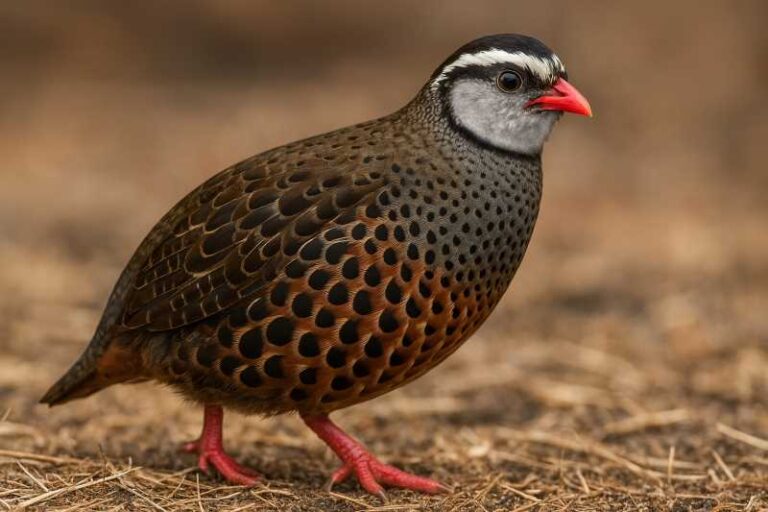
The Daurian Partridge is a compact, rounded bird, approximately 28–32 cm long. Its plumage is chiefly brown, grey, buff and rufous, providing effective camouflage in grassland and steppe habitats. The head and underparts are greyish, while the face and throat are warm sandy or rufous. Elongated feathers beneath the chin can give the species a bearded appearance.
Adults commonly show a dark patch on the belly, although its size and intensity vary geographically and between individuals. Males usually have a more strongly marked belly patch and slightly brighter plumage than females. Females are generally duller and less distinctly marked. Juveniles are more uniformly brown and cryptically patterned, with less developed adult facial and belly markings.
Range and Habitat
The Daurian Partridge has a broad distribution across temperate East Asia. Its range extends from parts of Central Asia, including Kazakhstan and Kyrgyzstan, eastwards through southern Siberia and Transbaikalia to Mongolia, northern and north-eastern China, and the Russian Far East.
It favours open grasslands, grassy and wooded steppes, semi-arid valleys, foothills, river margins and agricultural land. Areas with low or moderately tall vegetation combined with scattered shrubs, shelterbelts or small patches of woodland provide both feeding areas and cover from predators. It generally avoids true deserts and steep, heavily mountainous terrain.
The species occurs from lowlands to approximately 3,000 m in some parts of its range. It is primarily resident rather than a long-distance migrant, although local or seasonal movements may occur in response to snow cover, food availability and severe winter weather. Geographic variation in plumage has been reported, with some eastern populations appearing darker or more rufous than western birds. Taxonomic treatment of subspecies has varied, but the IOC currently recognises P. d. dauurica and P. d. suschkini.
Behaviour and Diet
Daurian Partridges are mainly terrestrial and spend most of their time walking or running through vegetation. They are usually most active during the morning and late afternoon, with periods of resting and sheltering during the warmest part of the day. When disturbed, they may remain concealed until closely approached before rising in a rapid, explosive flight to nearby cover.
Outside the breeding season, they form coveys that may contain several birds or, in favourable conditions, considerably larger groups. Covey formation improves vigilance and may help birds locate food and suitable shelter during winter.
The diet consists mainly of seeds, grains, shoots, leaves and other plant material. Invertebrates are also eaten, particularly during the breeding season. Young chicks depend more heavily on insects and other small invertebrates, which provide concentrated protein during early growth.
Breeding takes place in spring and early summer. Pairs nest on the ground, usually in a shallow scrape concealed beneath grass, low shrubs or other vegetation. Clutches commonly contain about 10–20 eggs, although clutch size varies with locality and conditions. Incubation lasts approximately 24–25 days. The chicks are precocial, leaving the nest soon after hatching and following the adults while they learn to forage and respond to danger.
Identification Tips
Look for a stocky, short-tailed partridge in open steppe, grassy valleys, farmland or low shrubland. The most useful field marks are:
- A greyish head and underparts combined with brown, buff and rufous upperparts.
- A sandy-rufous face and throat.
- Elongated feathers beneath the chin, producing the characteristic bearded appearance.
- A dark belly patch, usually more prominent in males.
- Strongly barred flanks and a rufous-brown tail.
- A preference for running into cover before making a short, powerful flight when flushed.
The species is most likely to be confused with the Grey Partridge, which has a broader Eurasian range and is closely related. Daurian Partridges typically show a more pronounced rufous face and throat and a conspicuous beard-like throat pattern. Plumage varies across the range, so identification should be based on several features rather than on the belly patch alone.
Conservation Status
The Daurian Partridge is currently assessed as Least Concern on the IUCN Red List. Its broad distribution and use of a range of open habitats support this global assessment, but local populations may be affected by habitat conversion and degradation.
Potential pressures include the expansion and intensification of agriculture, overgrazing, removal of shrubs and shelterbelts, infrastructure development, grassland burning, pesticide use and disturbance during the breeding season. Hunting and illegal shooting may also place additional pressure on some populations, particularly where the species is treated as a gamebird.
Conservation should focus on maintaining connected steppe and grassland habitats, retaining low shrub cover and field margins, reducing destructive burning and avoiding disturbance around active nests. Protected areas, sustainable grazing practices and cooperation between neighbouring countries are important because the species occurs across several national borders.
Frequently Asked Questions
Where does the Daurian Partridge live?
It occurs across temperate East Asia, including parts of Russia, Mongolia, China, Kazakhstan and Kyrgyzstan. It is associated mainly with open grassland, steppe, foothills, river valleys and suitable agricultural landscapes.
Is the Daurian Partridge migratory?
It is generally a resident species rather than a long-distance migrant. Local or seasonal movements may occur when snow, severe weather or limited food makes parts of its range unsuitable.
What does the Daurian Partridge eat?
Adults mainly eat seeds, grains, shoots, leaves and other plant material. Chicks consume more insects and other small invertebrates during their early development.
How does the Daurian Partridge nest?
It nests on the ground in a shallow scrape hidden beneath grass, shrubs or other vegetation. The chicks leave the nest soon after hatching and are able to follow the adults.
How can the Daurian Partridge be identified?
Key features include its stocky shape, grey head and underparts, rufous face and throat, beard-like throat feathers, barred flanks and usually visible dark belly patch.
Is the Daurian Partridge endangered?
The species is globally classified as Least Concern by the IUCN. Nevertheless, some local populations may face pressure from habitat loss, agricultural intensification, overgrazing, hunting and disturbance.
References
- BirdLife International. 2024. Perdix dauurica (Pallas, 1811). The IUCN Red List of Threatened Species 2024. https://doi.org/10.2305/IUCN.UK.2024-2.RLTS.T22678916A263632385.en. Accessed 8 September 2026.
- Gill, F., Donsker, D. and Rasmussen, P., eds. 2026. IOC World Bird List, version 15.2. International Ornithologists’ Union. https://www.worldbirdnames.org/. Accessed 8 September 2026.
- Madge, S. and McGowan, P. 2002. Pheasants, Partridges and Grouse: A Guide to the Pheasants, Partridges, Quails, Grouse, Guineafowl, Buttonquails and Sandgrouse of the World. Christopher Helm, London.
- Cao, M., et al. 2010. The Daurian Partridge, Perdix dauuricae, in China. Chinese Birds 1(1): 51–64. https://doi.org/10.5122/cbirds.2009.0005.
- Bao, X.-K., Liu, N.-F. and Qu, J.-Y. 2012. Effects of the Qinghai–Tibetan Plateau uplift and environmental changes on phylogeographic structure of the Daurian Partridge, Perdix dauuricae, in China. Molecular Phylogenetics and Evolution 62(3): 954–963. https://doi.org/10.1016/j.ympev.2011.11.024.
- U.S. Fish and Wildlife Service. n.d. Daurian Partridge, Perdix dauurica. Species account. https://www.fws.gov/species/daurian-partridge-perdix-dauurica. Accessed 8 September 2026.
- Global Biodiversity Information Facility. n.d. Perdix dauurica (Pallas, 1811). GBIF Backbone Taxonomy. https://www.gbif.org/species/5227956. Accessed 8 September 2026.
- Russian Federation Red Data Book. n.d. Perdix dauurica suschkini, Manchurian Bearded Partridge. Species account. https://redbookrf.ru/manchzhurskaya-borodataya-kurопатка-perdix-dauurica-suschkini. Accessed 8 September 2026.
Related posts