The White-crested Guan: An Avian Jewel of South America’s Forests
The White-crested Guan (Penelope pileata) is a remarkable bird species, known for its distinctive appearance and ecological importance. As a member of the Cracidae family, the White-crested Guan is an emblematic bird of South America’s tropical forests, where it contributes significantly to the dynamics of its habitat. This article delves into the unique characteristics, habitat, behavior, and conservation status of this fascinating bird.
Distinctive Characteristics
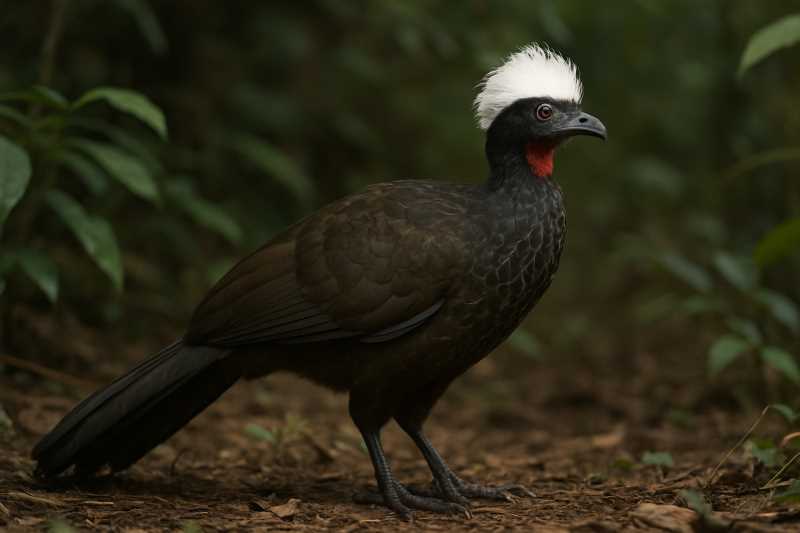
The White-crested Guan is easily identifiable by its striking white crest, which contrasts sharply with its predominantly dark plumage. This medium-sized bird measures approximately 70 to 90 cm in length and weighs between 1.2 to 1.7 kg. The plumage is mostly dark brown with a metallic sheen, while the underparts are lighter with a reddish-brown hue. The bird’s legs and beak are robust, adapted for its arboreal lifestyle.
One of the most captivating features of the White-crested Guan is its vocalizations, which include a variety of calls used for communication among individuals. These calls are particularly important during the breeding season, serving as a means to attract mates and establish territory.
Habitat and Distribution
The White-crested Guan is predominantly found in the eastern and central regions of South America, particularly in the Amazon rainforest and the Atlantic forests of Brazil. These birds thrive in dense, humid forests where they have access to abundant food sources. They are primarily arboreal, spending most of their time in the forest canopy, which provides protection from predators and access to fruit-bearing trees.
The habitat preferences of the White-crested Guan are closely tied to the health of the forest ecosystem. These birds are highly dependent on forested areas with minimal human disturbance, making them sensitive indicators of environmental health.
Behavior and Ecology
White-crested Guans are social birds, often seen in small flocks ranging from three to twelve individuals. These flocks are typically family groups, and their social structure plays a crucial role in their survival and reproduction. The guans are diurnal, foraging for food during the day and roosting in trees at night.
Their diet primarily consists of fruits, seeds, and leaves, making them important seed dispersers in their ecosystems. By consuming a wide variety of fruits and excreting the seeds in different locations, they contribute to the regeneration and maintenance of forest diversity.
The breeding season of the White-crested Guan generally occurs during the rainy season, when food resources are plentiful. They build nests high in the trees, using twigs and leaves to create a safe environment for their eggs. The female typically lays two to three eggs, which are incubated for about 24 to 28 days.
Conservation Status
The White-crested Guan is currently listed as Vulnerable on the IUCN Red List of Threatened Species. This status is primarily due to habitat loss and fragmentation caused by deforestation, agriculture expansion, and urban development. The loss of forest cover not only reduces available habitat but also disrupts the ecological processes that sustain these birds.
Conservation efforts are focused on habitat protection and restoration, as well as raising awareness about the ecological importance of the White-crested Guan. Protected areas and national parks play a crucial role in providing safe havens for these birds, while community-based conservation initiatives aim to engage local populations in preserving their natural heritage.
Conclusion
The White-crested Guan is a vital component of South America’s forest ecosystems, playing a key role in seed dispersal and forest regeneration. Its striking appearance and social behavior make it a fascinating subject for ornithologists and bird enthusiasts alike. However, the challenges it faces from habitat destruction underscore the importance of concerted conservation efforts.
Preserving the White-crested Guan and its habitat is not only crucial for the species itself but also for the overall health of the tropical forests they inhabit. By protecting these birds, we contribute to the preservation of biodiversity and the ecological balance of one of the world’s most vital ecosystems.
Related posts