Introduction
The Rosy-billed Pochard, Netta peposaca, is a South American duck in the family Anatidae. It occurs mainly in wetlands from central Chile and Argentina northwards through Uruguay, Paraguay and southern Brazil. Although classified among the pochards, it often feeds at the water’s surface and is closely associated with shallow freshwater habitats, marshes and lagoons. The species is partly migratory, with southern populations moving northwards during the austral winter. (ww.worldbirdnames.org)
Physical Description
The Rosy-billed Pochard is a robust medium-sized duck. Published measurements vary by source, but adults are generally about 40–57 centimetres long, with a wingspan of approximately 72–84 centimetres. (sib.gob.ar)
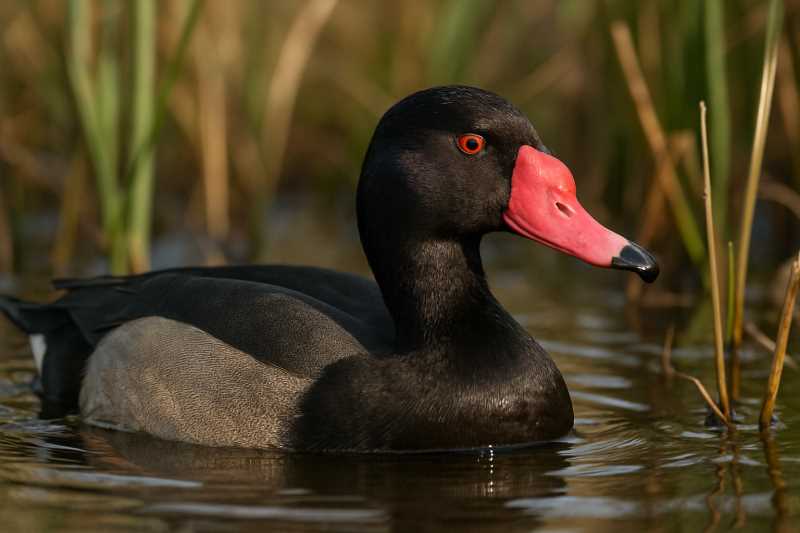
Adult males are distinctive. They have a dark blackish to purplish head, neck and breast, grey flanks, a white area beneath the tail and a broad white wing stripe that is especially obvious in flight. The bill is rosy red and swollen or knobbed at the base, and the iris is red. Females are more subdued, with largely brown plumage, a slate-grey bill and prominent white undertail coverts. Juveniles resemble females, although young males gradually develop darker plumage and a more coloured bill. (sib.gob.ar)
Range and Habitat
The species is native to South America. Its principal range includes Argentina, central Chile, Paraguay, Uruguay and southern Brazil, with occasional records farther south or outside the usual range. It favours freshwater lagoons, marshes, floodplains, rice-field wetlands, open pools and slow-moving rivers with emergent or submerged vegetation. Records in Argentina extend to about 900 metres above sea level, although most of the population is associated with lowland wetlands. (sib.gob.ar)
Rosy-billed Pochards are partly migratory rather than uniformly migratory. Birds breeding in southern Argentina and other southern parts of the range may move north during the austral winter, reaching northern Argentina, Uruguay, Paraguay, southern Brazil and, in some cases, southern Bolivia. The extent and timing of these movements are influenced by rainfall, water levels and the availability of suitable feeding wetlands. (rao.avesargentinas.org.ar)
Behaviour and Diet
The Rosy-billed Pochard is usually seen swimming in open water, alone, in pairs or in flocks. It can run across the water when taking flight and is generally a relatively quiet duck. Although it is placed among diving ducks, it commonly feeds by dabbling, up-ending and taking food from shallow water or wet margins. It may also dive when necessary.
Its diet is predominantly plant-based, including grasses, sedges, aquatic vegetation, seeds and other wetland plant material. A stomach-content study in Santa Fe Province, Argentina, recorded 16 food taxa and found that plant material, particularly Echinochloa and Polygonum, dominated the autumn diet. Animal matter, including small aquatic invertebrates, was also recorded, so the species is best described as primarily herbivorous with some omnivorous feeding. (scielo.br)
Breeding generally takes place during the austral spring and early summer, commonly from about October to December, although timing varies geographically. Courtship includes head-bobbing, neck extension, mock preening and exaggerated drinking movements. Seasonal pair bonds are formed, but they are not lifelong. The female builds a nest from plant material, often close to or over water, and may nest in tall wetland vegetation or rice fields. Clutches commonly contain about 6–10 pale cream to greenish eggs, which are incubated for approximately 27–29 days. The ducklings are precocial and leave the nest soon after hatching. Females provide most of the care, and broods may sometimes combine. (snr.unl.edu)
Identification Tips
Look for the following combination of features:
- A stocky, dark-bodied duck on freshwater wetlands.
- In males, a bright rosy-red bill with a rounded swollen base, red eyes and purplish-black head and breast.
- Grey flanks and a white patch beneath the tail.
- A broad white wing stripe visible when the bird flies.
- Females and juveniles are mainly brown, but the sharply contrasting white undertail coverts and slate-coloured bill help separate them from many other brown ducks.
The red bill and dark male plumage are usually the quickest field marks. In flight, the broad white wing stripe is particularly useful. Females can be confused with other brown waterfowl, so the white undertail area, heavy body shape and distinctive bill are important when making an identification. (sib.gob.ar)
Conservation Status
The Rosy-billed Pochard is currently listed as Least Concern on the IUCN Red List. This global category indicates that the species is not presently considered threatened at the global level, but it does not mean that local populations are free from pressure. (sib.gob.ar)
Important local threats include wetland drainage and conversion, changes in water availability, disturbance and hunting. Lead ammunition is an additional concern in parts of Argentina. A study of hunter-killed ducks from wetlands in Santa Fe Province found ingested lead pellets in 31 per cent of the sampled Rosy-billed Pochards, together with bone lead concentrations associated with harmful exposure. (bioone.org)
Effective conservation measures include protecting freshwater wetlands and floodplains, maintaining natural water regimes, monitoring important concentrations and migration sites, regulating hunting and replacing lead ammunition with non-toxic alternatives where hunting occurs. Conservation assessments should remain geographically specific because the species’ abundance and movements can vary substantially with rainfall and wetland conditions.
Frequently Asked Questions
Where does the Rosy-billed Pochard live?
It occurs mainly in Argentina, central Chile, Paraguay, Uruguay and southern Brazil. It uses freshwater lagoons, marshes, floodplains, rice-field wetlands and slow-moving rivers with suitable vegetation. (sib.gob.ar)
Is the Rosy-billed Pochard migratory?
It is partly migratory. Populations from southern parts of the range may move north during the austral winter, while other birds remain closer to their breeding areas. Movements are strongly affected by rainfall and water levels. (rao.avesargentinas.org.ar)
What does the Rosy-billed Pochard eat?
Its diet is mainly plant-based and includes grasses, sedges, aquatic plants and seeds. Small aquatic animals are also eaten, although plant material generally dominates the diet, particularly in autumn in the Santa Fe study area. (scielo.br)
How can you identify a male Rosy-billed Pochard?
The male has a dark purplish-black head and breast, grey flanks, red eyes and a bright rosy-red bill with a swollen base. A white patch beneath the tail and a broad white wing stripe are also useful identification features. (sib.gob.ar)
When does the Rosy-billed Pochard breed?
Breeding generally occurs during the austral spring and early summer, often from October to December. Females build nests from vegetation near or over water and incubate the eggs for roughly four weeks. (snr.unl.edu)
Is the Rosy-billed Pochard endangered?
No. The species is currently assessed globally as Least Concern. Nevertheless, habitat loss, hunting and lead exposure can create serious local risks and require continued monitoring and wetland protection. (sib.gob.ar)
References
- BirdLife International. 2024. Netta peposaca. The IUCN Red List of Threatened Species 2024: e.T22680351A264986238. International Union for Conservation of Nature. https://doi.org/10.2305/IUCN.UK.2024-2.RLTS.T22680351A264986238.en. Accessed 8 September 2026.
- Gill, F., Donsker, D. and Rasmussen, P. (eds.). 2026. IOC World Bird List, version 15.2. International Ornithologists’ Union. https://www.worldbirdnames.org/. Accessed 8 September 2026.
- Sistema de Información de Biodiversidad, Administración de Parques Nacionales, Argentina. n.d. Netta peposaca, Pato Picazo, Rosy-billed Pochard. https://sib.gob.ar/especies/netta-peposaca. Accessed 8 September 2026.
- Olguín, P. F., Attademo, A. M., Beltzer, A. H., Ronchi Virgolini, A. L., Lorenzón, R., Caselli, A., Arce, S. and Percara, A. 2014. Composition of the diet of Netta peposaca (Birds: Anseriformes) in Santa Fe province, Argentina. Zoologia, 31(1), 97–100. https://doi.org/10.1590/S1984-46702014000100011.
- Ferreyra, H., Romano, M. and Uhart, M. 2009. Recent and chronic exposure of wild ducks to lead in human-modified wetlands in Santa Fe Province, Argentina. Journal of Wildlife Diseases, 45(3), 823–827. https://doi.org/10.7589/0090-3558-45.3.823.
- Menegheti, J. O., Dotto, J. C. and Agra Balbueno, R. 2005. Distribución de abundancia y desplazamientos de bandadas de Netta peposaca en los ambientes del sistema Laguna Merín, Rio Grande do Sul, Brasil, registrados a través de conteos aéreos entre 1995 y 2004. XI Reunión Argentina de Ornitología. https://rao.avesargentinas.org.ar/sobre/xi-rao/distribucion-de-abundancia-y-desplazamientos-de-bandadas-de-netta-peposaca-pato-picazo-en-los-ambientes-del-sistema-laguna-merin-rio-grande-do-sul-brasil-registrados-a-traves-de-conteos-aereos/. Accessed 8 September 2026.
- Johnsgard, P. A. 1975. Waterfowl of North America. Indiana University Press.
- United States National Museum. 1926. Bulletin of the United States National Museum, no. 133. Smithsonian Institution. https://repository.si.edu/bitstream/handle/10088/10240/1/USNMB_1331926_unit.pdf. Accessed 8 September 2026.
Related posts