Introduction
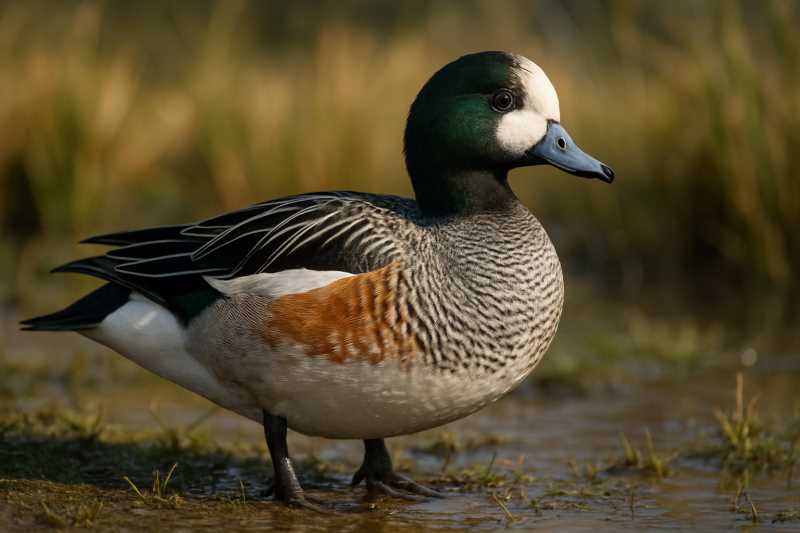
The Chiloe Wigeon, Mareca sibilatrix, is a medium-sized dabbling duck of southern South America. It is also known as the Southern Wigeon and as pato overo in parts of its native range. The species is named after Chiloé, an archipelago off the coast of southern Chile, and is noted for its contrasting black, white, chestnut and iridescent green plumage.
Physical Description
The Chiloe Wigeon is approximately 43–54 cm long, with a wingspan of about 75–86 cm. It has a compact body, a bluish-grey bill with a darker tip, and grey legs and feet.
Adults of both sexes have a largely white face, dark upperparts, a finely barred black-and-white breast, chestnut or rusty flanks, and a white belly. The head is dark with a greenish or blue-green iridescent area, most conspicuous in adult males. A broad white wing patch is especially noticeable when the bird is flying or stretching its wings.
Males are generally brighter and more strongly contrasted than females. Females have similar markings but duller, browner tones and less obvious iridescence. Juveniles are plainer than adults, lack the full metallic sheen of the head, and usually show less chestnut on the flanks. Their plumage is more heavily brown-mottled, particularly on the upperparts and wings.
Range and Habitat
The Chiloe Wigeon is native to southern South America. It breeds in central and southern Chile and Argentina, including Tierra del Fuego and the Falkland Islands. Some birds move northwards outside the breeding season, reaching Uruguay, Paraguay and southern Brazil. The species is therefore partly migratory, although the extent of movement varies across its range.
It occurs on freshwater lakes, lagoons, marshes, slow-flowing rivers and sheltered bays. It may also use wet grassland and shallow margins of wetlands, including sites near forest and Patagonian steppe. In Argentina, it has been recorded from sea level to approximately 1,200 metres, although elevation varies geographically.
Breeding habitat generally provides shallow water, dense vegetation and nearby cover suitable for nesting. The species is not restricted to the Chiloé Archipelago, despite its English name.
Behaviour and Diet
Chiloe Wigeons are usually seen singly, in pairs or in small groups, although larger flocks may form outside the breeding season. They often rest on grassy banks or beside shallow water and may associate with other ducks.
The species feeds mainly on plant material, including aquatic vegetation, grasses and seeds. It forages by dabbling in shallow water and by grazing on land near wetlands. Available evidence indicates that vegetation forms the main part of its diet, although small aquatic invertebrates may be taken incidentally.
Its calls include clear, whistling notes, particularly during social interactions and courtship. The female builds a ground nest concealed by grass, low vegetation or other cover, and lines it with down. Breeding occurs during the Southern Hemisphere spring and early summer in much of the southern range, commonly from September to December. The female incubates the eggs, while the male may remain nearby and assist in defending the pair’s area and caring for the young. Ducklings are precocial and leave the nest soon after hatching, remaining with the adults until they become independent.
Identification Tips
Look for the following combination of features:
- A medium-sized duck with a white face and dark, contrasting body.
- An iridescent green or blue-green area on the head, strongest in adult males.
- A finely barred black-and-white breast.
- Chestnut or rusty flanks contrasting with a pale belly.
- A bluish-grey bill and grey legs.
- A conspicuous white wing patch in flight.
The Chiloe Wigeon can be distinguished from the similar Crested Duck, Lophonetta specularioides, by its white face, more strongly patterned black-and-white breast, chestnut flanks and bluish-grey bill. The Crested Duck has a more elongated crest and a different overall pattern, with less of the Chiloe Wigeon’s crisp facial contrast.
Females and juveniles may appear less distinctive at a distance. In these birds, the white face, chestnut flank colour, dark-and-white body pattern and white wing patch remain useful field marks.
Conservation Status
The Chiloe Wigeon is classified as Least Concern on the IUCN Red List. It has a broad distribution and is regarded as a relatively common species in much of its range. A reliable current global population estimate and a clear long-term population trend are not established in the sources consulted.
Local populations may be affected by wetland drainage, agricultural expansion, urban development, water pollution, disturbance and changes in water management. These pressures are best addressed through the protection of freshwater wetlands, maintenance of vegetated shorelines, responsible land-use planning and regular monitoring of important breeding and non-breeding sites.
Frequently Asked Questions
Where does the Chiloe Wigeon live?
It lives mainly in Chile and Argentina, including Tierra del Fuego and the Falkland Islands. Outside the breeding season, some birds move north to Uruguay, Paraguay and southern Brazil.
Is the Chiloe Wigeon migratory?
It is partly migratory. Birds from southern areas may move north during the non-breeding season, while other individuals remain closer to their breeding areas.
What does the Chiloe Wigeon eat?
It feeds primarily on aquatic plants, grasses and seeds. It forages in shallow water and also grazes on wet grassland and the margins of lakes and marshes.
How can the Chiloe Wigeon be identified?
The most useful features are its white face, dark-and-white body pattern, chestnut flanks, iridescent green head and bluish-grey bill. A broad white wing patch is visible in flight.
Does the male Chiloe Wigeon incubate the eggs?
No. The female incubates the eggs. The male may remain nearby and help defend the area and care for the ducklings after hatching.
What is the conservation status of the Chiloe Wigeon?
The species is classified as Least Concern by the IUCN. Nevertheless, protection of freshwater wetlands remains important because local habitat loss and degradation can affect breeding and feeding areas.
References
- BirdLife International. 2016. Mareca sibilatrix. The IUCN Red List of Threatened Species 2016: e.T22680167A92847550. https://doi.org/10.2305/IUCN.UK.2016-3.RLTS.T22680167A92847550.en
- del Hoyo, J., Collar, N. J., Christie, D. A., Elliott, A. and Fishpool, L. D. C. 2014. HBW and BirdLife International Illustrated Checklist of the Birds of the World, Volume 1: Non-passerines. Lynx Edicions and BirdLife International, Barcelona and Cambridge.
- IOC World Bird List. n.d. Chiloe Wigeon, Mareca sibilatrix. World Bird Names. Accessed 8 September 2026. https://www.worldbirdnames.com/bird/chiloe-wigeon/469.html
- Sistema de Información de Biodiversidad, Administración de Parques Nacionales, Argentina. n.d. Mareca sibilatrix, Pato Overo, Chiloe Wigeon. Accessed 8 September 2026. https://sib.gob.ar/especies/mareca-sibilatrix
- Avibase, hosted by Birds Canada. n.d. Mareca sibilatrix, Chiloe Wigeon. Accessed 8 September 2026. https://avibase.bsc-eoc.org/species.jsp?avibaseid=0B8AF41FA861ED30&lang=EN
- Juárez, M. 2026. “Evidencias reproductivas del Pato Overo (Mareca sibilatrix) en el sur de la provincia de Santa Fe, Argentina.” Nuestras Aves 71. https://doi.org/10.56178/na.v71i.1178
Related posts