Introduction
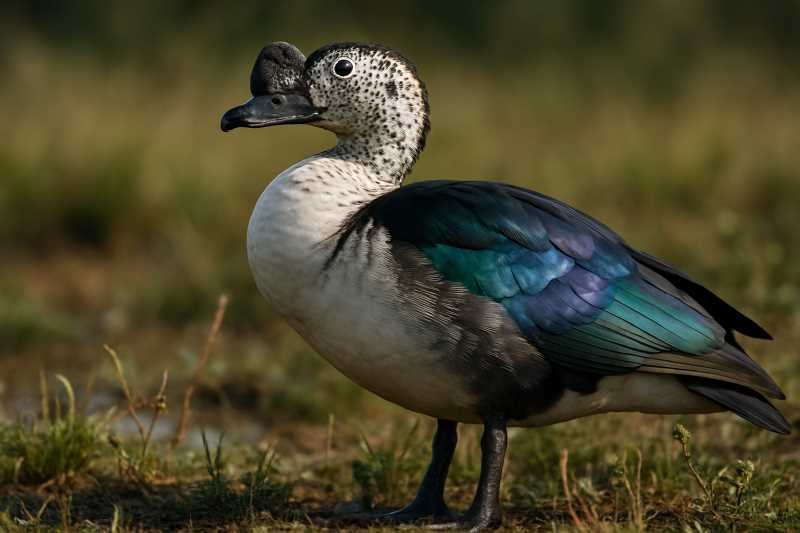
The Knob-billed Duck (Sarkidiornis melanotos) is a large tropical waterfowl species in the family Anatidae. It is recognised by the male’s prominent fleshy knob at the base of the bill, glossy dark upperparts and contrasting white body. The species is distributed across sub-Saharan Africa, Madagascar and tropical Asia. South American birds formerly treated as a subspecies are now commonly recognised separately as the American Comb Duck, Sarkidiornis sylvicola, although some taxonomic sources continue to treat the two forms as one species. (americanornithology.org)
Physical Description
The Knob-billed Duck is a large, long-bodied duck measuring approximately 60–79 cm in length. Males are substantially larger than females and have a conspicuous fleshy knob, or caruncle, on the upper mandible. This structure becomes most prominent during the breeding season. (birdsofindia.org)
Adult males have glossy blue-black to green-black upperparts, a dark crown and neck, and predominantly white underparts. The head and neck are marked with irregular black spotting, while the wings show contrasting dark, white and iridescent areas. Females are smaller and duller, lack the bill knob and usually show heavier spotting on the head and less intense gloss on the plumage. (birdsofindia.org)
Juveniles are browner and less glossy than adults. They commonly show a dark eye-stripe and more subdued, buff or brownish versions of the adult pattern. Adult plumage develops progressively, with full adult appearance generally reached after the first year or during the second year. (indiabiodiversity.org)
Range and Habitat
The Knob-billed Duck occurs across much of sub-Saharan Africa, including areas from West Africa to Ethiopia and southern Africa, as well as Madagascar. In Asia, it ranges from the Indian subcontinent through mainland Southeast Asia, including parts of Indochina. It is not normally treated as a South American species under the split taxonomy, because the South American population is generally assigned to Sarkidiornis sylvicola. (avibase.bsc-eoc.org)
It inhabits freshwater wetlands such as lakes, marshes, floodplains, swamps, slow-flowing rivers, rice fields and other shallow waters with nearby trees or dense vegetation. Tree-lined wetlands are particularly important because the species often nests in tree cavities. Birds may gather at permanent water bodies when seasonal wetlands dry, and many populations make local or seasonal movements in response to rainfall, water levels and food availability. (birdsofindia.org)
Behaviour and Diet
Knob-billed Ducks are wary birds that may retreat to vegetation or fly strongly away when disturbed. They are sociable and may occur in pairs, family groups or larger flocks. Their flight is powerful and somewhat goose-like, and they may perch in trees or on branches near water. (birdsofindia.org)
The diet is mainly vegetarian and includes aquatic plants, grasses, shoots, seeds and grains, including cultivated rice in some regions. Aquatic insects and their larvae, other invertebrates and occasional small vertebrates such as frogs or fish may supplement the diet. Foraging takes place on land, in shallow water and around wetland margins. (birdsofindia.org)
Breeding commonly coincides with the rainy or wet season, although timing varies geographically. Nests are usually placed in tree cavities near water, but the species may also use abandoned nests, hollow stumps, tall vegetation or other sheltered sites. Clutches commonly contain about 7–15 pale eggs, which are incubated by the female for approximately 28–30 days. Ducklings are precocial and leave the nest soon after hatching, normally under the guidance of the female. (birdsofindia.org)
Identification Tips
- Look for a large duck with a mostly white body, dark glossy upperparts and a long, broad bill.
- An adult male is unmistakable at close range because of the large fleshy knob at the base of the bill.
- Females lack the knob and are smaller, duller and more heavily marked on the head.
- In flight, the contrasting black, white and iridescent wing pattern is conspicuous.
- Juveniles are browner and less sharply patterned, with a dark eye-stripe.
- In the Old World range, the combination of large size, white body, dark glossy back and the male’s knob distinguishes the species from most other ducks. In South America, similar-looking birds are generally identified as the separate American Comb Duck, Sarkidiornis sylvicola. (birdsofindia.org)
Conservation Status
The Knob-billed Duck is currently assessed as Least Concern globally. Its wide distribution means that it is not considered globally threatened, but local populations may decline where wetlands are drained, converted for agriculture or degraded by changes in water management. Hunting and disturbance can also affect local numbers, while the species may occasionally come into conflict with farmers when it feeds in rice fields or other crops. (datazone.birdlife.org)
Conservation measures include protecting and restoring freshwater wetlands, maintaining suitable tree and nesting habitat, managing hunting sustainably and monitoring local populations. Regional assessments indicate that a favourable global category does not necessarily mean that every population is secure. For example, BirdLife South Africa reports evidence of decline in Knob-billed Duck counts in South African waterbird monitoring. (birdlife.org.za)
Frequently Asked Questions
Where does the Knob-billed Duck live?
It occurs in tropical and subtropical wetlands across sub-Saharan Africa, Madagascar and parts of South and Southeast Asia. It favours lakes, marshes, floodplains, swamps, rivers and rice-growing areas with nearby vegetation or trees.
Why does the male Knob-billed Duck have a knob on its bill?
The knob is a fleshy structure at the base of the upper bill. It is much larger in males and becomes more prominent during the breeding season, but its precise biological function is not fully established.
What does the Knob-billed Duck eat?
Its diet is mainly plant-based, including aquatic vegetation, grasses, shoots, seeds and grains. Invertebrates, frogs and small fish may also be eaten occasionally.
Does the Knob-billed Duck migrate?
It is generally considered resident or dispersive rather than a long-distance migrant. Many birds make local or seasonal movements when rainfall changes water levels and food availability.
Where does the Knob-billed Duck nest?
It most often nests in tree cavities near wetlands. It may also use abandoned nests, hollow stumps, tall vegetation or other sheltered sites. The female commonly lays about 7–15 eggs and incubates them for roughly 28–30 days.
Is the Knob-billed Duck endangered?
No. The species is currently classified as Least Concern globally, although habitat loss, hunting, disturbance and local wetland degradation can threaten particular populations.
References
- American Ornithological Society. 2020. 2020-B-2: Treat American Comb-Duck Sarkidiornis sylvicola as a separate species from Sarkidiornis melanotos. North and Middle America Classification Committee. American Ornithological Society. Accessed 8 September 2026.
- BirdLife International. n.d. Knob-billed Duck Sarkidiornis melanotos. BirdLife South Africa Red Data Book. BirdLife South Africa. Accessed 8 September 2026.
- BirdLife International. n.d. Taxonomy. BirdLife DataZone. BirdLife International. Accessed 8 September 2026.
- Gill, F., D. Donsker and P. Rasmussen, eds. 2026. IOC World Bird List, version 15.2. International Ornithologists’ Union. IOC World Bird List. Accessed 8 September 2026.
- U.S. Fish and Wildlife Service. n.d. Knob-billed Duck, Sarkidiornis melanotos. U.S. Fish and Wildlife Service. Accessed 8 September 2026.
- U.S. Fish and Wildlife Service. 2022. Ecological Risk Screening Summary: Knob-billed Duck Sarkidiornis melanotos. U.S. Fish and Wildlife Service. Accessed 8 September 2026.
- Birds of India. n.d. Sarkidiornis melanotos (Pennant, 1769), Comb Duck. Birds of India. Accessed 8 September 2026.
- Biodiversity Explorer. n.d. Sarkidiornis melanotos, Comb Duck. Animal Demography Unit, University of Cape Town. Biodiversity Explorer. Accessed 8 September 2026.
Related posts