Introduction
Darwin’s Nothura (Nothura darwinii) is a small, ground-dwelling tinamou in the family Tinamidae. It occurs in open country across parts of the southern Andes and southern South America, where its cryptic plumage helps it remain concealed among grasses, shrubs and steppe vegetation. The species is named in honour of Charles Darwin. (sib.gob.ar)
Physical Description
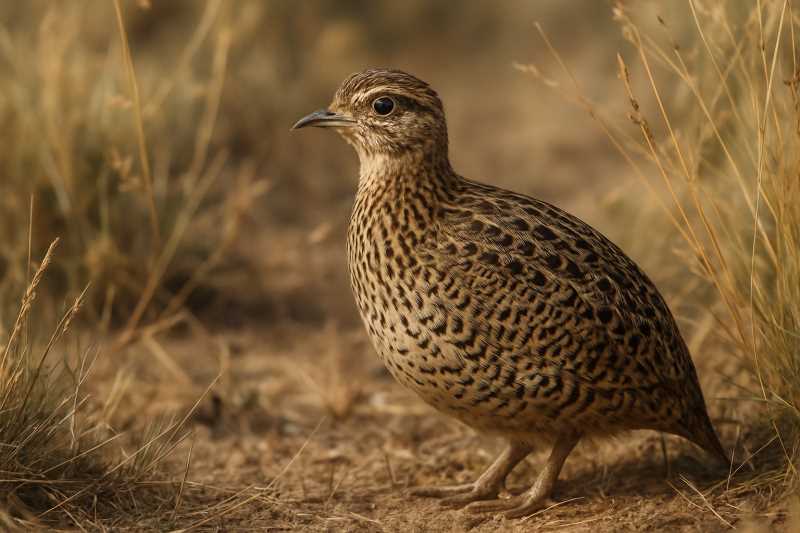
Darwin’s Nothura is a compact, quail-like bird measuring approximately 25–26 cm in length. Its upperparts are brown, greyish and buff, with fine streaking that blends with dry grass and rocky ground. The head and crown are darkly streaked, the throat is pale, and the breast and flanks show darker chestnut or brown markings. The belly is generally paler and less heavily marked than the breast.
The species has strong legs suited to walking and running, but it can fly when flushed. Its wings are adapted for short, rapid escape flights rather than sustained travel. There is no prominent sexual dimorphism documented for field identification, and males and females are generally similar in appearance. Reliable species-specific information on differences between adults and immature birds is limited. (ebird.org)
Range and Habitat
Darwin’s Nothura has a geographically broad but apparently discontinuous distribution. It is recorded from southern Peru, western Bolivia, northern Chile and several regions of Argentina, extending south-eastwards through open country to the Patagonian steppe and eastern Chubut. Several geographic forms or subspecies have been described, although subspecies treatment can vary between taxonomic authorities. (avibase.bsc-eoc.org)
The species occupies open and semi-open habitats, including puna grassland, dry Andean scrub, steppe, grassy Polylepis woodland, shrubland, farmland and other disturbed grassland. Elevational range varies substantially across its distribution. In the Andes it may occur at approximately 3,700–4,150 m, while in the southern part of its range it can occur close to sea level. In Bolivia it has been recorded most frequently in grassland and shrub habitats around 3,800–3,950 m. (researchgate.net)
Darwin’s Nothura is generally regarded as sedentary or non-migratory. Local movements may occur in response to food availability, weather or changes in agricultural conditions, but there is no evidence that it undertakes long-distance seasonal migration. (oiseaux.net)
Behaviour and Diet
This is a mainly terrestrial and diurnal bird that usually remains in dense grass or low vegetation. It is often heard before it is seen. When approached closely, it may stay motionless until flushed, then fly rapidly for a short distance before dropping back into cover. Its calls include a ringing trill and slower piping notes, with vocal activity reported particularly during the austral spring and early summer. (ebird.org)
The diet is varied and opportunistic. It includes seeds and other plant material, as well as insects and other small invertebrates. A study of Darwin’s Nothuras in the Bolivian highlands found that plant foods formed an important part of the winter diet, while animal food was also consumed. Research from north-western Argentina similarly described the species as a generalist and opportunistic forager, with diet changing according to season and habitat. (researchgate.net)
As in other tinamous, the male is responsible for incubating the eggs and caring for the young after hatching. The nest is placed on the ground, usually concealed in dense grass, shrubs or other cover. Detailed information on breeding dates, clutch size and nesting success is limited and may vary between regions.
Identification Tips
- Look for a small, short-tailed, quail-like bird in open grassland, steppe, puna or low scrub.
- The plumage is predominantly brown, buff and grey, with fine streaking and darker markings on the crown, breast and flanks.
- It usually keeps low in vegetation and may be detected by its call before it is seen.
- When flushed, it makes a short, powerful flight and quickly returns to ground cover.
- Darwin’s Nothura can resemble Spotted Nothura (Nothura maculosa). Where the two occur together, Darwin’s Nothura is generally the smaller-looking, paler or more buff-toned bird and often occupies higher elevations, but visual separation may be difficult in the field.
- In Andean habitats, comparison with Andean Tinamou and Ornate Tinamou may be useful. Darwin’s Nothura is smaller and more strongly associated with dense grass and low cover. (ebird.org)
Conservation Status
Darwin’s Nothura is currently assessed as Least Concern on the IUCN Red List. This assessment reflects its broad distribution and does not mean that all local populations are secure. A reliable current global population estimate and a species-wide population trend are not available in the sources consulted. (sib.gob.ar)
Potential pressures include conversion and degradation of grasslands, agricultural intensification, disturbance, fragmentation and changes in grazing or burning regimes. These threats should be interpreted cautiously because species-specific evidence is uneven across the range. Conservation is best supported by protecting remaining native grasslands and Andean shrublands, maintaining habitat mosaics, managing grazing and fire sustainably, and improving monitoring of the species in both natural and agricultural landscapes.
Frequently Asked Questions
Where does Darwin’s Nothura live?
Darwin’s Nothura occurs in southern Peru, western Bolivia, northern Chile and Argentina. Its habitats include puna grassland, Andean scrub, steppe, shrubland, grassy woodland and farmland.
How large is Darwin’s Nothura?
It is approximately 25–26 cm long. Its compact body, short tail and strong legs give it a quail-like appearance.
Can Darwin’s Nothura fly?
Yes. Although it spends most of its time on the ground, it can make a rapid, short flight when flushed or threatened.
What does Darwin’s Nothura eat?
Its diet includes seeds and other plant material, together with insects and other small invertebrates. The proportions vary with season and local food availability.
Is Darwin’s Nothura migratory?
It is generally considered sedentary or non-migratory. Local movements may occur when weather, food supplies or land-use conditions change.
Is Darwin’s Nothura endangered?
No. The species is currently assessed as Least Concern, although habitat loss and degradation may affect local populations and further monitoring is needed.
References
- Administracion de Parques Nacionales, Argentina. n.d. Nothura darwinii, Inambú Pálido, Darwin’s Nothura. Sistema de Información de Biodiversidad. Accessed 8 September 2026. https://sib.gob.ar/especies/nothura-darwinii
- Gill, F., Donsker, D. and Rasmussen, P. (eds). 2026. IOC World Bird List, version 15.2. International Ornithologists’ Union. Accessed 8 September 2026. https://worldbirdnames.org/
- Cornell Lab of Ornithology. n.d. Darwin’s Nothura, Nothura darwinii. eBird species account. Accessed 8 September 2026. https://ebird.org/species/darnot1
- Garitano-Zavala, A., Nadal, J. and Avila, P. 2003. The feeding ecology and digestive tract morphometry of two sympatric tinamous of the high plateau of the Bolivian Andes: the Ornate Tinamou (Nothoprocta ornata) and Darwin’s Nothura (Nothura darwinii). Ornitología Neotropical 14(2). https://digitalcommons.usf.edu/ornitologia_neotropical/vol14/iss2/3/
- Birds of Bolivia. 2021. Darwin’s Nothura, Nothura darwinii. Species account. Accessed 8 September 2026. https://birdsofbolivia.org/es/fichas-tecnicas/tinamous-perdices/nothura-darwinii/
- BirdLife International and Handbook of the Birds of the World. 2024. HBW and BirdLife International Checklist of the Birds of the World, version 9. Accessed 8 September 2026. https://device.report/m/13f7a58d6179540c78f92a4208e85ffff82eccc544e6df500d7fcfbb82d5fa81.pdf
Related posts