Introduction
The Cinnamon-throated Hermit (Phaethornis nattereri) is a small hummingbird of central and north-eastern South America. Despite its association with the Amazon region, it is found mainly in a range of wooded habitats outside tall, wet rainforest, including semi-deciduous forest, cerrado, woodland, secondary growth and gallery forest.
Physical Description
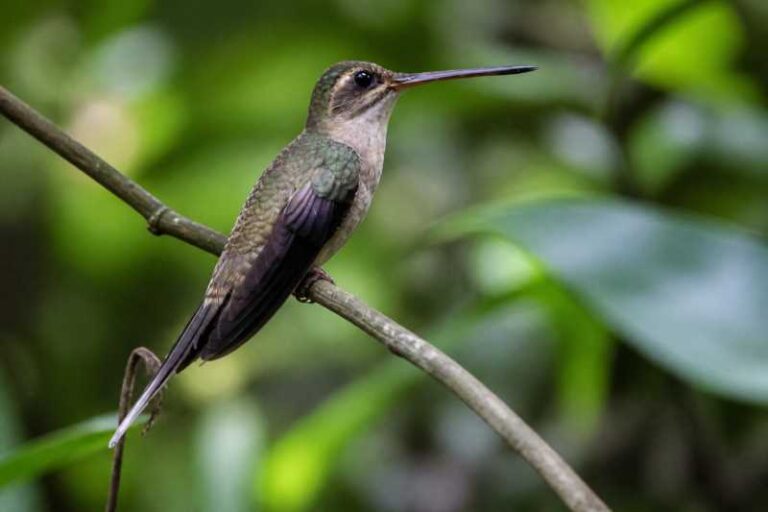
The Cinnamon-throated Hermit is approximately 10 centimetres long. Its upperparts are dull green to bronze-green, while the underparts are mainly warm cinnamon or tawny. The bird has a dark facial mask bordered by pale stripes above and below the eye, a long, slightly curved bill and contrasting rufous or cinnamon tones on the rump and uppertail coverts.
The tail is characteristic of hermits, with elongated central feathers and pale tips. Males generally have a darker throat, while females tend to show a paler throat and longer central tail feathers. The species is relatively subdued in colour compared with many hummingbirds, but the combination of its facial pattern, cinnamon underparts and tail markings is distinctive at close range.
Range and Habitat
The Cinnamon-throated Hermit occurs in Bolivia and Brazil. Its distribution is discontinuous or poorly documented, with one major population in eastern Bolivia and adjacent parts of south-western Brazil, including Mato Grosso and eastern Rondônia, and another in north-eastern Brazil, particularly Maranhão, Piauí and Ceará. Records also extend into parts of Pará and Tocantins.
It is not restricted to humid Amazonian rainforest. The species uses semi-deciduous forest, cerrado, wooded caatinga, gallery forest, forest islands and secondary vegetation. Much of its known range is at low elevation, although the available records do not establish a single strict upper elevation limit for all populations.
Taxonomic treatment of the north-eastern population has varied. Birds sometimes called the Maranhão Hermit have been treated by some authorities as a separate taxon, but the Cinnamon-throated Hermit remains the accepted species treatment used by major global bird-list authorities.
Where to See This Species
Chapada dos Guimarães National Park, Mato Grosso, Brazil
The Cinnamon-throated Hermit is documented from Chapada dos Guimarães and its surrounding cerrado and dry gallery-forest habitats. The national park and nearby public birding areas offer suitable woodland, forest-edge and streamside vegetation. It is worth looking in shaded growth and flowering plants during the morning, while recognising that local abundance can vary.
Nearby accommodation: Chapada dos Guimarães is the practical gateway, with guest houses, hotels, lodges and self-catering accommodation available in and around the town.
Serra da Capivara National Park, Piauí, Brazil
The species is documented from Serra da Capivara National Park, where dry woodland, caatinga and gallery habitats provide suitable conditions. The park is particularly relevant for the north-eastern population and is a realistic location for searching in wooded valleys, seasonal watercourses and areas of denser vegetation.
Nearby accommodation: São Raimundo Nonato is the main gateway settlement, with hotels, guest houses and other visitor accommodation serving the national park.
Behaviour and Diet
The Cinnamon-throated Hermit is active during the day and usually forages in shaded vegetation, forest edges and dense understory. Like other hermits, it may follow a regular route between flowering plants, a behaviour known as traplining. This allows it to revisit dependable nectar sources while also transferring pollen between flowers.
Its diet is based chiefly on nectar. Small arthropods are also likely to be taken, particularly when the bird needs additional protein. The species is generally encountered alone while feeding, although several individuals may use the same productive flowering area.
Detailed information about courtship, nesting and breeding success remains limited. Seasonal movements have been reported or suggested in parts of the range, especially where birds use seasonally changing forest and woodland habitats, but the species should not be described as universally migratory.
Identification Tips
Look for a small, long-billed hummingbird with:
- Dull green or bronze-green upperparts.
- Cinnamon or tawny underparts.
- A dark facial mask edged by pale supercilium and malar stripes.
- Cinnamon or rufous tones on the rump and uppertail coverts.
- Elongated central tail feathers with pale tips.
- A preference for shaded understory, gallery forest and woodland edges rather than exposed open ground.
The cinnamon underparts and facial mask help separate it from greener hermits. In areas where it overlaps with the Planalto Hermit, compare the overall colour, facial pattern, throat tone and tail markings rather than relying on size alone. Identification can be difficult from a brief view, so photographs, repeated sightings and vocal evidence are useful where local hermits occur together.
Conservation Status
The Cinnamon-throated Hermit is currently assessed as Least Concern. It is not regarded as globally threatened, but reliable information on population size, population trend and local abundance is limited.
The principal concern is the loss and alteration of woodland habitat through agricultural expansion, logging, infrastructure development, fire and fragmentation. These pressures can reduce flowering resources and nesting habitat, particularly in dry forest, cerrado and gallery-forest landscapes. Maintaining protected areas, retaining connected native vegetation and managing fire and land clearance responsibly are important conservation measures.
Responsible birdwatching and ecotourism can support local economies and conservation awareness when visitor use is carefully managed and benefits are shared with local communities. Further field surveys and monitoring would improve understanding of the species’ distribution, seasonal movements and response to habitat change.
Frequently Asked Questions
Where is the Cinnamon-throated Hermit found?
It is found in Bolivia and Brazil, with known populations in eastern Bolivia, south-western Brazil and north-eastern Brazil. Records also extend into parts of Pará and Tocantins.
Is the Cinnamon-throated Hermit an Amazon rainforest bird?
It occurs in the broader Amazonian region but is not confined to wet rainforest. It also uses cerrado, semi-deciduous forest, wooded caatinga, secondary growth and gallery forest.
What does the Cinnamon-throated Hermit eat?
It feeds mainly on nectar from flowering plants and may supplement its diet with small arthropods.
How can the Cinnamon-throated Hermit be identified?
Key features include cinnamon underparts, dull green upperparts, a dark facial mask bordered by pale stripes, a slightly curved bill and elongated central tail feathers with pale tips.
Where is the best place to look for this species?
Chapada dos Guimarães National Park in Mato Grosso and Serra da Capivara National Park in Piauí are documented protected-area locations. Search shaded woodland, gallery forest, forest edges and flowering vegetation.
Is the Cinnamon-throated Hermit endangered?
No. It is currently assessed as Least Concern, although habitat loss and fragmentation remain local conservation concerns and the species is not well studied across its entire range.
References
- BirdLife International
- IOC World Bird List
- Instituto Chico Mendes de Conservação da Biodiversidade
Related posts