Introduction
The Red-eyed Dove, Streptopelia semitorquata, is a large, widespread dove of sub-Saharan Africa and parts of south-western Arabia. It is commonly associated with woodland, savanna, riverine vegetation, cultivated areas, parks and gardens. Its red eye and dark half-collar make it one of the more distinctive African collared doves.
Physical Description
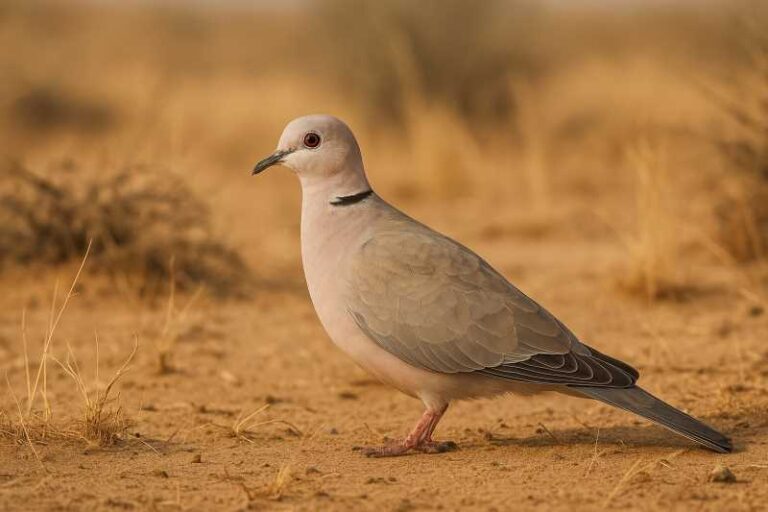
The Red-eyed Dove is a stocky dove measuring about 30 cm in length. Adults have greyish-brown to pale brown upperparts, darker flight feathers and a pinkish-grey head, breast and underparts. The forehead is paler than the crown, and the back of the neck shows a black half-collar.
The bare skin around the eye is reddish, while the iris may appear red, orange or brownish depending on the bird and viewing conditions. The legs are also reddish. In flight, the tail shows a dark band with a paler edge, a useful feature when separating it from some other collared doves.
Males and females are alike in plumage. Juveniles are duller and browner, with a more scaly or scalloped appearance to the body feathers.
Range and Habitat
The species occurs across much of sub-Saharan Africa, although it is less typical of very arid regions. It also occurs in parts of south-western Arabia. Geographic abundance varies considerably, and the species is generally most frequent where trees, shrubs and reliable water are available.
Typical habitats include woodland, savanna, forest edges, riparian vegetation, plantations, farmland, rural gardens and urban parks. It often uses open ground beneath trees for feeding and nearby branches or dense vegetation for resting and nesting. It is generally resident in much of its range, although local or seasonal movements may occur in response to rainfall, food availability and water.
Where to See This Species
Kruger National Park, Limpopo and Mpumalanga, South Africa
SANParks lists the Red-eyed Dove on the park’s bird checklist. It is a realistic species to look for in wooded savanna, camp areas, along roads and near water, particularly where open ground occurs beneath trees. The park’s extensive network of camps, roads and bird-viewing sites provides many opportunities to encounter doves while scanning the ground and lower branches.
Nearby accommodation: Accommodation is available in Kruger’s rest camps, with additional lodges, guest houses and self-catering options in gateway areas such as Hazyview, Phalaborwa and Komatipoort.
Garden Route National Park, Western and Eastern Cape, South Africa
SANParks specifically notes the Red-eyed Dove as common around the Nature’s Valley rest camp. The species is best sought around wooded camp surroundings, forest edges, gardens and riverine vegetation, where it may forage on the ground beneath trees.
Nearby accommodation: Nature’s Valley and nearby settlements offer guest houses, self-catering accommodation, campsites and small lodges. Storms River is another practical base for exploring parts of the national park.
Camdeboo National Park, Eastern Cape, South Africa
The SANParks bird checklist records the Red-eyed Dove in Camdeboo National Park. Look in wooded sections, around developed areas and wherever trees provide feeding and nesting habitat. Encounters may be less predictable in the park’s drier landscapes, so areas close to water and vegetation are more promising than exposed, barren ground.
Nearby accommodation: Graaff-Reinet is the main gateway town, with hotels, guest houses, self-catering accommodation, campsites and farm-stay options.
Behaviour and Diet
Red-eyed Doves are often seen alone or in pairs, although several may gather where food or water is plentiful. They spend much of their feeding time on the ground beneath trees and fly strongly with regular wingbeats and occasional sharp wing flicks.
Their diet is mainly plant-based and includes seeds, grains, flowers, nuts and fruit. Small invertebrates may be taken occasionally. The species readily uses gardens, cultivated land and other human-modified habitats when suitable food, trees and water are available.
The call is a deep, repeated series of cooing notes, often delivered from a prominent perch. It is used in territorial and pair communication. Breeding can occur during different parts of the year depending on location and local conditions. The nest is usually a flimsy platform of twigs and grass in a tree or shrub, although existing nests may sometimes be reused. One or two eggs are laid, and both parents share incubation, which commonly lasts about two weeks. Both adults care for the young after hatching.
Identification Tips
- Look for a large, heavy-bodied dove with a pinkish-grey breast and head.
- The reddish eye and reddish bare skin around the eye are important identification features.
- A black half-collar is visible on the back of the neck, rather than a complete ring around the neck.
- In flight, note the dark tail band with a paler edge.
- The Ring-necked Dove, Streptopelia capicola, is a common potential confusion species in parts of southern and eastern Africa. The Red-eyed Dove is larger and heavier, has a red eye, and lacks the Ring-necked Dove’s conspicuous white tail pattern in flight.
- The deep, measured cooing call can help confirm an identification when the bird is hidden in trees.
Conservation Status
The Red-eyed Dove is currently assessed as Least Concern on the IUCN Red List. Its very large geographic range and ability to use woodland, agricultural areas, parks and gardens reduce its overall vulnerability. A precise global population estimate is not available in the sources used here.
Local populations may nevertheless be affected by the loss of mature trees, changes in woodland structure, agricultural intensification and the degradation of riparian habitat. Maintaining native vegetation, protecting wooded corridors and retaining trees and shrubs in urban and agricultural landscapes can benefit this and other adaptable bird species.
Frequently Asked Questions
Where is the Red-eyed Dove found?
It is found across much of sub-Saharan Africa and in parts of south-western Arabia. It occurs in woodland, savanna, riverine vegetation, farmland, plantations, parks and gardens.
How can the Red-eyed Dove be identified?
Look for its large, stocky shape, reddish eye, pinkish-grey underparts, black half-collar and grey-brown wings. The dark tail band with a paler edge is useful when the bird is seen in flight.
What does the Red-eyed Dove eat?
It mainly eats seeds and grains, supplemented by flowers, nuts and fruit. It may also take small invertebrates occasionally and often feeds on the ground beneath trees.
Is the Red-eyed Dove migratory?
It is generally resident across much of its range, but local or seasonal movements occur in some areas. These movements may follow rainfall, food availability and access to water.
Where can I see a Red-eyed Dove?
Documented wildlife-viewing sites include Kruger National Park, Garden Route National Park and Camdeboo National Park in South Africa. Wooded areas, campgrounds, gardens, river margins and open ground beneath trees are useful places to search.
What is the conservation status of the Red-eyed Dove?
The species is listed as Least Concern by the IUCN. It remains widespread and adaptable, although local habitat loss and the removal of mature trees can reduce suitable habitat.
References
- IUCN Red List of Threatened Species
- Biodiversity and Development Institute
- South African National Parks
Related posts