Introduction
The Lesser Whistling Duck (Dendrocygna javanica), also called the Indian Whistling Duck or Lesser Whistling Teal, is a small, long-necked duck of the family Anatidae. It is distributed across the Indian subcontinent and much of mainland and island Southeast Asia, where it occupies freshwater wetlands, rice fields and other shallow, well-vegetated water bodies. The species is usually resident, although it may make local movements in response to water availability. (datazone.birdlife.org)
Physical Description
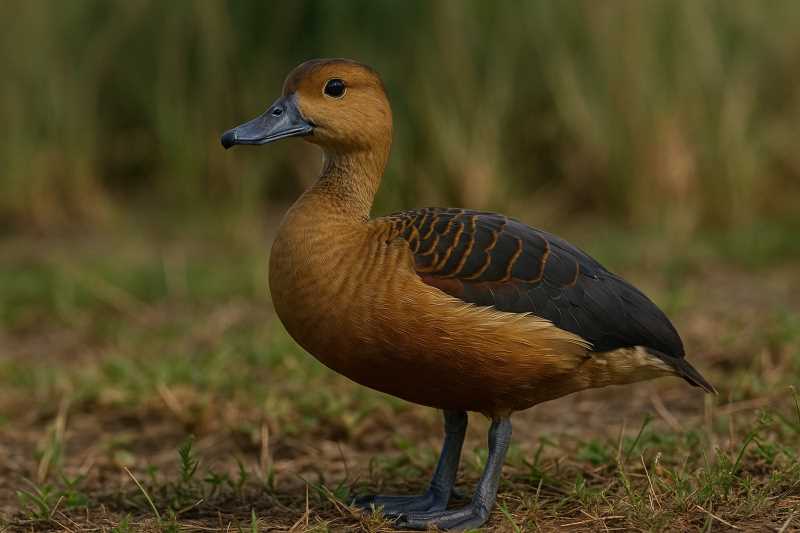
The Lesser Whistling Duck is approximately 38–42 cm long. It has a slim, upright profile, a long neck, rounded wings and relatively long legs. Adults are mainly pale brown to chestnut-brown, with a darker crown and nape, a greyish bill, dark flight feathers and chestnut upperwing coverts that are conspicuous in flight. A yellow to orange-yellow eye-ring is often visible at close range.
The sexes are alike in plumage. Juveniles are generally duller and paler, with less distinct head and flank markings. The species has no prominent crest or strong black-and-white patterning, which helps separate it from several other waterfowl. (nparks.gov.sg)
Range and Habitat
The species occurs from Pakistan, India, Nepal, Bangladesh and Sri Lanka eastwards through Myanmar, Thailand, Laos, Cambodia and Vietnam, and southwards through Malaysia, Singapore, Brunei and parts of Indonesia. Some range accounts also include southern China. It is generally regarded as a resident species, with local or seasonal movements rather than regular long-distance migration.
Typical habitats include shallow freshwater lakes, ponds, marshes, flooded grassland, reservoirs, rice paddies and vegetated wetland margins. It often favours wetlands with abundant aquatic plants and nearby trees, which provide cover and suitable roosting or nesting sites. It may also occur in coastal lagoons and mangrove-associated wetlands, although freshwater habitats are more characteristic. (datazone.birdlife.org)
Behaviour and Diet
Lesser Whistling Ducks are gregarious and may gather in small parties or large flocks, particularly outside the breeding period. They rest during the day and may feed more actively at dusk or at night, although they are also regularly seen feeding and moving between wetlands during daylight. They swim well, dive when necessary and walk readily on marshy ground. The species can also perch in trees, an unusual habit among many ducks.
The diet consists mainly of aquatic vegetation, tender shoots, seeds and grains, including cultivated rice. Animal food such as aquatic insects, molluscs, worms, small fish and frogs may also be taken. Feeding may involve dabbling, diving, grazing on wet ground and collecting food from the water surface.
The call is a repetitive, wheezy whistle, often heard when birds are flying or communicating within a flock. Breeding commonly coincides with the monsoon or rainy season, although timing varies geographically. Nests may be placed in natural tree hollows, old nests of other birds, forks or branches of trees, or on the ground near water. Clutch size is commonly about 7–12 eggs, with larger clutches also reported. The ducklings are precocial and leave the nest soon after hatching under parental guidance. (birdsofindia.org)
Identification Tips
Look for the following combination of features:
- Small size and a long, upright neck.
- Overall pale brown or chestnut-brown plumage.
- Dark crown and nape contrasting with the paler face and neck.
- Yellow or orange-yellow eye-ring.
- Dark wings with chestnut upperwing coverts, especially noticeable in flight.
- A soft, wheezy whistling call.
- Flocks resting on shallow, vegetated wetlands, rice fields or nearby trees.
The most relevant comparison in South and Southeast Asia is the Fulvous Whistling Duck (Dendrocygna bicolor). The Lesser Whistling Duck is smaller, has a darker crown, chestnut upper-tail coverts and lacks the Fulvous Whistling Duck’s strongly contrasting pale or whitish flank pattern and collar. Juveniles can be more difficult to identify because their plumage is duller and their markings are less distinct. (birdsofindia.org)
Conservation Status
The Lesser Whistling Duck is currently classified as Least Concern on the IUCN Red List. It remains widespread and locally common, but the condition of populations varies between regions. The species depends on wetlands that can be affected by drainage, conversion to agriculture or urban land, changes in water management, pollution and the loss of aquatic vegetation. Hunting and disturbance may also be significant local pressures in some parts of its range.
Conservation measures include protecting freshwater wetlands, maintaining suitable vegetation around lakes and marshes, retaining wetland features within agricultural landscapes and monitoring local populations. A Least Concern classification does not mean that individual wetlands or regional populations are free from threat. (datazone.birdlife.org)
Frequently Asked Questions
Where does the Lesser Whistling Duck live?
It occurs across the Indian subcontinent and much of mainland and island Southeast Asia. It uses shallow freshwater wetlands, marshes, rice fields, ponds, lakes and vegetated reservoirs.
Is the Lesser Whistling Duck migratory?
It is generally considered resident, but local movements occur. Birds may move between wetlands when water levels, food availability or seasonal conditions change.
What does the Lesser Whistling Duck eat?
Its diet is based mainly on aquatic plants, shoots, seeds and grains. It also takes aquatic insects, molluscs, worms and small aquatic vertebrates when available.
Where does it nest?
Nests may be built in tree hollows, old nests of other birds, tree forks or dense vegetation on the ground near water. Nest sites are usually close to suitable wetland habitat.
How can it be distinguished from the Fulvous Whistling Duck?
The Lesser Whistling Duck is smaller and has a darker crown, chestnut upper-tail coverts and less conspicuous white on the flanks. The Fulvous Whistling Duck is larger and shows stronger pale flank and collar markings.
What is its conservation status?
The species is classified as Least Concern by the IUCN. Nevertheless, wetland loss, pollution, altered water regimes and local hunting can affect populations and should be addressed through wetland protection and management.
References
- BirdLife International. n.d. Lesser Whistling-duck Dendrocygna javanica Species Factsheet. BirdLife DataZone. Accessed 8 September 2026. https://datazone.birdlife.org/species/factsheet/lesser-whistling-duck-dendrocygna-javanica
- Gill, F., Donsker, D. and Rasmussen, P. (eds). 2026. IOC World Bird List, version 15.2. International Ornithologists’ Union. Accessed 8 September 2026. https://www.worldbirdnames.org/
- eBird. n.d. Lesser Whistling-Duck Dendrocygna javanica. Cornell Lab of Ornithology. Accessed 8 September 2026. https://ebird.org/species/lewduc1
- National Parks Board Singapore. 2018. Dendrocygna javanica (Horsfield, 1821), Lesser Whistling Duck. Flora and Fauna Web. Accessed 8 September 2026. https://www.nparks.gov.sg/florafaunaweb/fauna/1/2/1296
- Billerman, S. M. (ed.). 2020. Lesser Whistling-Duck Dendrocygna javanica. Birds of the World. Cornell Lab of Ornithology. https://doi.org/10.2173/bow.lewduc1.01
- International Union for Conservation of Nature Bangladesh. 2025. Dendrocygna javanica, Lesser Whistling Duck. Red List of Bangladesh, 3rd edition. IUCN Bangladesh. Accessed 8 September 2026. https://portals.iucn.org/library/sites/library/files/documents/RL-549.3-003-v.3.pdf
- Robson, C. 2015. Birds of South-East Asia: Concise Edition. Princeton University Press.
Related posts