Introduction
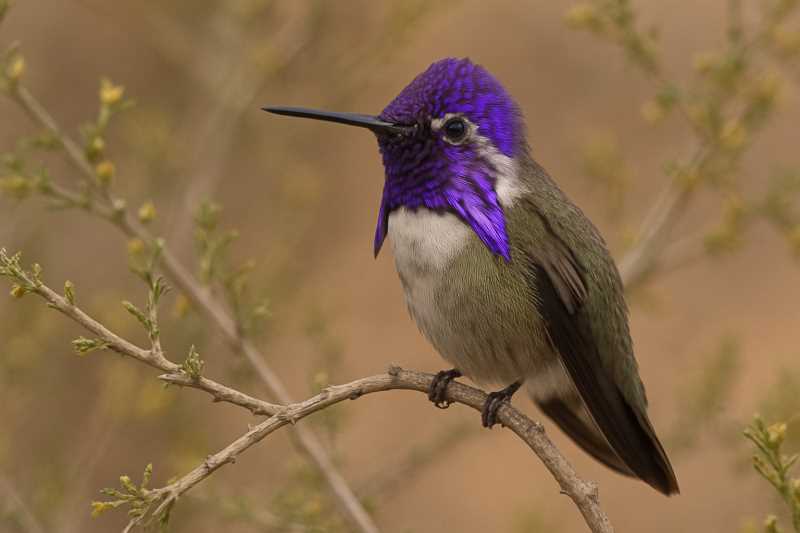
Costa’s Hummingbird, Calypte costae, is a small hummingbird of the deserts, coastal scrub and dry woodland of the southwestern United States and north-western Mexico. The species is best known for the adult male’s brilliant violet crown and deeply forked gorget, which can appear almost black in poor light. It is a specialised nectar feeder, but also takes small insects and spiders.
Physical Description
Costa’s Hummingbird is a small, compact hummingbird measuring about 8–9 cm in length. Both sexes have green upperparts, short tails and a relatively stout, dark bill.
Adult males are distinctive. The crown and gorget are iridescent violet-purple, and the elongated gorget feathers project backwards along the sides of the neck, creating a broad, pointed or moustache-like appearance. The colour changes from vivid violet in direct light to dark purplish or blackish tones in shade.
Females and juveniles are less conspicuous, with green upperparts, pale greyish or whitish underparts and a noticeable pale eyebrow. Juvenile males gradually develop purple feathers in the crown and throat as they mature. The sexes therefore differ strongly in appearance, particularly around the head and throat.
Range and Habitat
Costa’s Hummingbird occurs across the arid south-western United States and north-western Mexico. In the United States, its range includes southern California, southern Nevada, Arizona and parts of adjacent states. In Mexico, it occurs through Baja California and parts of the north-western mainland.
Typical habitats include Mojave and Sonoran Desert scrub, desert washes, rocky slopes, cactus and creosote scrub, coastal sage scrub, chaparral and dry woodland. In the Sonoran Desert it is often associated with flowering plants such as chuparosa, ocotillo, desert lavender and palo verde. In the Mojave Desert it may use scrub and woodland near springs, streams and other sources of flowering plants.
The species is resident in parts of its range but also makes seasonal movements. Birds breeding in the Sonoran and Mojave deserts may move towards coastal California, Baja California or other areas with suitable flowers during summer and autumn. It can also occur in urban gardens and parks, particularly where native nectar plants are available.
Where to See This Species
Joshua Tree National Park, California, United States
Costa’s Hummingbird is recorded as a common resident in Joshua Tree National Park. Look in desert scrub, washes and areas with flowering shrubs, particularly during late winter and spring when desert plants provide important nectar. The species may also be encountered around developed areas and water sources, although sightings are never guaranteed.
Nearby accommodation: The gateway communities of Joshua Tree, Twentynine Palms and Yucca Valley provide hotels, motels, cabins, holiday rentals, campsites and other accommodation options.
Organ Pipe Cactus National Monument, Arizona, United States
The National Park Service records Costa’s Hummingbird at Organ Pipe Cactus National Monument, where desert washes, flowering ocotillo, chuparosa and other Sonoran Desert plants provide suitable feeding habitat. The Kris Eggle Visitor Center area and greener washes can be productive places to watch for hummingbirds, especially during the spring flowering period.
Nearby accommodation: Ajo is the closest town with traveller accommodation, while the monument provides developed camping. Additional campsites and RV facilities are available around Ajo and Why.
Anza-Borrego Desert State Park, California, United States
Costa’s Hummingbird is recorded as a year-round resident of Anza-Borrego Desert State Park. Desert washes, flowering shrubs, cactus-rich areas and park habitats around Borrego Springs offer suitable places to search, with activity often increasing when native plants are in flower.
Nearby accommodation: Borrego Springs is the main gateway settlement, with hotels, guest houses, self-catering accommodation, RV facilities and campsites in and around the community and park.
Behaviour and Diet
Costa’s Hummingbirds hover while taking nectar from flowers and also catch small flying insects in mid-air. They may glean insects from leaves, branches and other vegetation. Nectar provides energy, while insects supply protein and other nutrients.
The species feeds from a wide range of desert and coastal plants. Important nectar sources include chuparosa, ocotillo, desert lavender, sage, penstemons, tree tobacco and bush monkeyflower. Costa’s Hummingbirds may also visit hummingbird feeders, but native flowering plants provide more natural feeding opportunities.
During the breeding season, males defend territories containing nectar sources and prominent perches. They sing a thin, high-pitched whistle and perform looping aerial displays. A male may fly towards a female, circle her repeatedly and then rise before making a broad U-shaped dive. He may also hover directly in front of her with his gorget spread.
The female builds the nest alone, usually placing it about 1–2 m above the ground in a shrub, small tree or cactus. The small cup-shaped nest is made from plant fibres, bark, down and other soft material bound together with spider silk. A typical clutch contains two white eggs. Incubation lasts about 15–18 days, and the young remain in the nest for roughly 20–30 days. The male does not help incubate the eggs or raise the young.
Identification Tips
- Look for a small, compact hummingbird with a short tail, green upperparts and a dark bill.
- An adult male is identified by the brilliant violet crown and the long, deeply lobed gorget feathers extending behind the throat.
- In dull light, the male’s gorget may look nearly black, but flashes of violet usually appear as the bird turns.
- Females and juveniles have a pale eyebrow and whitish or greyish underparts, with less contrast than many other desert hummingbirds.
- Compared with Anna’s Hummingbird, the adult male Costa’s has a more sharply projecting, deeply lobed gorget and a smaller, more compact appearance.
- Compared with Black-chinned Hummingbird, Costa’s Hummingbird usually shows a broader violet head pattern in the male and a paler, more obviously marked face in the female.
Conservation Status
Costa’s Hummingbird is currently assessed as Least Concern and is generally considered relatively common. Available monitoring indicates that populations have been broadly stable or have declined slightly in parts of North America in recent decades.
The main conservation concerns are the loss and degradation of desert scrub, coastal sage scrub and other flowering habitats through urban development, agriculture, grazing and changes in land use. Drought and climate change may also affect flowering times, nectar availability and the condition of desert vegetation.
Protection of desert washes, coastal scrub, native flowering plants and natural nesting habitat is important. In gardens, planting regionally native nectar-producing species and avoiding unnecessary disturbance of nests can provide useful supplementary habitat.
Frequently Asked Questions
Where does Costa’s Hummingbird live?
It occurs in the deserts, coastal scrub, chaparral and dry woodland of the south-western United States and north-western Mexico, including southern California, Arizona, Baja California and nearby regions.
What does a male Costa’s Hummingbird look like?
The adult male has green upperparts and a brilliant violet crown and gorget. The gorget feathers extend backwards along the sides of the neck, producing one of the species’ most distinctive field marks.
What does Costa’s Hummingbird eat?
It feeds mainly on flower nectar, especially from plants such as chuparosa, ocotillo, desert lavender and sage. It also catches small insects and may glean them from vegetation.
Does Costa’s Hummingbird migrate?
Some populations are resident, while others make seasonal movements. Birds breeding in inland deserts may move towards coastal California, Baja California or other areas with flowering plants during summer and autumn.
Where is the best place to see Costa’s Hummingbird?
Desert parks and reserves with flowering scrub are good places to try. Joshua Tree National Park, Organ Pipe Cactus National Monument and Anza-Borrego Desert State Park all document the species, although sightings depend on season, weather and local flowering conditions.
How does Costa’s Hummingbird nest?
The female builds a small cup-shaped nest from plant material and spider silk, usually in a shrub, small tree or cactus. She incubates the two eggs and raises the young without assistance from the male.
References
- Cornell Lab of Ornithology
- National Park Service
- California State Parks
Related posts