Introduction
The Curve-billed Tinamou (Nothoprocta curvirostris) is a shy, ground-dwelling bird of the northern Andes. It belongs to the tinamou family, Tinamidae, and is usually associated with high-elevation grassland, shrubland, open woodland and páramo-edge habitats. Although it can fly, it spends most of its time on the ground and is more often detected by its calls or a sudden flush than by prolonged observation.
Physical Description
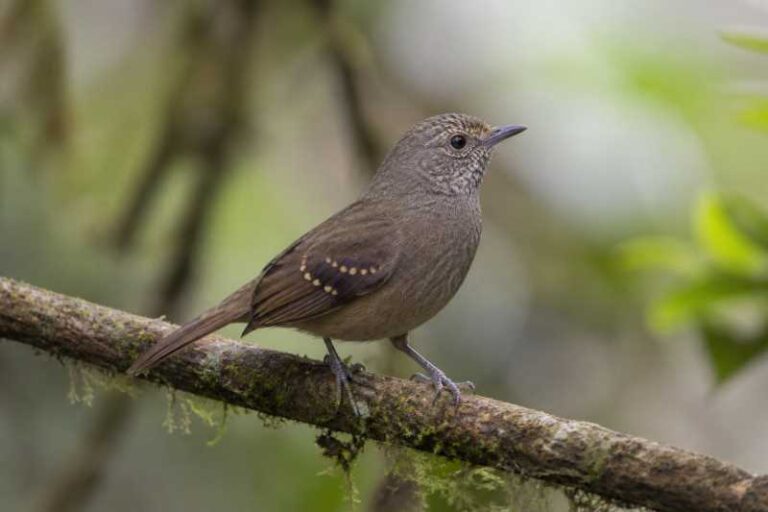
The Curve-billed Tinamou is approximately 28 centimetres long. Its upperparts are dark brown, marked with pale streaks and darker spotting. The breast is rufous with whitish markings, while the belly is generally tawny or buff. The crown is dark, and the sides of the head, throat and fore-neck are whitish. The legs are brown to dull orange.
Its most distinctive feature is the slender bill, which curves downwards and gives the species its common name. The plumage is cryptic and blends with grass, leaf litter and montane scrub. Males and females are generally similar in appearance, and reliable information on age-related plumage differences is limited.
Range and Habitat
The species occurs in the Andes from central Ecuador south through northern and central Peru. Some ornithological records and range discussions have also considered occurrences farther north, including Colombia, so published distribution accounts are not entirely uniform.
The Curve-billed Tinamou is resident rather than migratory. It is most often associated with elevations of approximately 2,800 to 3,700 metres, although local records may extend beyond this range. Preferred habitats include páramo slopes with bunchgrass and evergreen shrubs, high-elevation shrubland, pasture, open woodland, steep ravines and the edges of montane forest. It may also use lightly modified agricultural areas where suitable cover remains.
The recognised geographic variation includes the nominate form, N. c. curvirostris, and the Peruvian form N. c. peruviana. The limits and treatment of geographic variation should be checked against the current taxonomic authority being followed.
Behaviour and Diet
The Curve-billed Tinamou is primarily diurnal and terrestrial. It is secretive, usually moving through dense grass or scrub rather than crossing open ground for long distances. When disturbed, it may remain still until approached closely, then escape with a rapid, low flight or by running through cover.
Its diet is omnivorous and includes fallen fruit, seeds, tender shoots, flower buds, leaves, roots and small invertebrates. Feeding takes place mainly on the ground, where the bird searches through vegetation and leaf litter. The curved bill may assist with picking up food and probing loose substrate, although the precise feeding role of this bill shape is not well documented.
Detailed information on courtship, nesting and chick development remains limited. As with other tinamous, the species is expected to nest on the ground, and male incubation is characteristic of the family. However, species-specific breeding observations are insufficient to describe its reproductive system with confidence.
Identification Tips
Look for a medium-sized, brown, ground-dwelling bird in high Andean grassland, shrubland or open woodland. The most useful field marks are:
- A noticeably downcurved, slender bill.
- Dark brown upperparts with pale streaking and darker spotting.
- A rufous, whitish-spotted breast.
- A buff or tawny belly.
- A dark crown contrasting with whitish sides of the head and throat.
- Secretive behaviour and a tendency to run or flush suddenly from dense cover.
The combination of its curved bill, high-elevation habitat and plumage pattern helps separate it from other Andean tinamous. Care is still needed because several Nothoprocta species occupy similar grassland and shrubland environments. Vocalisations, elevation and range are useful supporting features when the bird is not seen clearly.
Conservation Status
The Curve-billed Tinamou is currently assessed as Least Concern on the IUCN Red List. This category reflects its broad distribution and the absence of evidence that it currently meets the thresholds for a threatened category; it does not mean that local populations are free from risk.
The species may be affected by the conversion and degradation of high-elevation grassland, shrubland and open woodland, including agricultural expansion, burning, grazing and other forms of habitat change. Its population size and trend are not well quantified, partly because its secretive behaviour makes systematic surveys difficult.
Maintaining connected areas of páramo, native grassland, shrubland and montane woodland is important. Further field surveys, monitoring of habitat change and confirmation of breeding and population trends would improve conservation planning.
Frequently Asked Questions
Where does the Curve-billed Tinamou live?
It lives in the northern Andes, mainly from central Ecuador through northern and central Peru. It is associated with high-elevation grassland, páramo-edge vegetation, shrubland, open woodland and steep montane slopes.
How high does the Curve-billed Tinamou occur?
Most records are from approximately 2,800 to 3,700 metres above sea level, although the exact elevation range varies between localities and published sources.
Is the Curve-billed Tinamou migratory?
No. It is regarded as a resident species rather than a regular migrant, although individuals may make local movements in response to food availability or habitat conditions.
What does the Curve-billed Tinamou eat?
Its diet includes fallen fruit, seeds, leaves, shoots, flower buds, roots and small invertebrates. It usually finds food while walking and searching through ground vegetation and leaf litter.
How can the species be identified?
Look for a secretive, brown tinamou with a conspicuously downcurved bill, a rufous and whitish-spotted breast, a buff belly, a dark crown and whitish sides to the head and throat.
Is the Curve-billed Tinamou threatened?
It is currently listed as Least Concern. Nevertheless, habitat conversion, burning, grazing and other changes to high Andean grassland and shrubland may affect local populations, and additional monitoring is needed.
References
- BirdLife International. 2024. Curve-billed Tinamou Nothoprocta curvirostris: Species factsheet. BirdLife Data Zone. Available at: https://datazone.birdlife.org/species/factsheet/curve-billed-tinamou-nothoprocta-curvirostris. Accessed 8 September 2026.
- Curipoma Heredia, S., Gavidia-Cóndor, J. & Granizo-Pazmiño, J. 2025. Registro del Tinamú Piquicurvo Nothoprocta curvirostris en el Bosque Protector Ilaló, Ecuador. Revista Ecuatoriana de Ornitología, 11(2), 142–145. https://doi.org/10.18272/reo.v11i2.3198
- Gill, F., Donsker, D. & Rasmussen, P., eds. 2026. IOC World Bird List, version 15.2. International Ornithologists’ Union. Available at: https://www.worldbirdnames.org/. Accessed 8 September 2026.
- McMullan, M. & Navarrete, L. 2017. Fieldbook of the Birds of Ecuador. Quito: Fundación de Conservación Jocotoco.
- del Hoyo, J., Elliott, A. & Sargatal, J., eds. 1992–2013. Handbook of the Birds of the World. Vol. 1, Ostrich to Ducks. Barcelona: Lynx Edicions.
- Schulenberg, T. S., Stotz, D. F., Lane, D. F., O’Neill, J. P. & Parker III, T. A. 2010. Birds of Peru: Revised and Updated Edition. Princeton, New Jersey: Princeton University Press.
- IUCN. 2026. The IUCN Red List of Threatened Species: assessment for Nothoprocta curvirostris. IUCN, Gland, Switzerland. Species information available through BirdLife International’s current species account. Accessed 8 September 2026.
Related posts