Introduction
The Malagasy Turtle Dove, also known as the Madagascar Turtle Dove, is a medium-sized pigeon in the family Columbidae. Its accepted scientific name is Nesoenas picturatus. Although strongly associated with Madagascar, the species also occurs naturally on some nearby western Indian Ocean islands and has been introduced to others.
Physical Description
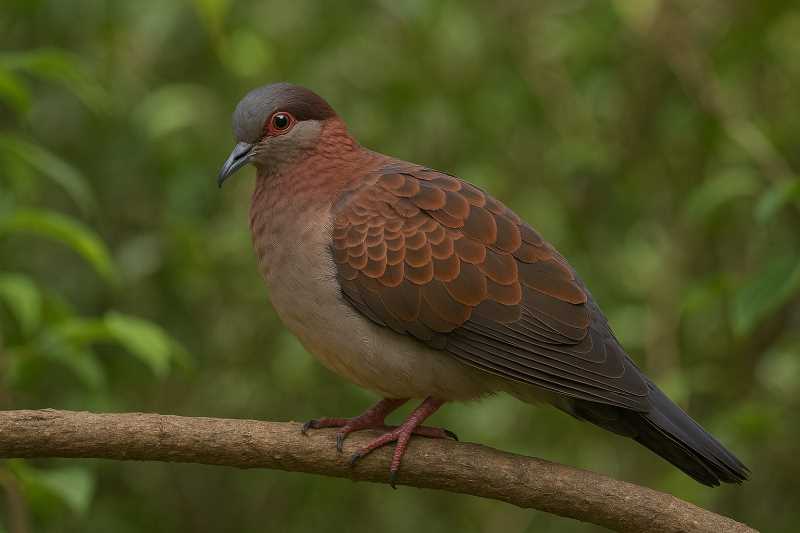
The Malagasy Turtle Dove is a medium-sized dove, usually about 30 centimetres long, with a wingspan of approximately 37 to 43 centimetres. Its plumage is generally pinkish-brown, rufous and grey, with a greyish head, darker reddish-brown wings and back, and paler underparts.
A distinctive feature is the dark, finely barred patch on the sides of the neck. The tail has conspicuous pale or white corners, which can be noticeable in flight. The eye is surrounded by a reddish or orange orbital ring.
The sexes are broadly similar, although females may appear slightly duller. Juveniles are generally more uniformly greyish-brown and lack the stronger contrasts of adults.
Range and Habitat
The species is native to Madagascar, the Comoros and the Seychelles. Different island populations are represented by recognised subspecies, and the taxonomy of some island forms has historically varied. Introduced populations also occur on islands including Mauritius, Réunion and parts of the Chagos Archipelago.
In Madagascar, the Malagasy Turtle Dove uses a wide range of wooded and semi-open habitats. It occurs in evergreen and deciduous forest, secondary woodland, scrub, forest edges, gardens and cultivated areas with sufficient trees or dense vegetation. It may be found from near sea level to elevations of about 2,000 metres.
The species is generally resident rather than migratory. It can nevertheless make strong flights between nearby islands and may move locally in response to food availability and habitat conditions.
Where to See This Species
Andasibe-Mantadia National Park, Alaotra-Mangoro, Madagascar
The Malagasy Turtle Dove has been recorded in the Andasibe-Mantadia area, where forest edges, secondary growth, gardens and other partly open habitats provide suitable feeding areas. Look along quiet tracks and clearings, particularly where leaf litter and low vegetation adjoin woodland.
Nearby accommodation: Andasibe village is the practical gateway, with lodges, guest houses and small hotels serving visitors to the national park.
Ankarafantsika National Park, Boeny, Madagascar
Ankarafantsika supports the species in dry forest, woodland and semi-open habitats. It is a realistic place to search because the dove has been documented in the park and is reported from the wider Ankarafantsika area. Early morning walks along forest tracks and around clearings offer the best opportunities for ground-feeding birds.
Nearby accommodation: Ampijoroa is the main park settlement, with basic park accommodation and campsites, while Mahajanga provides a wider choice of hotels and guest houses.
Ranomafana National Park, Fianarantsoa region, Madagascar
The species is included in bird records for Ranomafana National Park and has also been observed around the forest-edge habitats near Ranomafana village. Search along roads, village margins, gardens and more open vegetation as well as within the forest, because the dove often feeds on the ground in less densely vegetated areas.
Nearby accommodation: Ranomafana village is the main base, with lodges, guest houses and small hotels close to the park entrance.
Behaviour and Diet
The Malagasy Turtle Dove is mainly diurnal and spends much of its time on the ground. It is often seen alone or in pairs, although several birds may gather where food is plentiful. Its flight is strong and direct, despite its preference for walking and feeding beneath vegetation.
The diet consists chiefly of grass and other seeds. Fallen fruit, young plant material and small insects or other invertebrates may supplement the diet when available. Birds commonly forage beneath trees, along forest tracks, beside clearings and in lightly wooded areas.
Its call is a subdued, repetitive coo. Courtship behaviour may include head-lowering, body inflation and other displays involving the neck and breast. The nest is a loose platform of twigs placed in a tree, shrub or dense vegetation, often relatively low above the ground. Two white eggs are normally laid, and both adults contribute to incubation and care of the young.
By consuming fallen fruit and moving through wooded habitats, the species may contribute to local seed movement, although it is primarily a seed-eating ground forager rather than a specialised fruit disperser.
Identification Tips
- Look for a medium-sized, chunky dove with pinkish-brown or rufous upperparts and a greyish head.
- Check the sides of the neck for the distinctive dark patch marked with fine pale bars or spots.
- In flight, the pale corners of the tail can be conspicuous.
- The species is frequently found on the ground beneath trees, along forest edges and beside clearings.
- It is usually less boldly patterned than many similarly sized doves, but its combination of a grey head, warm reddish-brown body and neck markings is distinctive within its normal range.
Conservation Status
The Malagasy Turtle Dove is currently assessed as Least Concern at global level. This reflects its broad distribution and generally adaptable habits, rather than an absence of local pressures.
Deforestation, agricultural expansion, degradation of woodland and loss of vegetation around settlements can reduce suitable feeding and nesting habitat. Island populations may face additional risks because they are smaller and more geographically restricted. Protecting native forest, retaining wooded areas within agricultural landscapes and managing introduced populations responsibly are important conservation measures.
Frequently Asked Questions
Is the Malagasy Turtle Dove endemic to Madagascar?
No. Madagascar is the species’ principal native range, but the Malagasy Turtle Dove also occurs naturally in the Comoros and Seychelles. It has additionally been introduced to several other western Indian Ocean islands.
What does the Malagasy Turtle Dove eat?
It mainly eats seeds gathered from the ground. Fallen fruit, plant material and small insects or other invertebrates may also be taken when available.
Where does the Malagasy Turtle Dove build its nest?
It builds a loose platform of twigs in a tree, shrub or dense vegetation. The nest is often placed relatively low compared with the nests of many other pigeons and doves.
How many eggs does it lay?
A clutch normally contains two white eggs. Both adults take part in incubation and in feeding and caring for the young.
Is the Malagasy Turtle Dove migratory?
It is generally regarded as resident rather than migratory. It can make strong local movements and may fly between nearby islands, but it does not undertake a regular long-distance migration.
References
- IOC World Bird List
- IUCN Red List of Threatened Species
- Avibase
Related posts