Introduction
The Ferruginous Duck, Aythya nyroca, is a relatively small diving duck of the family Anatidae. It occurs across parts of Europe, Africa and Asia, with breeding and wintering distributions that overlap in some regions. The species is also known as the Ferruginous Pochard or White-eyed Pochard. It is a partial migrant and is associated mainly with freshwater wetlands containing abundant emergent or submerged vegetation. (unep-aewa.org)
Physical Description
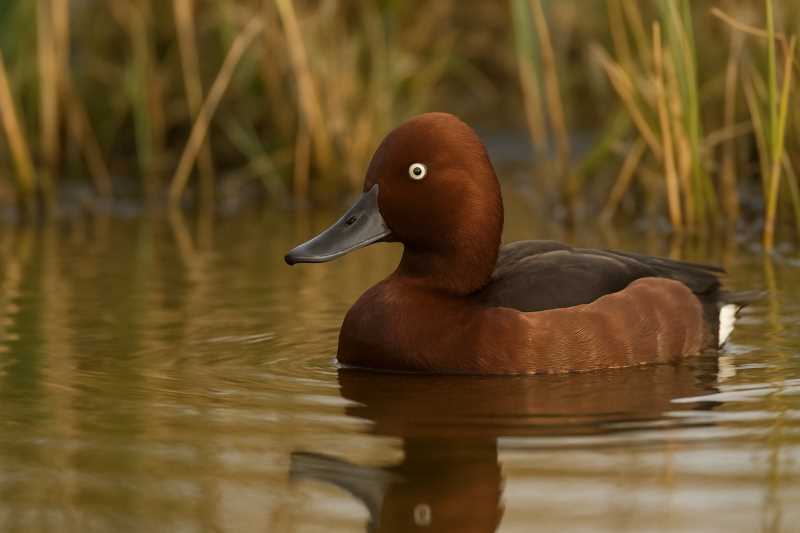
The Ferruginous Duck is approximately 38–42 cm long, with a compact body and a short, broad bill. The adult male has rich chestnut-brown plumage on the head, neck, breast and flanks, with a darker back and contrasting white undertail-coverts. In good light, the male’s pale or white iris is conspicuous.
The female is generally duller and browner, with a darker eye and less strongly contrasted plumage. Juveniles and first-winter birds are also browner and less richly coloured than adult males. In all plumages, the clean white undertail is an important feature, although it may be partly concealed when the bird is swimming. The bill is greyish with a darker tip, and the legs and feet are dark grey. (pup-assets.imgix.net)
Range and Habitat
The Ferruginous Duck has a broad but discontinuous range extending from southern and eastern Europe through western and central Asia, with additional populations in parts of the Middle East, North Africa and sub-Saharan Africa. It breeds in suitable wetlands across the southern Palearctic and winters in areas that may extend from western Africa and the Mediterranean region to the Indian subcontinent and South-East Asia. It is a partial migrant, and the extent of movement varies between populations. (unep-aewa.org)
It favours shallow freshwater lakes, marshes, oxbow lakes, fishponds, reservoirs, slow-flowing rivers and flooded wetlands. Dense reedbeds, sedge stands and submerged aquatic vegetation provide feeding areas, cover and nesting habitat. It may also use shallow brackish wetlands, lagoons and estuaries, particularly outside the breeding season. Elevational range varies geographically, and the species is found from lowland wetlands to inland sites at moderate elevations.
Behaviour and Diet
Ferruginous Ducks are primarily diurnal, although feeding may also occur during the evening or at night. They obtain food by diving, swimming and occasionally dabbling or up-ending in shallow water. Their diet includes aquatic plants, seeds, roots and other vegetative material, supplemented by aquatic insects, molluscs, worms, crustaceans and, where available, small fish or amphibians. The balance between plant and animal food varies with season and local conditions. (portals.iucn.org)
Outside the breeding season, the species can form sizeable flocks and may associate with Common Pochards, Tufted Ducks and other diving ducks. It is generally less conspicuous than many commoner waterfowl and may remain close to vegetation or spend long periods underwater.
Breeding and Reproduction
Breeding usually takes place from spring into summer, with timing varying across the range. Pairs nest in dense vegetation close to open water, including reedbeds, sedge stands and marsh margins. The female typically lays a clutch of about 7–10 eggs, and incubation lasts approximately four weeks. The ducklings are precocial, leaving the nest soon after hatching and swimming and feeding independently under the female’s supervision.
Nest success can be affected by declining water levels, habitat management and predators. Research in Hungary found that maintaining suitable water levels may both reduce access by terrestrial predators and preserve feeding habitat around nesting areas. (cambridge.org)
Identification Tips
Look for the following combination of features:
- A small to medium-sized diving duck with rich chestnut-brown plumage.
- A clearly defined white undertail, often visible when the bird is swimming or feeding.
- A pale or white eye in the adult male, contrasting with the darker eye of the female.
- A relatively steep forehead and rounded head profile.
- A grey bill with a darker tip and no prominent crest.
- Dark wings with a pale wing-bar visible in flight.
Common Pochards are larger and show a grey body, black breast and brighter red eye in adult males. Female Tufted Ducks can show pale markings around the undertail, but they usually have a more noticeable head shape, a darker overall appearance and, in males, a pronounced crest. Hybrids involving Ferruginous Ducks and other Aythya species occur, so unusual combinations of plumage, head shape or bill pattern should be treated cautiously. (birdforum.net)
Conservation Status
The Ferruginous Duck is classified as Near Threatened on the IUCN Red List. Its population has experienced a substantial long-term decline, although the size and trend of individual regional populations are not equally well documented. Major threats include the loss and degradation of wetlands, drainage, changes in water levels, drought and climate-related pressures, hunting and disturbance. Nest predation and unsuitable management of fishponds and other wetlands may also reduce breeding success in some areas. (birdsofindia.org)
Important conservation measures include protecting breeding and wintering wetlands, maintaining suitable water levels and aquatic vegetation, managing disturbance and hunting, monitoring populations across migration routes, and improving cooperation between countries sharing the species’ flyways. The AEWA International Single Species Action Plan recommends site protection, habitat management, measures to improve reproductive success and better population monitoring. (unep-aewa.org)
Frequently Asked Questions
Where does the Ferruginous Duck live?
It lives mainly in freshwater lakes, marshes, fishponds, reservoirs, slow-flowing rivers and other wetlands with dense aquatic vegetation. Its range extends across parts of Europe, Africa and Asia.
Is the Ferruginous Duck migratory?
It is a partial migrant. Some populations are resident or make relatively short movements, while others migrate between breeding wetlands in the northern or central parts of the range and wintering areas farther south.
How can a male Ferruginous Duck be identified?
An adult male is recognised by its rich chestnut-brown plumage, pale or white eye, dark back and sharply contrasting white undertail. The species is relatively small compared with the Common Pochard.
What does the Ferruginous Duck eat?
It feeds on aquatic plants, seeds, roots and other vegetation, together with insects, molluscs, worms, crustaceans and occasional small aquatic animals. It finds food by diving and sometimes by dabbling in shallow water.
When does the Ferruginous Duck breed?
Breeding generally occurs during spring and summer, with the exact timing varying geographically. The nest is usually concealed in dense vegetation near water, and the female commonly lays around 7–10 eggs.
Why is the Ferruginous Duck threatened?
The principal concerns are wetland loss and degradation, drainage, altered water levels, drought, climate-related pressures, hunting and disturbance. Predation and poor wetland management can also affect nesting success.
References
- BirdLife International. n.d. “Ferruginous Duck Aythya nyroca Species Factsheet.” BirdLife DataZone. Accessed 8 September 2026. https://datazone.birdlife.org/species/factsheet/ferruginous-duck-aythya-nyroca
- BirdLife International. 2019. “Aythya nyroca.” The IUCN Red List of Threatened Species 2019: e.T22680373A152620862. https://doi.org/10.2305/IUCN.UK.2019-3.RLTS.T22680373A152620862
- Gill, F., D. Donsker and P. Rasmussen, eds. 2026. IOC World Bird List, version 15.2. International Ornithologists’ Union. Accessed 8 September 2026. https://www.worldbirdnames.org/
- Robinson, J. A. and B. Hughes. 2006. International Single Species Action Plan for the Conservation of the Ferruginous Duck Aythya nyroca. CMS Technical Series No. 12; AEWA Technical Series No. 7. UNEP/AEWA Secretariat. https://www.unep-aewa.org/sites/default/files/publication/ts7_ssap_ferruginous_duck_complete_1.pdf
- Robinson, J. A. and B. Hughes. 2003. “The global status and distribution of the Ferruginous Duck.” In N. Petkov, B. Hughes and U. Gallo-Orsi, eds., Ferruginous Duck: From Research to Conservation, pp. 8–17. Sofia: BirdLife International, Bulgarian Society for the Protection of Birds and Threatened Waterfowl Specialist Group.
- Purger, J. J. and L. A. Mészáros. 2006. “Possible effects of nest predation on the breeding success of Ferruginous Ducks Aythya nyroca.” Bird Conservation International 16: 309–316. https://doi.org/10.1017/S0959270906000451
- British Trust for Ornithology. n.d. “Ferruginous Duck.” BirdFacts. Accessed 8 September 2026. https://www.bto.org/learn/about-birds/birdfacts/ferruginous-duck
Related posts