The Black Crake: A Closer Look at Zapornia flavirostra
The Black Crake, known scientifically as Zapornia flavirostra, is a fascinating bird belonging to the Rallidae family. This species, distinguished by its striking appearance and intriguing behaviors, is found predominantly across sub-Saharan Africa. As we delve into the world of the Black Crake, we will explore its habitat, physical characteristics, behavior, and conservation status, providing a comprehensive overview of this remarkable avian species.
Habitat and Distribution
The Black Crake thrives in diverse wetland environments, including marshes, swamps, riverbanks, and lakeshores. These birds are particularly common in areas with abundant vegetation, which provides both sustenance and cover from predators. Their distribution spans a wide range of countries, including South Africa, Kenya, Uganda, and Nigeria, to name a few. Adaptable and resilient, the Black Crake can also be found at elevations up to 3000 meters, showcasing its versatility in various ecological niches.
Physical Characteristics
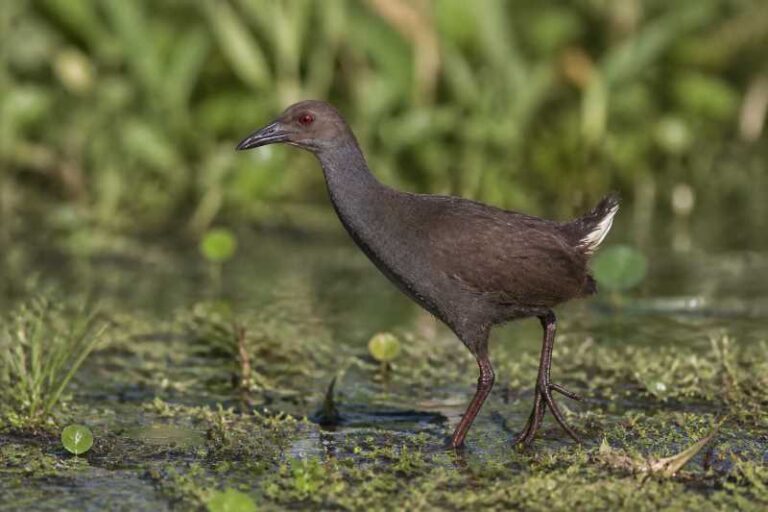
One of the most distinctive features of the Black Crake is its bold coloration. Adults boast a glossy black plumage complemented by a bright yellow bill and red eyes, creating a striking contrast. Their legs are a vivid red, adding to their unique appearance. Juveniles, however, exhibit a more subdued coloration, with brownish feathers and a dull yellow bill. These characteristics not only serve an aesthetic purpose but also play a role in the bird’s social interactions and mating displays.
Measuring around 20 to 23 centimeters in length, the Black Crake is relatively small, yet its presence is significant within its habitat. Its compact size allows it to navigate through dense vegetation with ease, a crucial adaptation for a bird that relies heavily on wetlands for survival.
Behavior and Diet
The Black Crake is known for its active and inquisitive nature. It is often seen foraging along the edges of water bodies, using its long toes to deftly walk across floating vegetation. Its diet is diverse, including insects, small fish, snails, and various plant materials. This omnivorous diet ensures that the Black Crake can thrive in fluctuating environmental conditions.
Socially, the Black Crake is an interesting subject. It is generally non-migratory, although some populations may exhibit local movements in response to changing water levels. These birds are often observed in pairs or small family groups, displaying strong territorial instincts. Vocalizations play a significant role in their communication, with a repertoire that includes a series of sharp, repetitive calls used to assert territory and signal alarm.
Reproduction and Lifespan
Breeding typically occurs during the wet season when resources are abundant. The Black Crake is monogamous, with pairs working collaboratively to build nests hidden among reeds or dense vegetation. The nest, a simple platform of plant material, provides a secure environment for the eggs. Clutch size generally ranges from three to six eggs, which both parents incubate over a period of about 19 to 21 days.
Chicks are precocial, leaving the nest shortly after hatching. They are capable of swimming almost immediately, a vital skill for avoiding predators. Parental care is intensive during the early stages of life, with both parents involved in feeding and protecting the young. This cooperative breeding strategy enhances the survival rate of the offspring, contributing to the species’ overall resilience.
Conservation Status
Currently, the Black Crake is classified as "Least Concern" by the International Union for Conservation of Nature (IUCN). Despite facing some threats, such as habitat destruction and pollution, its wide distribution and adaptability have helped maintain stable population numbers. Conservation efforts focusing on wetland preservation and reducing habitat degradation are vital to ensuring the continued success of this species.
Conclusion
The Black Crake (Zapornia flavirostra) is a testament to the adaptability and resilience of avian life in sub-Saharan Africa. Its striking appearance, intriguing behaviors, and ecological importance make it a species worth studying and protecting. As with many wetland-dependent species, the future of the Black Crake will largely depend on the conservation of its habitat. By understanding and mitigating the threats facing these environments, we can help ensure that the Black Crake continues to thrive for generations to come.
Related posts