Introduction
The Black-chinned Hummingbird (Archilochus alexandri) is a small migratory hummingbird of western North America. It breeds across much of the western United States and parts of north-western Mexico, then moves mainly to Mexico for winter, although some individuals winter along the Gulf Coast. It is adaptable and may occur in deserts, river corridors, mountain woodlands, parks and suburban gardens.
Physical Description
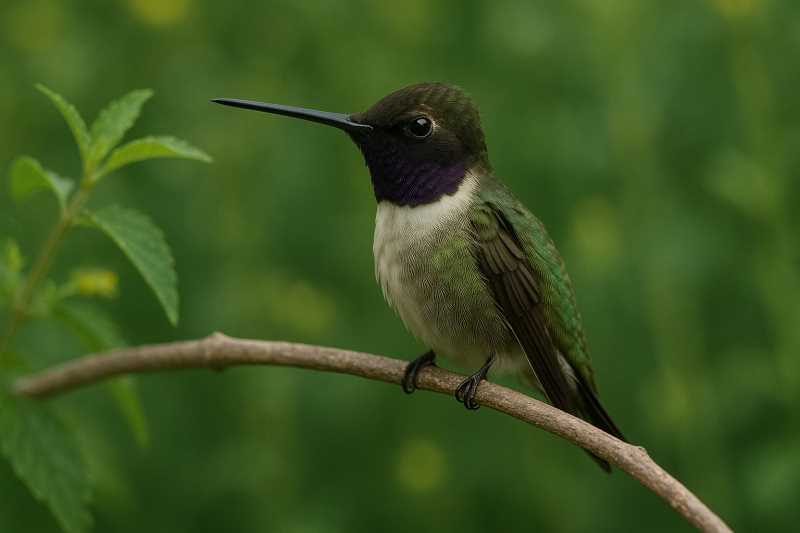
The Black-chinned Hummingbird is approximately 8 to 9 cm long. Females are generally slightly larger than males, although both sexes are small and slender. Adults have metallic green upperparts, pale greyish-white underparts and a long, straight bill.
The adult male has a black head and throat. A narrow band of iridescent violet or purple appears along the lower edge of the throat when the light reaches it at the right angle. A small white spot is usually visible behind the eye. The female has a duller green back, whitish underparts and a pale throat, often with faint grey or green markings. The outer tail feathers have white tips.
Immature birds resemble females. Young males gradually develop dark throat feathers, with a few purple feathers often appearing before the adult gorget is complete.
Range and Habitat
Black-chinned Hummingbirds breed from the western United States, including the south-west, Great Basin and parts of the Rocky Mountain region, into north-western Mexico. They also occur farther north during the breeding season in suitable areas. Most birds migrate to western Mexico for winter, while others travel through or remain along the Gulf Coast.
They use a wide range of habitats, including desert washes, canyons, riparian woodland, open oak and pinyon-juniper woodland, mountain forests, parks and residential gardens. In arid regions, mature trees and shrubs near rivers, springs or other reliable water sources are particularly important. The species is adaptable and may use disturbed or urban habitats when flowering plants, tall trees and suitable nesting sites are available.
Where to See This Species
Montezuma Castle National Monument, Arizona, United States
The Verde Valley is a reliable summer location, and the National Park Service describes the Black-chinned Hummingbird as one of the area’s most common hummingbirds. Look around riparian vegetation, flowering plants and the monument’s picnic areas, particularly during spring and summer. Early morning is a useful time to watch activity around flowers and feeding stations.
Nearby accommodation: Camp Verde is the nearest practical gateway, with hotels, guest houses, cabins, campsites and self-catering accommodation.
Bandelier National Monument, New Mexico, United States
Black-chinned Hummingbirds are documented as common summer birds at Bandelier, where they nest and raise young. Riparian areas and flowering vegetation in the canyons are especially suitable places to search during the breeding season.
Nearby accommodation: Los Alamos is the main nearby accommodation area, with hotels, guest houses, cabins and campsites available in the surrounding region.
Mesa Verde National Park, Colorado, United States
Mesa Verde supports both breeding and migratory Black-chinned Hummingbirds. The species has been included in park monitoring programmes, with birds recorded in habitats containing flowering plants and woodland edges. Summer is the most suitable season for searching, especially around vegetated areas and water sources.
Nearby accommodation: Mancos and Cortez are the principal gateway communities, offering hotels, motels, guest houses, cabins and campsites.
Behaviour and Diet
Black-chinned Hummingbirds are active, agile fliers that can hover while feeding and move rapidly between flowers. They often perch on exposed dead branches or high twigs, where they watch for competitors and passing insects.
Males are strongly territorial around flowers and feeders. They may chase other hummingbirds and perform steep courtship dives, sometimes descending from considerable height before pulling up near a female. Outside courtship and territorial encounters, the species is usually solitary.
Nectar from flowering plants provides most of the energy in the diet. The birds also take small insects and spiders, either by catching them in flight or picking them from vegetation. Insects are particularly important for breeding females and growing nestlings.
The breeding season generally extends from spring into summer, with timing varying across the range. The female builds a small, flexible cup nest from plant down and other soft fibres bound with spider silk. Nests are commonly placed on small branches below the main canopy. She alone incubates the usually two white eggs and feeds the young. The nestlings grow rapidly and normally leave the nest after about three weeks.
Gardeners can support visiting birds by planting suitable native flowering species and maintaining clean hummingbird feeders. Feeders should be cleaned regularly, and spoiled sugar solution should be replaced promptly.
Identification Tips
- Look for a small, slender hummingbird with a metallic green back and pale underparts.
- Adult males have a black head and throat, with a narrow purple or violet band visible in strong light.
- Females and immature birds have pale throats and white-tipped outer tail feathers.
- The species often perches conspicuously on a dead twig or high branch before making short feeding flights.
- In the western United States, compare it carefully with Anna’s Hummingbird and Costa’s Hummingbird. Adult male Black-chinned Hummingbirds have a darker, more restricted throat patch and lack Costa’s broad purple crown and projecting throat feathers. Female and immature birds can be more difficult to separate and should be identified using overall shape, tail pattern, habitat and range.
Conservation Status
The Black-chinned Hummingbird is classified as Least Concern. Available North American Breeding Bird Survey data indicate a broadly stable to slightly increasing long-term trend, although population estimates for hummingbirds can be affected by monitoring limitations.
The species remains vulnerable to local habitat loss, particularly the degradation of riparian woodland, springs and river corridors in arid landscapes. Drought, altered water availability, loss of flowering plants and changes in migration conditions may also affect local populations. Protecting native vegetation, maintaining healthy streamside habitats and reducing unnecessary pesticide use can benefit the species and its food resources.
Frequently Asked Questions
Where can the Black-chinned Hummingbird be found?
It occurs across much of the western United States and parts of north-western Mexico during the breeding season. Most birds winter in western Mexico, although some migrate through or winter along the Gulf Coast.
How can you identify a male Black-chinned Hummingbird?
An adult male has a metallic green back, pale underparts, a black head and throat, and a narrow iridescent purple band along the lower edge of the throat. A small white spot behind the eye is often visible.
What does the Black-chinned Hummingbird eat?
It feeds mainly on nectar from flowers, supplemented by small insects and spiders. Sugar-water feeders may provide an additional food source when they are kept clean and properly maintained.
Where does the Black-chinned Hummingbird nest?
The female usually builds a small cup-shaped nest on a slender branch below the main canopy. Plant down and spider silk give the nest both insulation and flexibility as the young grow.
Is the Black-chinned Hummingbird migratory?
Yes. Most individuals migrate south after breeding, with western Mexico being the main wintering area. Some birds remain along the Gulf Coast or pass through the region during migration.
How can I attract Black-chinned Hummingbirds to a garden?
Plant native flowering species suited to the local region, provide clean water where appropriate and maintain feeders with fresh sugar solution. Avoid pesticides that can remove insect prey or directly harm birds.
References
- Cornell Lab of Ornithology
- National Park Service
- IUCN Red List of Threatened Species
Related posts