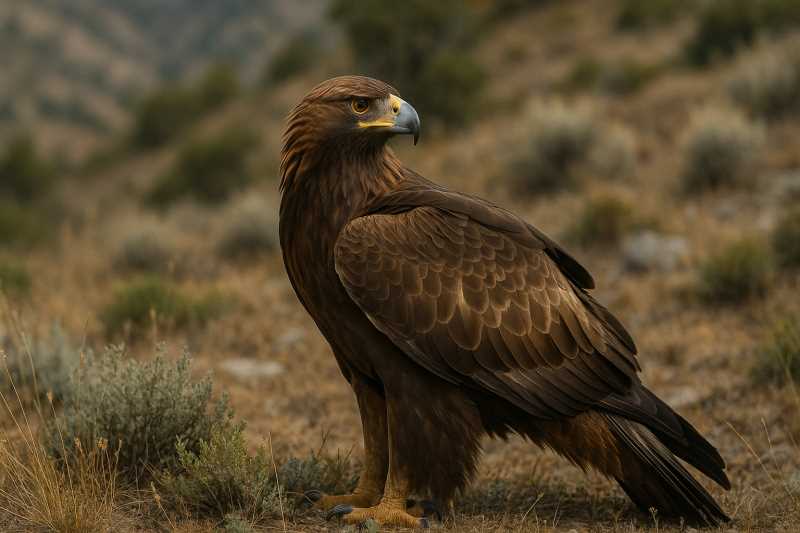
The Majestic Golden Eagle: A Symbol of Power and Grace
The Golden Eagle (Aquila chrysaetos) is one of the most renowned birds of prey, celebrated for its majestic appearance and unrivaled hunting prowess. This magnificent raptor is not only a symbol of power and freedom in various cultures but also plays a vital role in maintaining ecological balance. Found across the Northern Hemisphere, the Golden Eagle is admired for its adaptability, strength, and remarkable vision.
Physical Characteristics
Golden Eagles are impressive birds, with wingspans stretching between 6 to 7.5 feet, making them one of the largest birds of prey. Their plumage is primarily dark brown, with a striking golden hue on the back of the head and neck, from which they derive their name. This golden coloration is more pronounced in mature birds, adding to their regal appearance.
These raptors have powerful talons and a beak designed for tearing flesh, which are essential tools in their hunting arsenal. Their keen eyesight is estimated to be four to eight times stronger than that of humans, allowing them to spot prey from great distances.
Habitat and Distribution
Golden Eagles are distributed widely across the Northern Hemisphere. They inhabit a range of environments including mountainous regions, open grasslands, and deserts. This adaptability is a testament to their evolutionary success. In North America, they are commonly found in the western states and provinces, while in Europe, they are prevalent in the Scottish Highlands and parts of Scandinavia.
Their preference for open or semi-open landscapes is linked to their hunting strategy, which involves soaring high and scanning large areas for potential prey. These birds often establish territories that can span over 60 square miles, depending on the availability of food.
Diet and Hunting
The diet of the Golden Eagle is diverse, but they predominantly feed on small to medium-sized mammals such as hares, rabbits, and ground squirrels. In some regions, they are known to hunt larger prey, including young deer and even foxes. Their hunting technique is both graceful and efficient; they use their incredible speed and agility to swoop down on unsuspecting prey, delivering a powerful strike with their talons.
Golden Eagles are also known to scavenge carrion, especially during the winter months when live prey is scarce. This opportunistic feeding behavior further enhances their survival in harsh environments.
Reproduction and Lifespan
Golden Eagles are monogamous, often forming life-long pair bonds. They build large nests, known as eyries, on cliffs or in tall trees, which they return to year after year. The female typically lays one to four eggs, with both parents sharing incubation duties.
Chicks hatch after about 45 days and are dependent on their parents for food and protection. The fledglings leave the nest at around 10 weeks old but may remain in their parents’ territory for several months as they learn to hunt.
In the wild, Golden Eagles can live up to 30 years, with some individuals reaching even greater ages in captivity.
Conservation Status
While the Golden Eagle is not currently considered endangered, its populations face threats from habitat destruction, poisoning, and collisions with wind turbines and power lines. Conservation efforts focus on preserving their natural habitats and mitigating these human-induced risks.
Organizations and governments across the globe are working to ensure that these magnificent birds continue to soar across our skies. Public education and awareness campaigns are crucial in fostering coexistence between humans and Golden Eagles.
Cultural Significance
Throughout history, Golden Eagles have held significant cultural importance. They are revered in Native American traditions as spiritual messengers and symbols of courage. In ancient Rome, they represented power and authority, serving as the emblem of legions.
Today, the Golden Eagle remains a powerful symbol of wildlife conservation and the beauty of the natural world. Their presence is a reminder of the intricate connections within ecosystems and the need to protect these majestic creatures for future generations.
Golden Eagles embody the wild and untamed spirit of nature, inspiring awe and respect across cultures and continents. Their continued existence is a testament to the resilience of wildlife and the importance of conservation efforts worldwide.
Related posts