Introduction
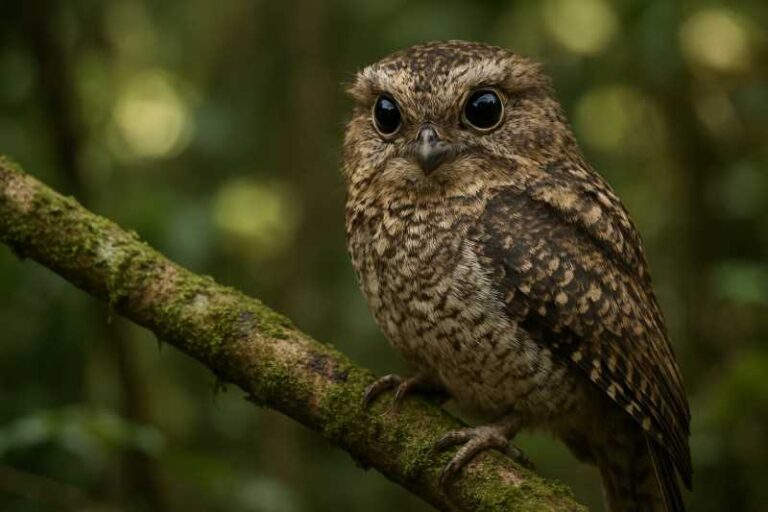
The Buff-collared Nightjar (Antrostomus ridgwayi) is a nocturnal member of the nightjar family, Caprimulgidae. It is recognised by its cryptic grey, brown and rufous plumage, prominent buffy-cinnamon neck collar and distinctive accelerating song. The species occurs mainly in Mexico and parts of Central America, with a small and localised range extending into the United States.
Physical Description
The Buff-collared Nightjar is a medium-sized nightjar measuring approximately 22–23 cm in length and weighing about 48 g. Its plumage is intricately mottled in grey, brown, black and rufous tones, providing effective camouflage when the bird roosts on the ground during daylight.
Both sexes have a conspicuous buffy-cinnamon collar across the back and sides of the neck, often connected with a narrow pale or whitish throat band. The adult male has prominent white markings in the outer tail feathers. The female has narrower, pale buff or cinnamon tail markings rather than extensive white. Juveniles are less clearly documented but are generally duller and more finely marked than adults.
The species has the large eyes, broad gape and stiff rictal bristles typical of nightjars. These bristles project around the bill and are associated with the capture of flying insects.
Range and Habitat
The Buff-collared Nightjar is distributed from southern and western Mexico through scattered areas of Guatemala, Honduras and Nicaragua. It reaches the northern limit of its range in southeastern Arizona and, less regularly, extreme southwestern New Mexico. It is not known as a regular species of Texas, as suggested in the original article.
The species occupies tropical deciduous forest, thorn forest, arid and semi-arid scrub, open woodland, forest edges, ravines and rocky canyons. In the United States it is particularly associated with remote canyons containing brush, trees and open ground. It has been recorded from near sea level to approximately 2,400 metres, although local habitat use varies across its range.
Most populations are treated as resident, but the northernmost populations may move south seasonally. The distribution is uneven and locally discontinuous, especially towards the northern and southern limits of the range. Two subspecies are recognised in current IOC taxonomy.
Behaviour and Diet
The Buff-collared Nightjar is mainly nocturnal and is most active after dusk and before dawn. During the day it usually roosts on the ground, often beneath small bushes on hillsides, where its cryptic plumage makes it difficult to detect. It may also use low perches for hunting.
It feeds primarily on flying insects, including moths and other aerial arthropods. The bird makes short, agile sallies from low perches or from the ground, using its broad gape to capture prey in flight. Its flight can appear swift and erratic when it is pursuing insects in open areas or along woodland edges.
The male’s song is a rapid, accelerating series of hollow or clucking notes, often rendered as “cuk-cuk-cuk-cuk-cukacheea” or “préstame-tu-cuchillo”. Males commonly sing from low perches, and the vocalisations are used in territorial and reproductive communication.
Breeding information remains limited. The species does not build a conventional nest. Instead, it lays its eggs directly on bare ground or in a shallow natural depression, usually among leaf litter or other surrounding material. Documented clutches generally contain two eggs, although detailed observations are scarce. Incubation lasts about 19 days in the available accounts, with the female undertaking most or all of the incubation. Both adults may care for the young after hatching.
Identification Tips
The most reliable way to locate and identify a Buff-collared Nightjar is by its voice. Listen for a fast, accelerating sequence of hollow notes ending in a more emphatic phrase, usually heard from a canyon, woodland edge or thorn forest after dark.
Useful visual features include:
- A prominent buffy-cinnamon collar on the back of the neck.
- Intricately mottled grey, brown, black and rufous plumage.
- A relatively pale, medium-sized nightjar shape.
- White outer tail markings in adult males, contrasting with narrower buff markings in females.
- A habit of roosting on the ground or making short feeding flights from low perches.
The species is larger than a Common Poorwill and slightly smaller than a Mexican Whip-poor-will. The bold neck collar and distinctive song help separate it from these similar nightjars, although views in poor light are often inconclusive.
Conservation Status
The Buff-collared Nightjar is currently assessed as Least Concern on the IUCN Red List. It has a broad overall distribution, but its population size and long-term trend are not well quantified, particularly in Mexico and Central America.
Local threats may include the conversion and fragmentation of tropical dry forest, thorn forest and woodland, together with disturbance or inappropriate fire and grazing management in canyon habitats. In the United States, the species has a very small and localised range and is considered rare, making the protection of occupied canyons and riparian woodland especially important.
Conservation measures should focus on retaining connected areas of dry forest, scrub and open woodland, protecting known breeding sites from avoidable disturbance, and improving survey coverage. Further research is needed on population size, movement, breeding success and habitat requirements.
Frequently Asked Questions
Where does the Buff-collared Nightjar live?
It occurs mainly in Mexico, with scattered populations in Guatemala, Honduras and Nicaragua. A small northern range reaches southeastern Arizona and, less regularly, southwestern New Mexico.
What does a Buff-collared Nightjar look like?
It is a medium-sized, cryptically marked nightjar with mottled grey, brown and rufous plumage. Its most distinctive feature is the broad buffy-cinnamon collar on the back of the neck.
What does the Buff-collared Nightjar eat?
It feeds mainly on flying insects, including moths and other aerial arthropods caught during short flights from low perches or the ground.
How can the Buff-collared Nightjar be identified by sound?
Its song is a rapid, accelerating series of hollow clucks that ends with a stronger final phrase, often described as “cuk-cuk-cuk-cuk-cukacheea”.
Where does the Buff-collared Nightjar nest?
It does not construct a conventional nest. The female lays the eggs directly on the ground, usually in a shallow depression among leaf litter or other natural cover.
Is the Buff-collared Nightjar endangered?
The species is currently classified as Least Concern globally. Nevertheless, local populations may be vulnerable to the loss and fragmentation of dry woodland, thorn forest and canyon habitat.
References
- BirdLife International and IUCN. 2020. Antrostomus ridgwayi. The IUCN Red List of Threatened Species 2020: e.T22689801A168861529. https://doi.org/10.2305/IUCN.UK.2020-3.RLTS.T22689801A168861529.en. Accessed 8 September 2026.
- Bowers Jr., R. K. and Dunning, J. B. 2020. Buff-collared Nightjar (Antrostomus ridgwayi), version 1.0. In Birds of the World, edited by S. M. Billerman. Cornell Lab of Ornithology, Ithaca, New York. https://doi.org/10.2173/bow.bucnig.01.
- Cornell Lab of Ornithology. n.d. Buff-collared Nightjar, Antrostomus ridgwayi: Overview. All About Birds. https://www.allaboutbirds.org/guide/Buff-collared_Nightjar/overview. Accessed 8 September 2026.
- Cornell Lab of Ornithology. n.d. Buff-collared Nightjar, Antrostomus ridgwayi: Identification. All About Birds. https://www.allaboutbirds.org/guide/Buff-collared_Nightjar/id. Accessed 8 September 2026.
- Gill, F., Donsker, D. and Rasmussen, P., eds. 2026. IOC World Bird List, version 15.2. International Ornithologists’ Union. https://www.worldbirdnames.org/.
- Radel, A. and Lonneker, J. 2018. Buff-collared Nightjar (Caprimulgus ridgwayi) bBCNIx_CONUS_2001v1 Range Map. U.S. Geological Survey Science Analytics and Synthesis Program. https://doi.org/10.5066/F7G73CTT.
- American Ornithologists’ Union. 1998. Check-list of North American Birds, 7th edition. American Ornithologists’ Union, Washington, D.C. Biodiversity Heritage Library scan. https://www.biodiversitylibrary.org/.
- Mlodinow, S. G. and O’Brien, M. 2021. Buff-collared Nightjar: First confirmed nesting record in Arizona and the United States. North American Birds 71(2). American Birding Association. https://www.aba.org/wp-content/uploads/2021/01/NAB-71-2.pdf.
Related posts