Introduction
The Malleefowl (Leipoa ocellata) is a large, ground-dwelling megapode endemic to Australia. It occupies arid and semi-arid habitats across parts of southern mainland Australia and is best known for constructing large incubation mounds in which its eggs develop without direct brooding by the parents. The species is secretive, well camouflaged and usually encountered singly or in pairs. (dcceew.gov.au)
Physical Description
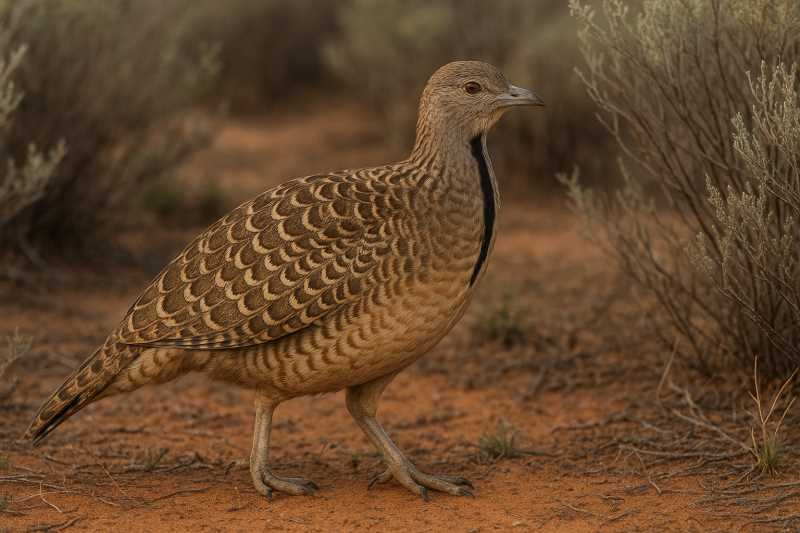
The Malleefowl is approximately 55–60 cm long and generally weighs between 1.5 and 2.5 kg. The sexes are broadly similar in appearance. Adults have a greyish head and neck, a chestnut or rufous chin, a pale throat and breast marked by a dark central stripe, and mottled brown, black, grey and white upperparts. This subdued pattern provides effective camouflage among mallee trunks, leaf litter and sandy soil. (environment.nsw.gov.au)
It has a relatively short bill, robust legs and large feet adapted for scratching, digging and moving leaf litter. The wings are short, broad and rounded. Although it is capable of strong flight, it normally spends most of its time walking or running on the ground and may fly into a tree to roost or when disturbed. (environment.nsw.gov.au)
Malleefowl chicks are highly precocial. They hatch with feathers, emerge from the mound without parental assistance and are independent from the moment they reach the surface. (environment.nsw.gov.au)
Range and Habitat
The Malleefowl is endemic to Australia. Its present distribution is fragmented across inland and southern parts of Western Australia, South Australia, Victoria and New South Wales. Historically, it occurred more widely across southern Australia, but much of its former range has been reduced or divided by clearing and other land-use changes. (dcceew.gov.au)
It is most strongly associated with semi-arid and arid mallee shrublands on sandy or loamy soils. It may also occur in related Eucalyptus and Callitris woodlands, open shrublands and, in parts of Western Australia, coastal heath. Suitable habitat provides abundant leaf litter for mound construction, feeding areas and enough cover for concealment. (dcceew.gov.au)
Malleefowl pairs occupy large territories around their breeding mounds. Populations are generally sparse, and suitable habitat may support only a small number of breeding pairs over a substantial area. (museumsvictoria.com.au)
Behaviour and Diet
Malleefowl are primarily terrestrial and are often most noticeable by their tracks, scratching or mound activity rather than by their calls. When alarmed, a bird may run away or freeze and rely on its camouflage. It can fly strongly when necessary, but normally walks or runs through the understorey and roosts in trees at night. (museumsvictoria.com.au)
The species is an opportunistic omnivore. Its diet includes seeds, shoots, flowers, buds, fruits, lerps, fungi and a range of invertebrates, including insects and spiders. Food availability varies with season and rainfall, and poor conditions can reduce breeding activity and recruitment. (cdn.environment.sa.gov.au)
Mound incubation
Malleefowl are among Australia’s three mound-building birds. A breeding pair constructs or refurbishes a large mound, usually about 3–5 m across and up to 1 m high, using sand, soil and moist leaf litter. As the organic material decomposes, it generates heat that incubates the eggs. (dcceew.gov.au)
The male performs most of the mound maintenance. He opens, closes, adds to or removes material from the mound to regulate the temperature of the egg chamber, which is maintained at approximately 33°C. The female lays individual eggs at intervals of roughly 5–9 days, with the total number varying according to food availability and seasonal conditions. A season may produce around 15–24 eggs, although the number is not fixed. (environment.nsw.gov.au)
Eggs usually hatch after roughly two months, although incubation time varies with mound temperature. A chick may take several hours to dig through the mound, sometimes up to about 15 hours. Once outside, it receives no parental care. (environment.nsw.gov.au)
Identification Tips
Look for a large, stocky bird moving quietly through dry mallee or other semi-arid shrubland. Useful field marks include:
- Mottled brown, grey, black and white plumage that blends with leaf litter.
- A greyish head and neck with a dark cap or crest.
- A chestnut or rufous chin.
- A pale throat and breast with a prominent dark central stripe.
- Strong legs, large feet and a short bill.
- A tendency to run or freeze rather than immediately fly when disturbed.
A large mound of sand and leaf litter, especially one showing recent scratching or fresh openings, can indicate Malleefowl activity. The mound itself is often easier to find than the bird. Unlike the more brightly coloured Australian Brush-turkey, the Malleefowl is adapted to dry inland shrublands and has subdued mottled plumage rather than a black body with a red head. (environment.nsw.gov.au)
Conservation Status
The Malleefowl is listed as Vulnerable under the IUCN Red List and as Vulnerable under Australia’s Environment Protection and Biodiversity Conservation Act 1999. Its distribution is fragmented, and many local populations have declined following habitat loss and degradation. (keybiodiversityareas.org)
Major threats include clearing for agriculture and other development, inappropriate or overly frequent fire, grazing and competition for food resources, drought and climate variability, and predation by introduced Red Foxes and feral Cats. Fragmentation can also isolate breeding populations and reduce access to suitable mound-building habitat. (museumsvictoria.com.au)
Conservation measures include protecting and restoring mallee habitat, managing fire regimes, reducing introduced predator impacts, maintaining habitat connectivity and monitoring populations through mound surveys, cameras and community-based programs. The National Malleefowl Monitoring Program and regional conservation projects provide important information for assessing population trends and management outcomes. (dcceew.gov.au)
Frequently Asked Questions
Where does the Malleefowl live?
The Malleefowl lives in fragmented parts of southern mainland Australia, including Western Australia, South Australia, Victoria and New South Wales. It is mainly associated with arid and semi-arid mallee shrublands and related dry woodlands. (dcceew.gov.au)
Does the Malleefowl sit on its eggs?
No. The eggs are buried in a large mound of sand, soil and decomposing leaf litter. The male regulates the temperature of the egg chamber by adding or removing mound material rather than incubating the eggs with his body. (environment.nsw.gov.au)
How large is a Malleefowl mound?
A typical mound is about 3–5 m in diameter and can be up to 1 m high, although size varies with age, construction history and local conditions. (dcceew.gov.au)
How many eggs does a Malleefowl lay?
A female commonly lays around 15–24 eggs in a breeding season, with one egg laid every several days. The total varies according to rainfall, food availability and other environmental conditions. (environment.nsw.gov.au)
Do Malleefowl look after their chicks?
No. The chicks hatch inside the mound, dig their way to the surface and begin living independently. They receive no feeding or protection from their parents after hatching. (environment.nsw.gov.au)
Why is the Malleefowl threatened?
The main pressures are habitat clearing and fragmentation, unsuitable fire regimes, grazing, drought and predation by introduced Red Foxes and feral Cats. Conservation programs focus on habitat protection, predator management, monitoring and community involvement. (museumsvictoria.com.au)
References
- Department of Climate Change, Energy, the Environment and Water. 2025. Malleefowl: Threatened Species Action Plan species profile. Australian Government. https://www.dcceew.gov.au/environment/biodiversity/threatened/action-plan/malleefowl. Accessed 8 September 2026.
- Department of Agriculture, Water and the Environment. 2025. National Recovery Plan for the Malleefowl (Leipoa ocellata). Australian Government. https://www.agriculture.gov.au/sites/default/files/documents/malleefowl.pdf. Accessed 8 September 2026.
- Environment and Heritage, New South Wales Government. 2024. Malleefowl. NSW Government. https://www.environment.nsw.gov.au/topics/animals-and-plants/native-animals/native-animal-facts/birds/malleefowl. Accessed 8 September 2026.
- Gill, F., Donsker, D. and Rasmussen, P., eds. 2026. IOC World Bird List, version 15.2. International Ornithologists’ Union. https://www.worldbirdnames.org/. Accessed 8 September 2026.
- Museums Victoria. n.d. Malleefowl. Melbourne Museum. https://museumsvictoria.com.au/melbourne-museum/resources/wild/mallee/malleefowl/. Accessed 8 September 2026.
- NSW Department of Climate Change, Energy, the Environment and Water. 2025. Malleefowl profile. NSW Threatened Species. https://threatenedspecies.bionet.nsw.gov.au/profile?id=10459. Accessed 8 September 2026.
- Australian Museum. 2018. The mound builders. Australian Museum Magazine, 21(4). https://museum-publications.australian.museum/media/dd/Uploads/Documents/38353/ams370_vXXI_04_lowres.a71c6d7.pdf. Accessed 8 September 2026.
- IUCN. 2026. The IUCN Red List of Threatened Species. International Union for Conservation of Nature. https://www.iucnredlist.org/. Accessed 8 September 2026.
Related posts