The Palm Cockatoo, also known as the Goliath Cockatoo, is one of the most striking and charismatic parrots in the world. Native to the rainforests and woodlands of northern Australia and New Guinea, this imposing black parrot captivates with its unique appearance, remarkable intelligence, and intriguing behaviors. As one of the largest cockatoo species, the Palm Cockatoo holds a special place in both ornithology and conservation, not just for its rarity, but for its complex social and vocal behavior that rivals some primates.
Identification
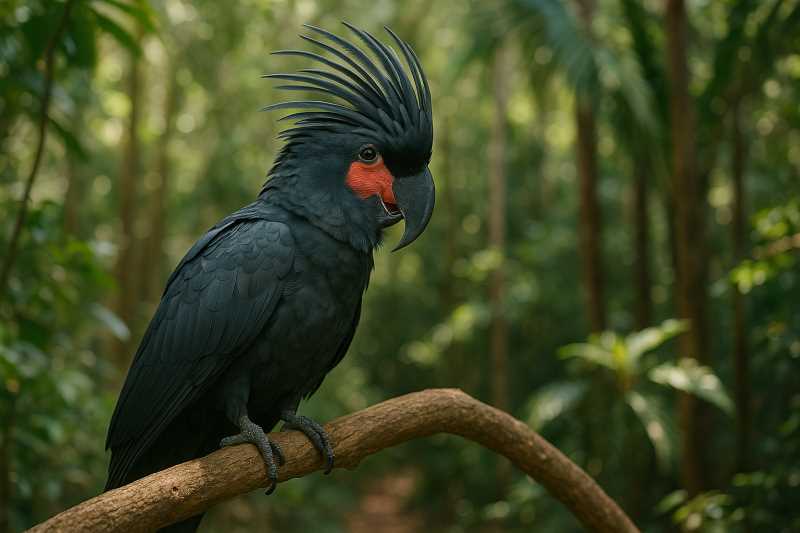
The Palm Cockatoo is instantly recognizable due to its large size, smoky-black plumage, vivid red cheek patches, and elongated crest feathers. It typically measures between 55 and 60 cm (21.5–23.5 inches) in length and weighs up to 1.2 kilograms (2.6 pounds). Its massive black beak is the largest of any parrot relative to body size and is powerful enough to crack open the toughest nuts.
The bare red skin on the face changes color depending on the bird’s emotional state, ranging from pale pink to deep crimson. Its towering crest feathers, which it raises and lowers expressively, add to its dramatic appearance. In flight, its broad wings and slow, heavy wingbeats create a distinctive silhouette.
Habitat and Distribution
The Palm Cockatoo is found in the monsoon forests and savannah woodlands of Cape York Peninsula in northern Queensland, Australia, and throughout New Guinea and nearby islands. In Australia, it is typically restricted to undisturbed habitats where it can find large, old-growth trees suitable for nesting.
These birds favor areas close to water sources and rely on tree hollows—often in Eucalyptus species—for breeding. Their patchy distribution is largely governed by the availability of these nesting trees, which are becoming increasingly scarce due to logging and habitat modification.
Behavior
Among parrots, the Palm Cockatoo exhibits some of the most fascinating and unique behaviors. Males are known for their use of tools—specifically, they break off sticks or seed pods and use them to drum against hollow trees during courtship displays. This behavior is believed to be a form of communication or territory marking and is one of the only known examples of musical instrument use in non-human animals.
Palm Cockatoos are generally solitary or found in pairs, though loose groups may gather around feeding areas. They are shy and cautious in the wild, often remaining high in the canopy and difficult to approach. Their vocalizations include a wide variety of whistles, screeches, and mechanical-sounding calls, with individuals showing considerable variation in their vocal repertoire.
Diet
The diet of the Palm Cockatoo primarily consists of seeds, nuts, fruits, and berries. In particular, they feed on the seeds of the Pandanus palm and the kanari tree (Canarium spp.), using their formidable beak to crack through hard shells.
They are also known to eat insects and their larvae on occasion, particularly during the breeding season when they require extra protein. Foraging is often slow and methodical, with birds carefully inspecting branches and foliage in search of food.
Breeding
Palm Cockatoos are slow breeders, typically raising only one chick every two years. Breeding season in Australia spans from August to January. The female lays a single egg in a large tree hollow lined with chewed wood and bark.
Incubation lasts around 30 days, and the chick remains in the nest for up to 100 days—the longest known nesting period among parrots. Both parents contribute to feeding and protecting the young, though breeding success is notoriously low due to predation, competition for nesting sites, and natural failure.
Conservation Status
The Palm Cockatoo is classified as Vulnerable under the IUCN Red List. In Australia, its population is estimated to be fewer than 3,000 individuals, with a declining trend. Major threats include habitat loss, particularly the removal of large, hollow-bearing trees essential for nesting. Additionally, illegal trapping for the pet trade and increased frequency of fires further jeopardize their habitat.
Conservation efforts focus on habitat protection, research into breeding success and population dynamics, and public education. Cape York Peninsula is a key conservation area, and efforts are underway to secure nesting habitats and reduce human disturbance in critical breeding zones.
The Palm Cockatoo stands as a symbol of the wild, remote forests it inhabits. Its dramatic appearance, complex behavior, and ecological vulnerability make it not only a subject of ornithological fascination but also a flagship species for conservation efforts in northern Australia and New Guinea.
Related posts