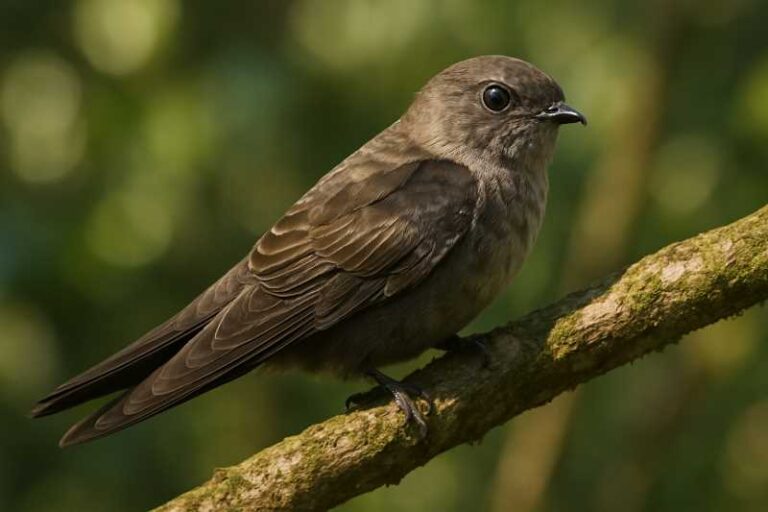
The Golden Bowerbird is a jewel of the Queensland Wet Tropics, an avian artisan whose dazzling golden plumage and complex courtship displays place it among Australia’s most iconic and admired bird species. As the smallest member of the bowerbird family, this rare and elusive creature has fascinated ornithologists, ecotourists, and conservationists alike.
Identification
The male Golden Bowerbird is unmistakable in appearance. Clad in brilliant golden-yellow plumage across the head, nape, and underparts, it contrasts sharply with its olive-brown wings and back. A slight crest gives it a regal air, further accentuated during courtship. Females and juveniles, however, are far more subdued, adorned in shades of olive and brown with faint yellowish underparts — a practical camouflage for life in the dense rainforest.
Measuring around 25 centimeters in length, the species is relatively small by bowerbird standards. Its strong, slightly decurved bill is adapted to forage for fruits and insects among the treetops and forest floor.
Habitat and Distribution
Endemic to the montane rainforests of northeastern Queensland, the Golden Bowerbird inhabits elevations generally above 700 meters, particularly in the Atherton Tablelands region. Key locations include Mount Hypipamee, Paluma Range, and Wooroonooran National Park.
This bird’s dependency on undisturbed, mature rainforest makes it highly sensitive to habitat fragmentation. It thrives in cool, moist climates where dense canopy cover and mid-story vegetation offer both feeding opportunities and privacy for its bower sites.
Behavior
The Golden Bowerbird is best known for its remarkable courtship behavior. Males are polygynous and do not participate in raising the young. Instead, they devote their energy to constructing and maintaining one of the most sophisticated bowers in the avian world — a twin-tower structure built from sticks, vines, and moss.
These twin towers can exceed a meter in height and are often decorated with lichen, flowers, fruits, and even snail shells, which the male meticulously arranges to impress visiting females. Displaying males perform a mix of vocalizations, fluttering flights, and visual posturing from favored perches near their bower.
Vocalizations include a repertoire of mechanical-sounding clicks, trills, and mimicry of other species — part of their strategy to intrigue females with a show of variety and vitality.
Diet
Golden Bowerbirds are primarily frugivorous, feeding on a wide range of rainforest fruits from species such as laurels, figs, and palms. Their foraging is not restricted to fruit alone; they also consume insects and other invertebrates, especially during the breeding season when protein demands are high.
They play an important ecological role as seed dispersers, helping to maintain the biodiversity of the tropical forests in which they reside.
Breeding
Breeding season spans from August to January, aligning with increased fruit availability. After mating, the female assumes full responsibility for nest building, incubation, and rearing the chicks. The nest is a cup-shaped structure, often well-hidden in the upper branches of dense foliage.
Clutch size is typically one to two eggs. While the male remains focused on maintaining and defending his bower, the female invests considerable effort in ensuring the survival of her brood.
Conservation Status
The Golden Bowerbird is classified as Least Concern by the IUCN due to its relatively stable population and range restricted to protected areas. However, it is considered Vulnerable under Queensland’s Nature Conservation Act due to its limited distribution and susceptibility to habitat degradation, especially from climate change, bushfires, and invasive species.
Ongoing conservation efforts focus on habitat protection, invasive species control, and ecological research. Birdwatching tourism in the Wet Tropics has also helped generate awareness and support for preserving this unique species.
Conclusion
The Golden Bowerbird is a master craftsman and a symbol of the ecological richness of Australia’s tropical rainforests. Its vivid plumage and captivating courtship rituals have made it an icon of avian beauty and behavior. As the climate continues to shift and habitats face mounting pressure, the continued survival of this remarkable species depends on dedicated conservation and ecological stewardship.
Related posts