Introduction
The Pink-eared Duck (Malacorhynchus membranaceus) is a small Australian waterfowl species distinguished by its broad, square-ended bill, zebra-like barring and small pink patch behind the eye. It is highly nomadic, moving between wetlands as rainfall, flooding and water availability change across the continent.
Physical Description
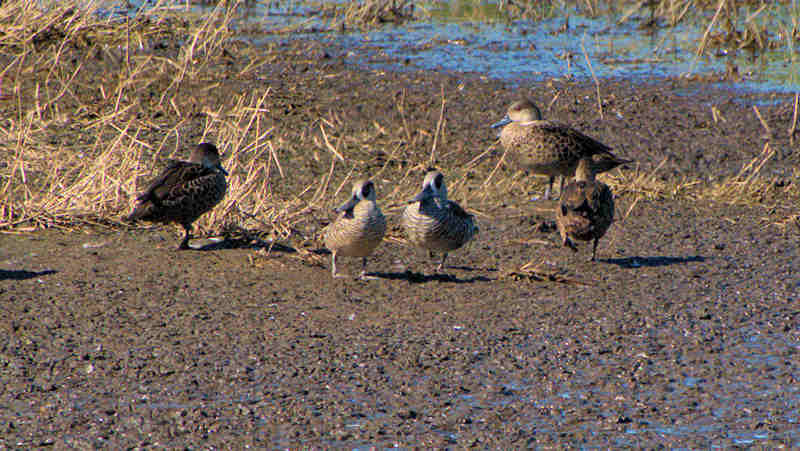
The Pink-eared Duck is about 38–45 centimetres long. It has brown upperparts, a grey head, a white face marked by a large dark brown eye patch, and strongly barred brown-and-white plumage across the neck, breast, flanks and underparts. A small pink patch behind the eye gives the species its common name, although this feature can be difficult to see at a distance.
The bill is large, grey and spatulate, with a broad square tip and fine lamellae, or comb-like filtering structures, along its edges. These structures help the duck strain small food items from the water. In flight, the species shows pale trailing edges to the wings and a conspicuous white crescent on the rump.
Males and females have broadly similar plumage and are not reliably distinguished by appearance alone. Juveniles and recently fledged birds may show less sharply defined facial markings and barring than adults.
Range and Habitat
The Pink-eared Duck is endemic to Australia and occurs across much of the mainland. It is most widespread in inland Australia, including the Murray–Darling Basin, but may also occur in southern and coastal regions when suitable wetlands are available. It is an occasional visitor to Tasmania.
Preferred habitats include shallow temporary lakes, claypans, floodplain wetlands, swamps and other open freshwater bodies. Fresh and brackish coastal wetlands may also be used. The species is strongly nomadic and dispersive, travelling considerable distances to locate newly flooded areas or productive shallow water. Local abundance can therefore change greatly between seasons and years.
Behaviour and Diet
Pink-eared Ducks are usually social and may gather in large flocks when extensive wetlands provide suitable feeding conditions. They often feed in head-to-tail pairs, swimming in circles to create a rotating column of water that concentrates small aquatic organisms. This behaviour is commonly called vortex feeding.
The specialised bill is used to draw water in through the tip and filter it through the lamellae along the sides. The diet consists mainly of microscopic plants and small aquatic animals, including algae, plankton and tiny invertebrates. The birds may also forage along the bottom in shallow water.
Breeding is opportunistic and is closely associated with rainfall, flooding and the availability of food. Nesting can occur at different times of year when conditions are favourable. Pink-eared Ducks may use abandoned or occupied nests constructed by other waterbirds, including Eurasian Coots and Black-tailed Native Hens. They may also construct a rounded down-lined nest in a tree hollow, stump, branch or log above the water. The female incubates the eggs, while both parents care for the young.
Identification Tips
Look for the following combination of features:
- A small, pale duck with bold zebra-like barring on the neck, breast and flanks.
- A very broad, square-ended grey bill that appears oversized for the head.
- A white face with a large dark eye patch.
- A small pink spot immediately behind the eye.
- In flight, pale wing edges, a light underbody and a prominent white rump crescent.
- A preference for shallow open water, often in groups or feeding pairs.
The combination of the huge spatulate bill, dark facial patch, strong barring and pink ear patch makes the species distinctive. It may superficially suggest an Australasian Shoveler because of the bill shape, but the Pink-eared Duck is smaller and has very different facial markings and body barring.
Conservation Status
The Pink-eared Duck is listed globally as Least Concern on the IUCN Red List. Its broad Australian distribution, nomadic movements and ability to exploit temporary wetlands reduce the likelihood of the species being concentrated in a small number of sites.
Nevertheless, the species depends on functioning wetlands and can be affected by the loss, degradation or alteration of shallow water habitats. Water extraction, changes to natural flooding regimes, wetland drainage and long-term changes in rainfall and temperature may reduce feeding and breeding opportunities. Conservation measures include protecting important wetlands, maintaining environmentally appropriate water flows and managing water resources so that temporary and permanent wetland habitats remain available.
Frequently Asked Questions
Where does the Pink-eared Duck live?
It occurs across much of Australia, particularly in inland regions. It uses shallow temporary lakes, floodplain wetlands, swamps, claypans and other open water bodies, and occasionally visits coastal wetlands and Tasmania.
Why is it called the Pink-eared Duck?
The name refers to the small pink patch of feathers behind the eye. The patch is subtle and is often less noticeable than the species’ bold facial markings and zebra-like body barring.
What does the Pink-eared Duck eat?
It mainly eats microscopic plants and small aquatic animals, including algae, plankton and tiny invertebrates. Its specialised bill filters these items from shallow water.
Do Pink-eared Ducks migrate?
They are not conventional long-distance migrants with a fixed seasonal route. Instead, they are highly nomadic and disperse in response to rainfall, flooding and the availability of suitable wetlands.
How does the Pink-eared Duck feed in circles?
Pairs often swim head-to-tail in a circle, creating a rotating column of water. This vortex can concentrate small aquatic organisms, making them easier to filter from the water.
Is the Pink-eared Duck threatened?
The species is currently assessed as Least Concern globally. However, wetland loss, altered water regimes and climate-related changes to rainfall and flooding may affect local populations and breeding opportunities.
References
- BirdLife Australia. 2026. Pink-eared Duck. BirdLife Australia bird profile. Available at: https://birdlife.org.au/bird-profiles/pink-eared-duck/ (accessed 8 September 2026).
- Gill, F., Donsker, D. and Rasmussen, P. (eds). 2026. IOC World Bird List, version 15.2. International Ornithologists’ Union. Available at: https://www.worldbirdnames.org/ (accessed 8 September 2026).
- International Union for Conservation of Nature. 2024. Malacorhynchus membranaceus. The IUCN Red List of Threatened Species, assessment e.T22680336A253983238. Available at: https://www.iucnredlist.org/ (accessed 8 September 2026).
- Museums Victoria. n.d. Malacorhynchus membranaceus, Pink-eared Duck. Museums Victoria Collections. Available at: https://collections.museumsvictoria.com.au/species/5729 (accessed 8 September 2026).
- Department of Biodiversity, Conservation and Attractions, Government of Western Australia. 2023. Pink-eared Duck. Western Australian animal fact sheet. Available at: https://library.dbca.wa.gov.au/static/FullTextFiles/060430.pdf (accessed 8 September 2026).
- Game Management Authority, Victoria. n.d. Game duck species: Pink-eared Duck. Government of Victoria. Available at: https://www.gma.vic.gov.au/hunting/duck/game-duck-species (accessed 8 September 2026).
- Department of Energy, Environment and Climate Action, Victoria. 2019. Ageing and sexing Victorian native game birds using plumage characters. Arthur Rylah Institute for Environmental Research Technical Report Series No. 294. Available at: https://www.ari.vic.gov.au/__data/assets/pdf_file/0016/415330/ARI-Technical-Report-294-Ageing-and-sexing-Victorian-native-game-birds-using-plumage-characters.pdf (accessed 8 September 2026).
- Department of Agriculture, Fisheries and Forestry, Australian Government. 2025. A stocktake of the number and distribution of Australian waterbirds. Report IR441. Available at: https://www.agriculture.gov.au/sites/default/files/documents/ir441.pdf (accessed 8 September 2026).
Related posts