The Enigmatic Red-billed Helmetshrike: A Comprehensive Exploration
Introduction
The Red-billed Helmetshrike (Prionops caniceps) is a captivating bird species belonging to the Vangidae family. This bird is predominantly found in the dense forests and woodland savannas of Central and West Africa. Known for its striking appearance and complex social behavior, the Red-billed Helmetshrike is a bird that has intrigued ornithologists and bird enthusiasts alike. This article delves into the various aspects of the Red-billed Helmetshrike, including its taxonomy, physical characteristics, habitat, behavior, and conservation status.
Taxonomy and Classification
The Red-billed Helmetshrike belongs to the order Passeriformes, which is the largest order of birds, encompassing more than half of the world’s avian species. Within this order, the Red-billed Helmetshrike is part of the Vangidae family, a group known for its diversity and adaptive radiation in Madagascar and the African mainland. The genus Prionops comprises several species of helmetshrikes, with the Red-billed Helmetshrike (Prionops caniceps) being one of the most recognized members. The species was first described by the English ornithologist John Cassin in 1856.
Physical Characteristics
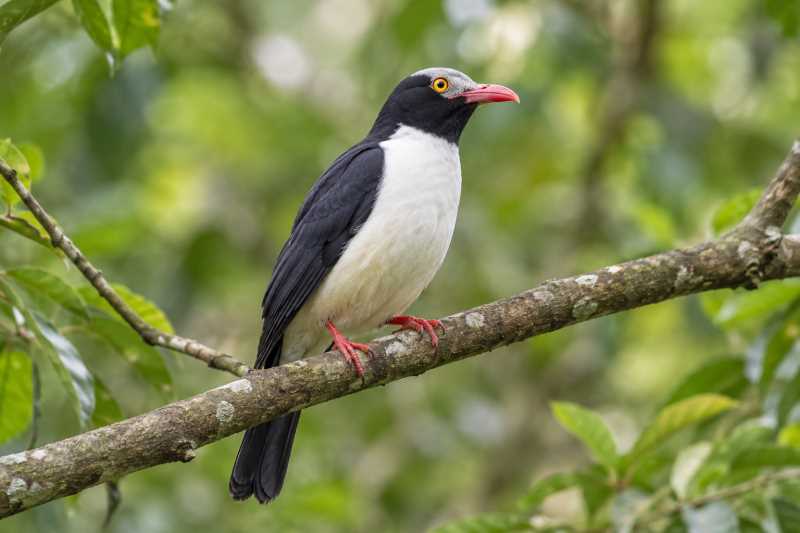
The Red-billed Helmetshrike is a medium-sized passerine bird, measuring approximately 20 centimeters in length. It is easily recognizable by its distinctive bright red bill and striking black and white plumage. The head is adorned with a black cap that extends down to the nape, contrasting sharply with the white underparts. The wings and tail are predominantly black, with white markings that are particularly noticeable in flight. The eyes are surrounded by a distinctive yellow or orange eye-ring, adding to its charismatic appearance.
The bird’s robust and slightly hooked bill is adapted for its feeding habits, allowing it to forage efficiently in its natural habitat. Both sexes exhibit similar plumage, making it challenging to distinguish between males and females in the field.
Habitat and Distribution
The Red-billed Helmetshrike is predominantly found in the lowland forests, secondary growth, and woodland savannas of Central and West Africa. Its range extends from Sierra Leone and Liberia in the west to Cameroon, Gabon, and the Democratic Republic of the Congo in the east. The species thrives in areas with dense vegetation, where it can forage for insects and small invertebrates.
These birds are highly adaptable and can be found in a variety of forest types, including primary and secondary forests, as well as degraded habitats. However, they show a preference for areas with ample tree cover and a rich undergrowth, which provide shelter and abundant food resources.
Behavior and Social Structure
One of the most fascinating aspects of the Red-billed Helmetshrike is its complex social behavior. These birds are highly gregarious and are often observed in small flocks consisting of 6 to 12 individuals. The flocks are cohesive units that engage in cooperative foraging and vigilance, enhancing their ability to locate food and detect potential predators.
The social structure of these flocks is hierarchical, with dominant individuals often leading foraging expeditions and initiating vocalizations. The birds communicate through a series of melodious calls and whistles, which serve to maintain group cohesion and coordinate movements through the dense foliage.
Red-billed Helmetshrikes exhibit cooperative breeding behavior, where several individuals assist in raising the young. This cooperative system involves not only the breeding pair but also additional group members who help in nest building, incubation, and feeding the chicks. Such behavior is thought to enhance the survival rate of the offspring and is a testament to the species’ intricate social dynamics.
Diet and Foraging Habits
The diet of the Red-billed Helmetshrike consists primarily of insects and other small invertebrates. The birds are adept at gleaning insects from foliage, branches, and the forest floor. They exhibit a variety of foraging techniques, including hovering and sallying from perches to capture prey.
In addition to insects, Red-billed Helmetshrikes have been known to consume small fruits and seeds, particularly during periods when insect prey is scarce. This opportunistic diet allows them to adapt to seasonal changes in food availability and maintain their energetic needs throughout the year.
Reproduction and Lifespan
Breeding in Red-billed Helmetshrikes is closely tied to the rainy season, which ensures an abundance of food resources for the growing chicks. The construction of the nest is a cooperative effort, with several group members contributing to its building. The nest is typically a cup-shaped structure made of twigs, leaves, and other plant materials, strategically placed in the fork of a tree.
The female lays a clutch of 2 to 4 eggs, which are incubated by the breeding pair and occasionally by other group members. After an incubation period of approximately two weeks, the eggs hatch, and the chicks are fed by all group members. This cooperative breeding system not only increases the chances of chick survival but also strengthens social bonds within the flock.
The lifespan of Red-billed Helmetshrikes in the wild is not well-documented, but like many passerine birds, it is likely to be several years, with survival heavily influenced by predation, habitat quality, and food availability.
Conservation Status and Threats
The Red-billed Helmetshrike is currently classified as Least Concern by the International Union for Conservation of Nature (IUCN). Despite this seemingly secure status, the species faces several threats that could impact its population in the future.
Habitat loss due to deforestation and land conversion for agriculture is the primary threat to the Red-billed Helmetshrike. As forests are cleared for logging, farming, and urban development, the available habitat for these birds diminishes, leading to potential declines in population numbers.
Climate change also poses a significant threat to the species, as it can alter the distribution of suitable habitats and affect the availability of food resources. Conservation efforts aimed at preserving forest habitats and promoting sustainable land-use practices are essential to ensure the long-term survival of the Red-billed Helmetshrike.
Conclusion
The Red-billed Helmetshrike is a remarkable bird, both in terms of its striking appearance and its complex social behavior. As a species that thrives in the rich and diverse ecosystems of Central and West Africa, it serves as an important indicator of forest health and biodiversity. Understanding the ecology and behavior of the Red-billed Helmetshrike is crucial for developing conservation strategies that can protect not only this species but also the myriad of other organisms that share its habitat.
As we continue to explore and appreciate the natural world, the Red-billed Helmetshrike stands out as a symbol of the intricate social structures and ecological interactions that define our planet’s avian diversity.
References
- BirdLife International (2023). Prionops caniceps. The IUCN Red List of Threatened Species 2023.
- Fry, C. H., Keith, S., & Urban, E. K. (2000). The Birds of Africa: Volume VI. Princeton University Press.
- Mackworth-Praed, C. W., & Grant, C. H. B. (1955). African Handbook of Birds: Birds of Eastern and North Eastern Africa. Longmans.
- Sinclair, I., & Ryan, P. (2003). Birds of Africa South of the Sahara. Struik Publishers.
Related posts