
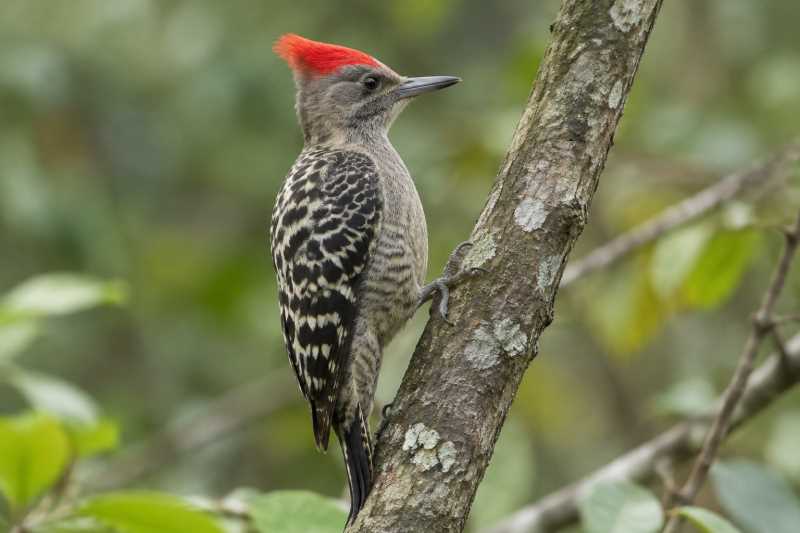
The Grey-and-Buff Woodpecker: Nature’s Subtle Artisan
In the vast expanse of Southeast Asia’s lush forests, a small and relatively inconspicuous bird, the Grey-and-buff Woodpecker (Hemicircus concretus), weaves its way through the dense foliage. Often overlooked due to its modest size and subtle coloration, this avian species commands attention in the ornithological world for its unique adaptations and behaviors.
Taxonomy and Distribution
The Grey-and-buff Woodpecker belongs to the family Picidae, renowned for their chiseling beaks and drumming communication. Hemicircus concretus is a member of the genus Hemicircus, which comprises small and stout woodpeckers with a distinct appearance. The species is predominantly found in the lowland and montane forests of Southeast Asia, spanning countries such as Thailand, Malaysia, Indonesia, and the Philippines.
Their habitat selection is primarily dictated by the availability of suitable foraging grounds, often favoring dipterocarp and secondary forests. Despite their name, Grey-and-buff Woodpeckers are not exclusively bound to grey and buff hues; they exhibit a fascinating array of patterns which serve as camouflage against the bark of trees.
Morphological Features
At first glance, Hemicircus concretus might appear understated, but a closer look reveals a bird perfectly adapted to its ecological niche. Typically measuring around 14 centimeters in length, it is among the smaller woodpecker species. The plumage mainly consists of grey and brown tones, enhanced by buff underparts and a subtly barred pattern on its wings and tail. This cryptic coloration is an evolutionary strategy to evade predators.
One of the most notable features of this species is its short and stout bill, which is well-suited for extracting insects from crevices in the bark. Unlike some of their larger relatives, Grey-and-buff Woodpeckers do not excavate large cavities; instead, they prefer gleaning insects from the surface or shallow layers of bark.
Behavioral Ecology
Grey-and-buff Woodpeckers are diurnal and exhibit a fascinating array of behaviors. They are primarily insectivorous, feeding on ants, beetles, and other arthropods. Their feeding technique involves deftly navigating tree trunks and branches, using their sharp bill to probe and pick prey from beneath the bark.
Socially, they are known to be quite active and vocal, often found in pairs or small groups. Their calls, though not as resonant as those of larger woodpeckers, are distinctive and serve as an important means of communication, particularly during the breeding season.
Breeding generally occurs between March and June, coinciding with the abundance of food resources. The species is monogamous, with pairs working collaboratively to raise their young. Nests are usually excavated in decaying wood, where the female lays two to three eggs. Both parents share the responsibility of incubating the eggs and feeding the chicks.
Conservation Status and Threats
According to the International Union for Conservation of Nature (IUCN), the Grey-and-buff Woodpecker is currently classified as Least Concern. However, this status belies the challenges the species faces due to habitat loss. Deforestation for agriculture, logging, and urbanization poses a significant threat to their natural habitat.
Conservation efforts are crucial in regions where habitat destruction is rampant. Preserving primary and secondary forests, coupled with sustainable land-use practices, can help ensure the survival of this species. Additionally, initiatives to raise awareness about the ecological importance of woodpeckers can foster community involvement in conservation efforts.
The Role in Ecosystems
Woodpeckers play a pivotal role in forest ecosystems, and the Grey-and-buff Woodpecker is no exception. By controlling insect populations, they help maintain the health of trees, preventing infestations that could otherwise lead to forest decline. Furthermore, their nesting behavior creates habitats for other species; abandoned woodpecker nests are often repurposed by other birds and small mammals.
Conclusion
The Grey-and-buff Woodpecker may not be the most flamboyant of its family, but its subtle beauty and ecological significance make it an invaluable component of Southeast Asian forests. As with many species, its future hinges on our ability to balance human needs with the conservation of natural habitats. By fostering a deeper understanding and appreciation of such species, we can work towards a future where both humans and wildlife thrive.
In celebrating the Grey-and-buff Woodpecker, we acknowledge the intricate tapestry of life that thrives in our world’s forests, reminding us of the delicate balance that sustains biodiversity.
References
- BirdLife International (2021). "Hemicircus concretus." The IUCN Red List of Threatened Species 2021.
- Winkler, H., Christie, D.A., & Nurney, D. (1995). Woodpeckers: A Guide to the Woodpeckers of the World.
- Collar, N. J., & Andreev, A. V. (2001). Handbook of the Birds of the World. Vol. 6. Mousebirds to Hornbills.
Related posts


