Bushy-tailed Opossum (Glironia venusta): An In-depth Look
Introduction
The Bushy-tailed Opossum, scientifically known as Glironia venusta, is a rarely seen mammal belonging to the family Didelphidae. First described in 1912, this elusive creature has intrigued biologists and wildlife enthusiasts alike due to its elusive nature and limited sightings. This article provides a comprehensive overview of the Bushy-tailed Opossum, discussing its physical characteristics, habitat, behavior, and conservation status.
Physical Description
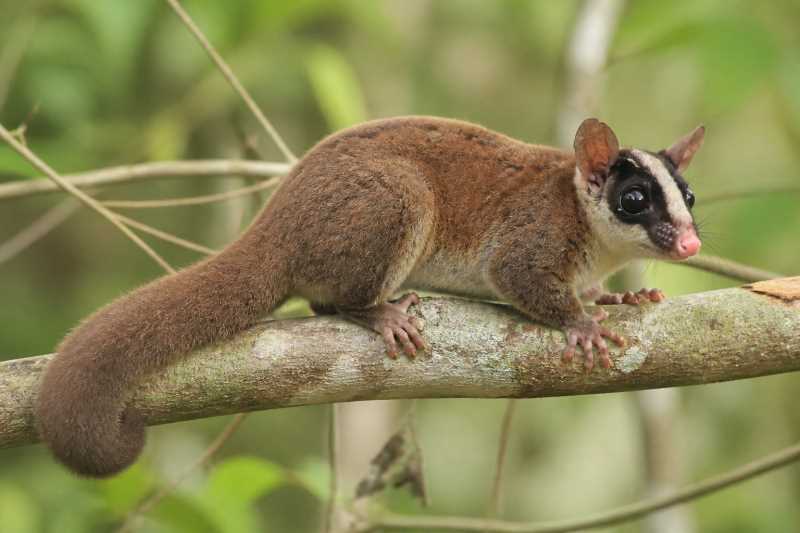
The Bushy-tailed Opossum is aptly named for its distinctive, bushy tail, which sets it apart from other opossums. This species has a body length ranging from 20 to 30 centimeters, with a tail that can extend up to 35 centimeters. The tail is covered in thick, bushy fur, which is unusual for opossums, and serves as a key identifying feature.
The fur of the Bushy-tailed Opossum is soft and dense, typically exhibiting a grayish-brown color with a lighter underbelly. Its eyes are large and dark, adapted for its nocturnal lifestyle, and its ears are rounded and relatively large compared to its head. This species has a prehensile tail, aiding in its arboreal lifestyle, allowing it to grasp branches and navigate through trees with ease.
Range and Habitat
The Bushy-tailed Opossum is native to South America, with its range primarily concentrated in the Amazon Basin. Countries where it has been documented include Brazil, Peru, Ecuador, Colombia, and Bolivia. However, due to its elusive nature, precise range data is limited.
This species prefers dense, tropical rainforests, particularly areas with abundant canopy cover where it can utilize its arboreal skills. The Bushy-tailed Opossum is most commonly found in primary forests, although it may also inhabit secondary growth forests.
Behavior and Diet
Primarily nocturnal, the Bushy-tailed Opossum is most active during the night. It is an arboreal species, spending the majority of its time in the trees. Due to its nocturnal habits and forested habitats, direct observations of this species are rare, contributing to the scarcity of detailed behavioral data.
The diet of the Bushy-tailed Opossum is omnivorous, comprising fruits, insects, small vertebrates, and possibly nectar. Its dietary habits are likely similar to other opossums, although specific preferences remain largely undocumented due to the limited number of observed specimens.
Identification Tips (Field Recognition Cues)
- Tail: Look for the distinctive bushy tail, which is unique among opossums and serves as the primary identification feature.
- Size and Shape: Note the moderate size with a body length of 20-30 cm and a tail length of up to 35 cm.
- Fur and Coloration: Observe the grayish-brown fur with a lighter underbelly, which is another identifying characteristic.
- Habitat: This species is found in dense, tropical rainforests, particularly in the Amazon Basin.
- Behavior: They are nocturnal and arboreal, so sightings are more likely at night and in tree-rich environments.
Conservation Status (with Threats and Protections)
The Bushy-tailed Opossum is currently listed as Data Deficient on the IUCN Red List. This classification highlights the lack of sufficient data to make a precise assessment of its conservation status. However, several factors potentially threaten its survival.
Threats
- Habitat Destruction: Deforestation in the Amazon Basin poses a significant threat to the Bushy-tailed Opossum. As primary forest habitats are cleared for agriculture, logging, and urban expansion, the available habitat for this species diminishes.
- Climate Change: Changes in climate patterns can alter the rainforest ecosystems, affecting food availability and habitat conditions for the opossum.
Protections
Due to its elusive nature and the lack of comprehensive data, targeted conservation efforts for the Bushy-tailed Opossum are limited. However, the protection of large areas of the Amazon rainforest through national parks and reserves indirectly benefits this species by preserving its natural habitat.
Frequently Asked Questions
1. What is the habitat preference of the Bushy-tailed Opossum?
The Bushy-tailed Opossum prefers dense tropical rainforests, particularly primary forests with abundant canopy cover. It is primarily found in the Amazon Basin across countries like Brazil, Peru, Ecuador, Colombia, and Bolivia.
2. How can you identify a Bushy-tailed Opossum in the wild?
Identification involves looking for a bushy tail, grayish-brown fur with a lighter underbelly, and its arboreal and nocturnal behavior. It is usually found in primary rainforest habitats.
3. Are Bushy-tailed Opossums endangered?
Currently, the Bushy-tailed Opossum is classified as Data Deficient by the IUCN, indicating insufficient data to determine its exact conservation status. However, habitat destruction due to deforestation poses a threat.
4. What does the Bushy-tailed Opossum eat?
This opossum is omnivorous, with a diet consisting of fruits, insects, small vertebrates, and possibly nectar, although specific dietary habits are not well-documented.
5. Why is there little information about the Bushy-tailed Opossum?
The Bushy-tailed Opossum is elusive and rare, with few sightings and limited direct observations, contributing to the scarcity of detailed information about its behavior and ecology.
Related posts