The Crimson-breasted Finch: A Jewel of the Avian World
The natural world is replete with avian wonders, yet few are as captivating as the Crimson-breasted Finch (Rhodospingus cruentus). This diminutive bird, with its vivid plumage and fascinating behaviors, is a subject of considerable interest among ornithologists and bird enthusiasts alike. Native to the lush landscapes of Central and South America, the Crimson-breasted Finch offers an intriguing glimpse into the diversity and adaptability of bird species in tropical environments.
Taxonomy and Classification
The Crimson-breasted Finch belongs to the family Thraupidae, a diverse group of birds commonly referred to as tanagers. Despite its common name suggesting a relationship with finches, this species is more closely related to tanagers, highlighting the complexity and sometimes confusing nature of avian classification. The genus Rhodospingus, to which it belongs, is monotypic, meaning it contains only this single species. This unique classification underscores the distinctiveness of the Crimson-breasted Finch within the broader taxonomic framework.
Physical Characteristics
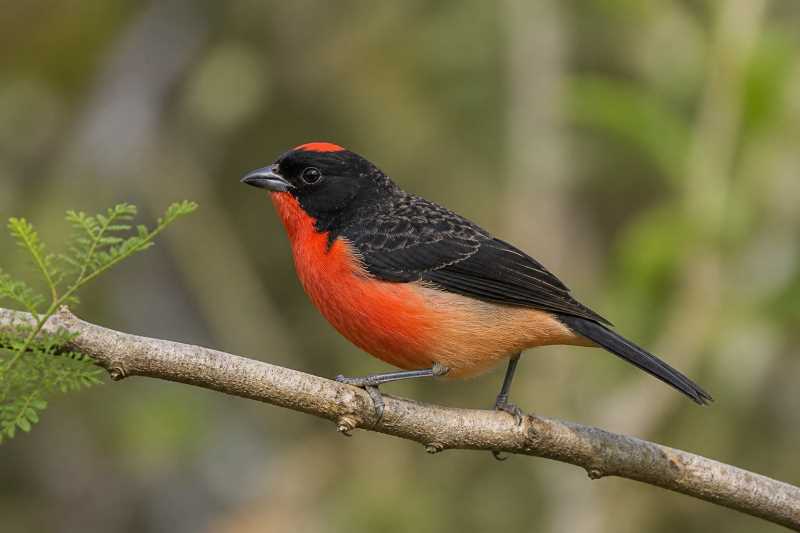
Perhaps the most striking feature of the Crimson-breasted Finch is its vibrant coloration. Males boast a brilliant, crimson-red chest and face, which contrasts sharply with their otherwise dark plumage. This vivid coloration plays a crucial role during the breeding season, as males display their bright feathers to attract potential mates. Females, on the other hand, exhibit a more subdued palette, with olive-brown upperparts and paler underparts, allowing them to blend more seamlessly into their surroundings, an adaptation likely linked to nesting and predation avoidance.
Size-wise, these birds are compact, measuring approximately 12 to 13 centimeters in length, with wingspans reaching up to 20 centimeters. Their small size and agile flight make them adept at navigating the dense foliage of their natural habitats.
Habitat and Distribution
The Crimson-breasted Finch is primarily found in the lowland regions of Ecuador, Peru, and Colombia. They favor habitats that offer a combination of dense shrubbery and open spaces, such as forest edges, secondary growth, and scrublands. This preference for transitional habitats reflects the bird’s adaptability, as these environments often provide abundant food resources and nesting sites.
These birds are non-migratory, maintaining their territories year-round. This sedentary lifestyle necessitates a keen adaptation to their environment, as they must cope with seasonal variations in food availability and climatic conditions.
Diet and Foraging Behavior
Omnivorous in nature, the Crimson-breasted Finch’s diet includes a mix of seeds, fruits, and insects. Their feeding behavior is both opportunistic and adaptable, allowing them to exploit a wide range of food resources. During the breeding season, insects become a particularly important component of their diet, providing the necessary protein to support egg production and the growth of young chicks.
Foraging typically occurs in pairs or small family groups, with birds gleaning food from foliage or capturing insects in flight. Their ability to exploit different food sources and foraging strategies is a testament to their adaptability, a key factor in their survival and reproductive success.
Reproductive Behavior
The breeding season for the Crimson-breasted Finch coincides with the rainy season, a time when food resources are most abundant. Courtship involves elaborate displays by males, showcasing their vibrant plumage and engaging in song to attract mates. These displays not only serve to woo females but also to establish and defend territories against rival males.
Nesting sites are typically located in dense shrubbery or small trees, providing concealment from predators. The female is primarily responsible for building the nest, a cup-shaped structure made from twigs, grasses, and other plant materials. Clutch sizes generally range from two to three eggs, with both parents sharing responsibilities for incubation and feeding of the chicks.
Conservation Status
Currently, the Crimson-breasted Finch is classified as a species of Least Concern by the International Union for Conservation of Nature (IUCN). Despite this seemingly secure status, the species faces potential threats from habitat destruction and fragmentation, primarily due to agricultural expansion and deforestation. Conservation efforts aimed at preserving their natural habitats are essential to ensure the long-term survival of these vibrant birds.
Conclusion
The Crimson-breasted Finch, with its striking appearance and intriguing behaviors, continues to captivate bird watchers and researchers. Its presence in the ecosystems it inhabits serves as a reminder of the rich biodiversity found in tropical regions and the importance of conservation efforts to protect these natural treasures. By deepening our understanding of the Crimson-breasted Finch, we contribute to the broader goal of preserving the planet’s avian diversity for future generations.
In the realm of birds, the Crimson-breasted Finch stands out not only for its beauty but for its resilience and adaptability, embodying the intricate balance and interconnectedness of life within its ecosystem. As we continue to explore and appreciate the wonders of the natural world, the Crimson-breasted Finch holds a special place as a jewel of avian life, deserving of both admiration and protection.
Related posts