The Variable Woodpecker (Celeus undatus): A Comprehensive Overview
The Variable Woodpecker, scientifically known as Celeus undatus, is a captivating species that belongs to the Picidae family. This avian marvel, native to the neotropical regions of South America, is a testament to nature’s artistry and adaptability. Its unique characteristics and behaviors make it an intriguing subject for ornithologists and bird enthusiasts alike.
Taxonomy and Nomenclature
The Variable Woodpecker, or Celeus undatus, is part of the genus Celeus, which includes several other woodpecker species. The genus name ‘Celeus’ is derived from the Greek word "keleus," meaning a kind of woodpecker, while ‘undatus’ refers to the wavy or undulating patterns found in its plumage. This nomenclature aptly describes the bird’s distinct appearance.
Physical Description
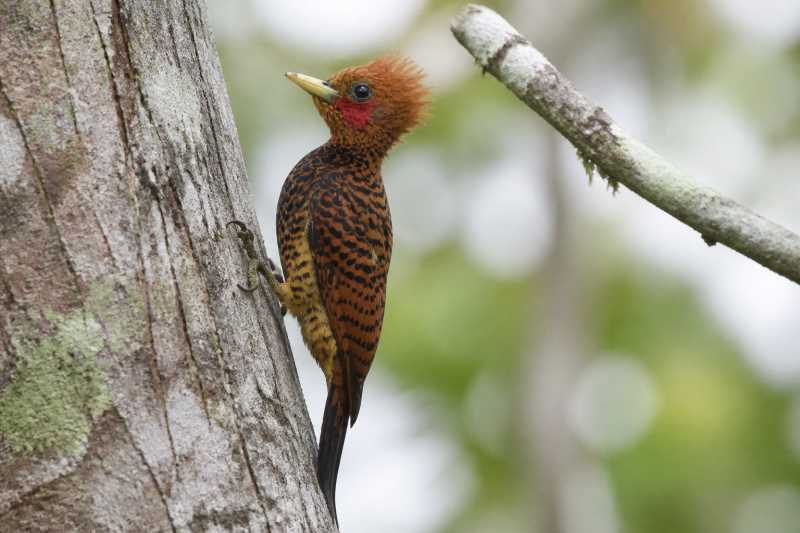
One of the most striking features of the Variable Woodpecker is its vibrant plumage. The bird exhibits a range of colors, with a general palette of browns, yellows, and blacks. The most distinctive feature is the undulating or wavy patterns on its wings and back, which provide excellent camouflage against tree bark.
Adult Variable Woodpeckers are medium-sized, measuring approximately 25 to 28 centimeters in length. They possess a strong, chisel-like bill, which is essential for their foraging habits. Their zygodactyl feet, with two toes facing forward and two backward, provide excellent grip and stability when navigating tree trunks.
Habitat and Distribution
The Variable Woodpecker is predominantly found in the humid forests of the Amazon Basin, extending into parts of Venezuela, Colombia, Ecuador, Peru, and Brazil. It thrives in a variety of forested habitats, including lowland rainforests, subtropical or tropical moist montane forests, and even secondary growth forests.
These woodpeckers prefer areas with high tree density, which offers ample foraging opportunities and nesting sites. Their adaptability to different forest types is a testament to their resilience and versatility as a species.
Behavior and Diet
Variable Woodpeckers are primarily insectivorous, feeding on a diet rich in ants, beetles, and larvae found beneath the bark of trees. Their strong beaks are adept at chiseling through wood to uncover insects, and their long, barbed tongues assist in extracting prey from crevices.
These birds are known for their characteristic drumming behavior, which serves multiple purposes such as communication, territory defense, and courtship. The drumming is achieved by rapidly striking their bill against tree trunks, producing a resonant sound that can be heard over long distances.
Reproduction and Lifespan
The breeding season for Variable Woodpeckers varies depending on their geographical location, but generally coincides with the onset of the rainy season. They are monogamous birds, forming long-term pair bonds.
Nesting usually occurs in tree cavities, which are excavated by both members of the pair. The female typically lays a clutch of two to four eggs, which are incubated by both parents. The chicks are altricial, meaning they are born helpless and require extensive parental care. Both parents participate in feeding and nurturing the young until they fledge.
Conservation Status
The International Union for Conservation of Nature (IUCN) currently classifies the Variable Woodpecker as a species of Least Concern. However, their populations are subject to pressures from habitat destruction and deforestation, particularly in the Amazon Basin. Conservation efforts focused on preserving forest habitats are crucial for ensuring the long-term survival of this species.
Importance in Ecosystem
Variable Woodpeckers play a vital role in their ecosystem as both predators and prey. As insectivores, they help control insect populations, contributing to the health of their forest habitats. Additionally, the cavities they excavate for nesting provide essential nesting sites for other bird species and small mammals.
Human Interaction
While the Variable Woodpecker is not a common pet, it is a subject of interest for bird watchers and ecotourists. Its presence in biodiverse regions makes it an important species for promoting ecotourism, which can support local economies and conservation efforts.
Conclusion
In summary, the Variable Woodpecker is a remarkable species that embodies the beauty and complexity of the natural world. Its unique adaptations and behaviors are a testament to the evolutionary processes that have shaped its existence. Protecting its habitat and ensuring its survival should be a priority for conservationists and nature enthusiasts alike, as these efforts contribute to the overall health and diversity of our planet’s ecosystems.
Related posts