Introduction
The Moustached Hawk-Cuckoo, Hierococcyx vagans, is a secretive forest cuckoo of the Sundaic region and mainland Southeast Asia. It is generally uncommon and is most often detected by its calls or by brief views as it moves through dense vegetation. The species is resident rather than migratory across its recognised range.
Physical Description
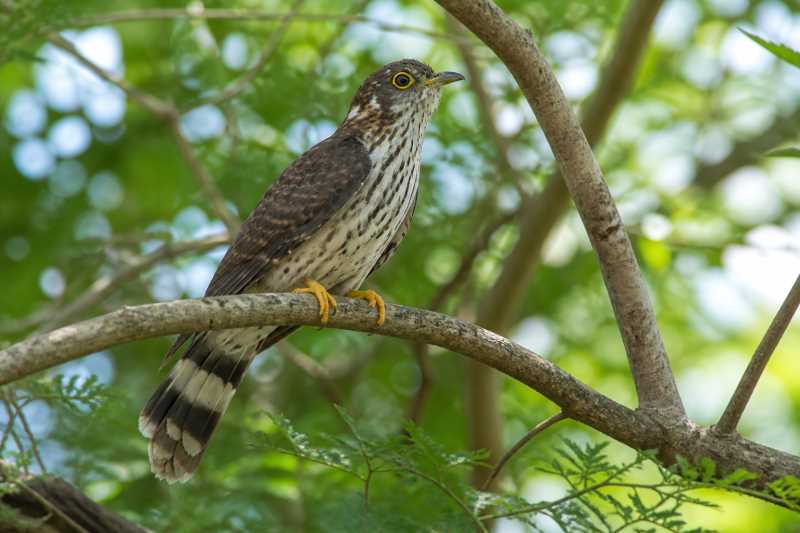
The Moustached Hawk-Cuckoo is a medium-sized cuckoo with a hawk-like outline, pointed wings and a long, graduated tail. Adults have grey on the crown and nape, brown upperparts, pale underparts with dark streaking, and a conspicuous dark moustache or malar stripe against the whitish face. The tail is barred and usually shows a pale or buffy tip, while the flight feathers have pale barring.
The dark facial marking, barred tail and streaked underparts are useful identification features, although views are often brief and obscured by foliage. Juveniles are generally darker and browner above, with heavier or less sharply defined streaking below. Reliable evidence for consistent differences between the sexes is limited, so field identification should not normally depend on sex.
Range and Habitat
The species occurs in the Sundaic lowlands and adjacent mainland Southeast Asia, including southern Myanmar, peninsular Thailand, southern Laos, Peninsular Malaysia, Sabah and Sarawak, Brunei, Sumatra and Kalimantan in Indonesia. A historical record from Java has not been supported by more recent confirmed records, and the Philippines is not part of the current recognised range.
Moustached Hawk-Cuckoos are associated mainly with evergreen forest, including lowland and lower hill forest, alluvial forest, forest edges, secondary growth and bamboo forest. They have been recorded from sea level to approximately 900 metres, although the exact upper limit may vary between regions. The species is not considered migratory, but local movements may occur in response to food availability and seasonal conditions.
Where to See This Species
Kaeng Krachan National Park, Phetchaburi, Thailand
Recent documented records from Kaeng Krachan include the park’s stream crossings, mid-elevation forest and Ban Krang area. These locations provide suitable evergreen and lower hill forest habitat, and the species may be found by listening carefully along forest roads and trails, particularly during periods of bird activity in the morning.
Nearby accommodation: Kaeng Krachan town and the Phetchaburi area provide guest houses, resorts and other accommodation suitable for visitors to the park.
Taman Negara National Park, Pahang, Malaysia
The Moustached Hawk-Cuckoo has been documented in the Kuala Tahan area of Taman Negara. Dense lowland rainforest, forest edges and riverine habitats make the park a realistic place to search, although the species is unobtrusive and is more likely to be heard than seen.
Nearby accommodation: Kuala Tahan is the main gateway settlement, with lodges, guest houses, campsites and other rainforest-oriented accommodation.
Khao Pra–Bang Khram Wildlife Sanctuary, Krabi, Thailand
A documented record from the Khao Pra–Bang Khram, or Khao Nor Chu Chi, area confirms the species in this protected lowland forest landscape. The sanctuary’s evergreen forest, streams and dense understorey are appropriate habitat for a quiet, forest-dependent cuckoo.
Nearby accommodation: Khlong Thom is the nearest practical town for guest houses and small hotels, while the wider Krabi area offers a broader range of accommodation.
Behaviour and Diet
The Moustached Hawk-Cuckoo is usually solitary and secretive. It spends much of its time in the middle and upper levels of forest vegetation, where its brown, grey and streaked plumage provides effective camouflage. It may sit quietly for extended periods before making a short flight between perches.
Its diet is believed to consist mainly of insects and other small invertebrates, including caterpillars, beetles and spiders. It appears to forage by watching from a perch and taking prey from foliage or in short sallies through the vegetation. Detailed studies of its feeding ecology remain limited.
Like other cuckoos, it is a brood parasite. The female lays in the nest of another bird, leaving the host to incubate the egg and raise the young. The principal host species of the Moustached Hawk-Cuckoo are not well documented, and its breeding behaviour remains comparatively poorly known.
Identification Tips
- Look for a medium-sized cuckoo with a grey head, brown back, pale streaked underparts and a dark moustache-like facial mark.
- The barred tail, pale tail tip and pale barring in the wings are useful supporting features.
- Its hawk-like shape can cause confusion with small forest raptors, but the long cuckoo-like tail, soft facial pattern and lack of true raptor structure are helpful clues.
- Do not rely on the facial moustache alone. Compare the whole combination of head pattern, tail barring, underpart streaking, habitat and call.
- The species may be confused with other hawk-cuckoos in Southeast Asia. Careful attention to range, tail pattern and the degree of streaking is important, especially in poor light or when the bird is seen only in flight.
Conservation Status
The Moustached Hawk-Cuckoo is currently assessed as Near Threatened on the IUCN Red List. Its population is considered to be decreasing, mainly because it depends on forest in a region experiencing continuing deforestation and habitat degradation.
Logging, agricultural expansion, forest conversion, fragmentation and fire can reduce suitable habitat. The species shows some tolerance of secondary and degraded forest, and parts of its range occur in protected areas, but the long-term conservation priority remains the protection and restoration of connected lowland and lower hill forests.
Frequently Asked Questions
Where does the Moustached Hawk-Cuckoo live?
It occurs in southern mainland Southeast Asia and the Sundaic region, including southern Myanmar, Thailand, Laos, Malaysia, Brunei, Sumatra and Kalimantan.
Is the Moustached Hawk-Cuckoo migratory?
No. It is regarded as a non-migratory resident, although individuals may make local movements within forest landscapes.
What does the Moustached Hawk-Cuckoo eat?
It is believed to feed mainly on insects and other small invertebrates, including caterpillars, beetles and spiders.
Is the Moustached Hawk-Cuckoo a brood parasite?
Yes. It lays its eggs in the nests of other birds, which then incubate the egg and care for the cuckoo chick. The main host species are not well established.
How can the species be identified?
Look for the grey head, brown upperparts, pale streaked underparts, dark moustache-like marking, barred tail and hawk-like silhouette. Its call can also be important because the bird is often difficult to see.
Is the Moustached Hawk-Cuckoo endangered?
It is not currently classified as Endangered, but it is assessed as Near Threatened because forest loss and habitat degradation are causing an ongoing population decline.
References
- BirdLife International
- IOC World Bird List
- Cornell Lab of Ornithology, Macaulay Library and eBird
Related posts