Southern Boubou: The Secretive Songster of Sub-Saharan Africa
The Southern Boubou, scientifically known as Laniarius ferrugineus, is a captivating bird species that belongs to the family Malaconotidae. This bird, with its striking appearance and melodious duet calls, is a fascinating subject for both ornithologists and bird enthusiasts. Native to the southern regions of Africa, the Southern Boubou is not only known for its vocalizations but also for its secretive nature, making it a challenge to observe in the wild.
Physical Characteristics
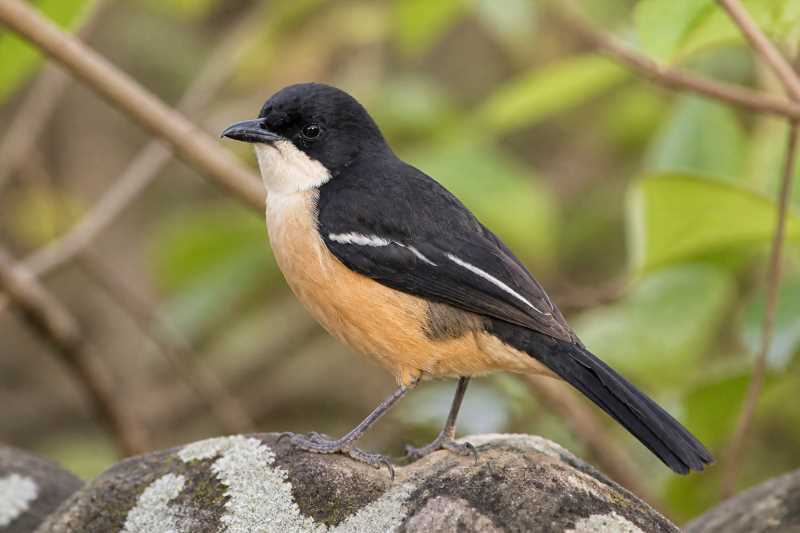
The Southern Boubou is a medium-sized bird, typically measuring between 20 to 22 centimeters in length. Its plumage is predominantly black and white, with a glossy black head, back, and tail, contrasting sharply with its white underparts. The wings are adorned with a combination of black and white, with distinctive white wing patches that are visible in flight. The eyes are dark brown, and the legs and bill are black, giving the bird a sleek and elegant appearance.
One of the most distinguishing features of the Southern Boubou is its rusty or ferruginous flanks, which are more pronounced in some subspecies. This coloration can vary slightly, providing a subtle yet beautiful contrast to the bird’s otherwise monochrome plumage.
Habitat and Distribution
The Southern Boubou is predominantly found in the sub-Saharan regions of Africa, with its range extending from southern Kenya to South Africa. It inhabits a variety of environments, including woodlands, thickets, forest edges, and gardens. The bird is particularly fond of dense undergrowth and shrubbery, which provide ample cover and nesting sites.
Despite its wide distribution, the Southern Boubou is more commonly observed in the southern parts of its range. It has adapted well to human-altered landscapes, often being found in suburban gardens and parks where there is sufficient vegetation.
Behavior and Diet
The Southern Boubou is known for its secretive and shy nature, often skulking in dense vegetation and only revealing itself when it feels safe. It is a territorial species, with pairs defending their territory vigorously from intruders. The bird is most active during the early morning and late afternoon, spending much of its time foraging for food.
Its diet is primarily carnivorous, consisting of insects, spiders, and other small invertebrates. The Southern Boubou is also known to feed on small reptiles, such as lizards, and occasionally fruits. It employs a sit-and-wait strategy, remaining still and scanning its surroundings before pouncing on unsuspecting prey.
Vocalizations
One of the most enchanting aspects of the Southern Boubou is its vocal repertoire. The bird is renowned for its complex duet calls, which are performed by paired males and females. These duets are not only a means of communication between partners but also serve to establish and reinforce territorial boundaries.
The duet begins with one bird, typically the male, emitting a melodious whistle, followed closely by the female responding with a contrasting note. This exchange creates a harmonious and rhythmic pattern that can be heard echoing through their habitat. The vocalizations of the Southern Boubou are considered some of the most beautiful among African birds, captivating listeners with their clarity and musicality.
Breeding and Nesting
The breeding season of the Southern Boubou varies depending on the region, but it generally occurs during the warmer months when food is abundant. The birds are monogamous, forming long-term pair bonds that can last for several breeding seasons.
Nesting takes place in dense foliage, where the female constructs a cup-shaped nest using twigs, grass, and leaves. The nest is carefully concealed to protect it from predators. The female typically lays two to three eggs, which are incubated for about 14 to 16 days. Both parents share the responsibility of feeding and caring for the chicks until they fledge, which occurs approximately three weeks after hatching.
Conservation Status
Currently, the Southern Boubou is classified as a species of Least Concern by the International Union for Conservation of Nature (IUCN). This status is due to its wide distribution and stable population numbers. However, habitat destruction and changes in land use pose potential threats to local populations.
Efforts to conserve the Southern Boubou include preserving its natural habitats and promoting awareness about the importance of maintaining biodiversity in both urban and rural areas. By fostering environments where these birds can thrive, we ensure that future generations will continue to enjoy the melodic duets of this remarkable species.
Conclusion
The Southern Boubou, with its striking appearance and enchanting vocalizations, is a true gem of the avian world. Its ability to adapt to different environments while maintaining its secretive nature makes it a fascinating subject for study and observation. As we continue to learn more about this remarkable bird, it serves as a reminder of the rich biodiversity that exists within our world and the importance of preserving it for the future.
Related posts