Introduction
The Asian Emerald Cuckoo, Chrysococcyx maculatus, is a small forest cuckoo in the family Cuculidae. It is noted for the male’s iridescent green plumage, strong sexual dimorphism and brood-parasitic breeding strategy. The species occurs from the Himalayas and northeastern South Asia through southern China and mainland Southeast Asia, with some populations moving south outside the breeding season. (worldbirdnames.org)
Physical Description
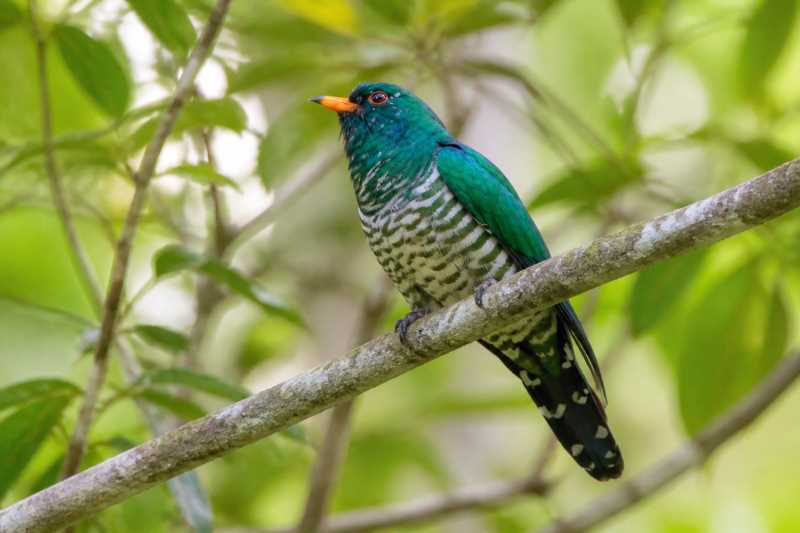
The Asian Emerald Cuckoo is approximately 17–18 centimetres long. The adult male has an iridescent dark green head, back, wings and upper breast. The lower breast and belly are white with green or bronze barring. The bare skin around the eye is orange, and the bill is yellow or orange with a dark tip.
The female is distinctly different from the male. She has coppery-green upperparts, a rusty or pale rufous crown and nape, and barred underparts. Juveniles resemble females, while young males have more heavily barred underparts and lack the adult male’s clean white lower breast. Both sexes show a noticeable white band on the underwing in flight. (thainationalparks.com)
Range and Habitat
The species’ main breeding range extends from the Himalayan foothills eastwards through Nepal, Bhutan, northeastern India, Bangladesh, southern China, Myanmar, northern Laos, northern and central Vietnam, and northern Thailand. Further south, including parts of peninsular Southeast Asia, Sumatra and Sri Lanka, it is generally recorded as a migrant, winter visitor or occasional visitor rather than a confirmed breeding species. Seasonal status varies between regions. (pmc.ncbi.nlm.nih.gov)
Asian Emerald Cuckoos inhabit subtropical and tropical moist lowland and montane forests, including evergreen forest, mixed forest and wooded margins. They are usually associated with tree cover and are most often encountered in the canopy or along forest edges. Although the original article gave an elevation range reaching about 2,000 metres, elevation varies across the range and a single universal upper limit is not well established.
Where to See This Species
Khao Yai National Park, Nakhon Ratchasima Province, Thailand
Khao Yai is a recognised site for the species and offers extensive evergreen and mixed forest with suitable canopy habitat. The cuckoo is generally difficult to locate, so quiet observation along forest roads, trails and woodland edges is more productive than searching open ground. Records from Thailand include both resident and seasonal birds. (thainationalparks.com)
Nearby accommodation: Pak Chong is the main practical gateway, with hotels, guest houses, resorts and self-catering accommodation.
Kaeng Krachan National Park, Phetchaburi Province, Thailand
Asian Emerald Cuckoo is included in the park’s bird records. The extensive moist forest, canopy and forest-edge habitat make Kaeng Krachan a realistic place to look, particularly during guided birding visits and along quieter roads near forested campsites. Sightings have also been recorded around the park campground. (thainationalparks.com)
Nearby accommodation: Kaeng Krachan town and the surrounding reservoir area provide guest houses, campsites, lodges and small resorts.
Doi Inthanon National Park, Chiang Mai Province, Thailand
Doi Inthanon lies within the species’ documented Thai range and includes montane forest habitat. The cuckoo has been recorded in the park, including along forest roads at middle and higher elevations. Birders should concentrate on the canopy and forest margins, especially during the warmer months when birds are more likely to be calling or moving through the area. (thainationalparks.com)
Nearby accommodation: Chom Thong is the principal gateway, with hotels, guest houses, homestays and small resorts.
Behaviour and Diet
The Asian Emerald Cuckoo is usually solitary and unobtrusive. It spends much of its time in the upper canopy, where its green plumage can make it surprisingly difficult to detect. It may sit quietly among leaves before making a short flight between trees, and its rapid movements can result in only brief views.
Its diet consists mainly of insects and other small invertebrates, including caterpillars, ants and bugs. It usually gleans prey from foliage in the canopy rather than feeding on the ground. Reliable sources emphasise animal prey, so claims that fruit and berries form a major part of its diet should be treated cautiously. (thainationalparks.com)
The species is an obligate brood parasite. The female lays her egg in the nest of another bird, leaving the host to incubate the egg and raise the young. Recorded hosts include small forest birds such as the Crimson Sunbird, Little Spiderhunter and several leaf-warblers. Host use varies geographically, and the available evidence does not justify applying the behaviour of better-known cuckoos to every Asian Emerald Cuckoo nest. (thainationalparks.com)
The call is not the familiar two-note call of the Common Cuckoo. Reported vocalisations include a short call given in flight and soft or whistled twitters. Vocal activity is most useful during the breeding season, but the species can remain difficult to approach even when calling. (thainationalparks.com)
Identification Tips
- Look for a small cuckoo, about 17–18 centimetres long, in the upper canopy or along a forest edge.
- An adult male is immediately distinctive when seen well: glossy emerald-green upperparts, a white lower breast and green-barred belly, with orange skin around the eye.
- A female or juvenile has a rusty or pale rufous crown and nape, coppery-green upperparts and extensively barred underparts.
- The white underwing band is a useful feature when the bird flies across an opening.
- The Asian Emerald Cuckoo can be confused with the Violet Cuckoo, Chrysococcyx xanthorhynchus. The Asian Emerald Cuckoo has greener rather than violet upperparts, and females show a stronger contrast between the rufous crown and the coppery-green back. It can also be compared with smaller bronze-cuckoos, but its vivid green colouring, contrasting bill and distinctive female plumage are useful separating features. (singaporebirds.com)
Conservation Status
The Asian Emerald Cuckoo is currently classified as Least Concern on the IUCN Red List. The species has a very large geographic range and does not meet the thresholds for a threatened category based on range size. A reliable global population estimate is not available.
The global assessment did not identify a specific major threat or establish a global population decline. Nevertheless, loss and fragmentation of moist forest can reduce suitable habitat locally, particularly where forest is cleared or degraded. Protecting remaining forest, maintaining connected woodland and monitoring breeding and wintering populations remain important conservation measures. (doi.org)
Frequently Asked Questions
Where can the Asian Emerald Cuckoo be found?
It occurs from the Himalayan region through northeastern India, Bangladesh, southern China, Myanmar, northern mainland Southeast Asia and Thailand. Some birds move farther south outside the breeding season.
What does the Asian Emerald Cuckoo look like?
The male is glossy emerald-green above, with a white lower breast and green-barred belly. The female and juvenile are coppery-green and rufous above, with strongly barred underparts.
Is the Asian Emerald Cuckoo migratory?
Seasonal movements vary by region. It breeds mainly in the Himalayan and northern mainland Southeast Asian part of its range, while farther south it is often a migrant or winter visitor. Some Thai populations are considered resident or presumed resident.
What does the Asian Emerald Cuckoo eat?
It mainly eats insects and other small invertebrates, including caterpillars, ants and bugs. It usually searches for prey among foliage in the forest canopy.
Does the Asian Emerald Cuckoo build its own nest?
No. It is an obligate brood parasite. The female lays her egg in the nest of another bird, which then incubates the egg and raises the young cuckoo.
Is the Asian Emerald Cuckoo endangered?
No. The species is currently assessed as Least Concern, although forest loss and habitat fragmentation may still affect local populations.
References
- IOC World Bird List
- IUCN Red List of Threatened Species
- Thai National Parks
Related posts