Introduction
Denham’s Bustard (Neotis denhami) is a large ground-dwelling bird of open grasslands, savannas and other lightly wooded habitats across much of Sub-Saharan Africa. It is a member of the bustard family, Otididae, and is also known in some southern African sources as Stanley’s Bustard. Although it can fly strongly, it spends most of its time walking through open country in search of food. Its wide but fragmented range, habitat loss and collision risks have contributed to a global conservation assessment of Near Threatened.
Physical Description
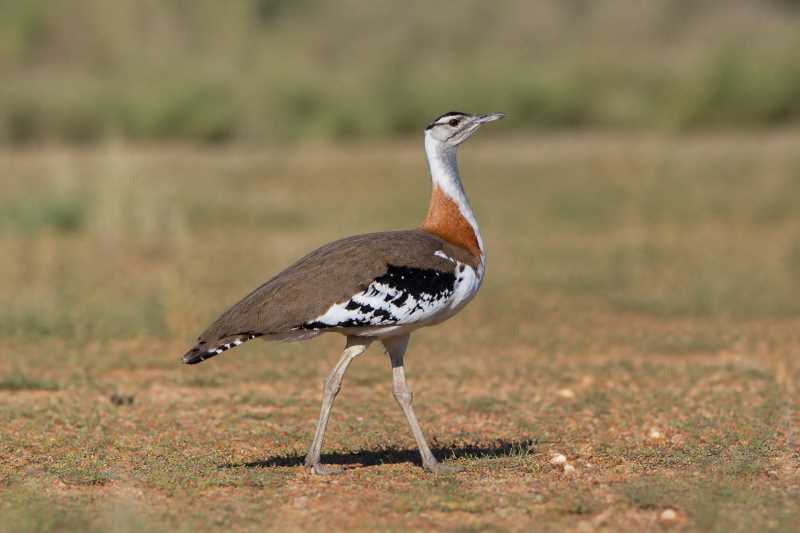
Denham’s Bustard is a large, long-legged bird measuring approximately 100 to 120 cm in length. Reported adult weights range from about 3.7 to 7.6 kg, with males generally heavier and more robust than females.
The adult male has a black-and-white crown pattern, a broad white supercilium, a bluish-grey face and a pale grey fore-neck. The hind-neck and upper mantle are deep chestnut, while the back and rump are brown with fine darker markings. The underparts are largely white, and the wings show bold black-and-white patterning that is conspicuous in flight. The tail is dark with broad pale bands.
Females are smaller and less boldly marked. Their fore-neck and upper breast are finely barred, and their upperparts are generally plainer than those of males. Juveniles are also smaller and less distinctly patterned than adult males.
Range and Habitat
Denham’s Bustard has a broad but discontinuous distribution extending from the Sahel and West Africa through eastern Africa and southwards into parts of southern Africa. The species is represented by three recognised subspecies, with different subspecies occupying western, eastern and southern portions of the range.
It occurs in open grasslands, savannas, grassy floodplains, lightly wooded country, shrubland, fallow fields, agricultural landscapes and dried marshes. It may be found from lowlands to high-elevation grasslands, with records up to about 3,000 metres. Suitable habitat usually provides open ground for walking and feeding, with enough vegetation cover for nesting and shelter.
Denham’s Bustard is not uniformly sedentary. Movements vary by region, and some populations shift in response to rainfall, food availability and seasonal changes in habitat. Inland birds may move to lower elevations during winter, while birds in parts of the Sahel undertake more substantial seasonal movements.
Where to See This Species
Bontebok National Park, Western Cape, South Africa
South African National Parks describes Bontebok National Park as an excellent place to look for Denham’s Bustard. The park’s open renosterveld, grassland and other natural vegetation provide suitable habitat, and the species is included on the park’s official bird list. Search open landscapes and grassland edges from the park’s roads and recognised viewing areas, particularly during quiet periods when birds are more likely to be walking and feeding.
Nearby accommodation: Swellendam is the nearest practical gateway, with park campsites and self-catering accommodation, as well as guest houses and other lodging in town.
Nyika National Park, Northern Region, Malawi
Nyika National Park is a high-altitude grassland park where the rare Denham’s Bustard is documented among the park’s birdlife. Its broad montane grasslands and open plateau habitat are well suited to a species that favours unobstructed ground. Birdwatchers should explore open areas around the plateau and use local guides where available, as sightings are not guaranteed.
Nearby accommodation: Chelinda is the main accommodation area on the plateau, with lodge and camp-style accommodation. Additional guest houses and basic services are available around Rumphi, the principal gateway town.
Marakele National Park, Limpopo, South Africa
Denham’s Bustard is included in the South African National Parks bird list for Marakele National Park. The park’s open grassland and savanna habitats provide appropriate conditions, although the species is not necessarily encountered on every visit. Look across open veld and grassland clearings, especially during early morning and late afternoon when ground-feeding birds are more active.
Nearby accommodation: Thabazimbi is the nearest practical town, with lodges, guest houses, campsites and self-catering accommodation serving visitors to the park.
Behaviour and Diet
Denham’s Bustard is primarily terrestrial and usually walks deliberately through open habitat while searching for food. It is often seen alone or in small groups of two to seven birds, although larger temporary gatherings may form where food is plentiful or during seasonal movements. Groups can contain mostly males or mostly females outside the breeding period.
The species is omnivorous. Its diet includes insects and other invertebrates, seeds, shoots and other plant material, as well as small vertebrates when available. Feeding opportunities may increase in recently managed or naturally disturbed grassland where insects are easier to find.
Males perform an elaborate courtship display in which the neck and chest are inflated and normally concealed white feathers are flared. The display may be accompanied by deep booming sounds and wing movements. The mating system is not fully understood, but observations suggest that males may mate with more than one female. The female lays her eggs on the ground and undertakes the main work of incubation and chick care.
Identification Tips
- Look for a large, upright bustard walking through open grassland or savanna.
- Adult males show a distinctive black-and-white crown, a broad white eyebrow, a bluish-grey face and a pale grey fore-neck.
- The chestnut hind-neck contrasts with the darker brown back and the white underparts.
- Bold black-and-white wing markings are especially noticeable when the bird flies.
- Females are smaller and show finer barring across the fore-neck and upper breast.
- The much larger Kori Bustard has a more barred greyish neck, while Ludwig’s Bustard generally has a darker grey-brown fore-neck. Denham’s Bustard is also distinguished by its more striking black-and-white crown pattern and chestnut hind-neck.
Conservation Status
Denham’s Bustard is currently assessed globally as Near Threatened. Its population is considered to be declining, although the total population size remains uncertain and movement patterns make precise assessment difficult. In South Africa, the species is assessed regionally as Vulnerable.
Major threats include the loss and degradation of open grassland through agricultural expansion, afforestation, intensive grazing, development and poorly managed fire regimes. Collision with power lines is an important additional risk, particularly in landscapes where birds move between feeding and breeding areas. Hunting, disturbance and other forms of human pressure may also affect local populations.
Important conservation measures include protecting remaining grasslands, maintaining a varied and suitable grazing and burning regime, improving monitoring, reducing collision risks from power infrastructure and ensuring that protected-area planning includes important habitats outside existing reserves. GPS tracking and other movement studies are helping to clarify seasonal movements and identify high-risk areas.
Frequently Asked Questions
Where does Denham’s Bustard live?
Denham’s Bustard lives in open grasslands, savannas, floodplains, lightly wooded areas, shrubland, fallow fields and some agricultural landscapes across Sub-Saharan Africa.
Is Denham’s Bustard migratory?
It is best described as partly mobile rather than uniformly migratory. Some populations make seasonal or local movements in response to rainfall, food availability and changing habitat conditions.
What does Denham’s Bustard eat?
It is omnivorous and eats insects and other invertebrates, seeds, shoots, plant material and occasional small vertebrates.
How can Denham’s Bustard be identified?
The most useful features are its large size, black-and-white crown, pale grey fore-neck, chestnut hind-neck, white underparts and boldly patterned wings. Females are smaller and more finely barred than males.
Where is a good place to see Denham’s Bustard?
Bontebok National Park in South Africa is one of the more practical wildlife-viewing sites because South African National Parks specifically identifies it as an excellent place to see the species. Nyika National Park in Malawi and Marakele National Park in South Africa also document the species in their bird lists or visitor information.
What threatens Denham’s Bustard?
The main threats are habitat loss and degradation, unsuitable land management, power-line collisions, disturbance and, in some areas, hunting pressure. Its fragmented distribution and uncertain population size make continued monitoring important.
References
- BirdLife International
- South African National Parks
- Malawi Tourism
Related posts