Introduction
The Green-throated Mountaingem (Lampornis viridipallens) is a resident hummingbird of the highlands of southern Mexico and northern Central America. It is associated mainly with humid montane forests, cloud forests and pine-oak woodland. The species is locally common in suitable habitat, but its restricted range makes the protection of highland forests important.
Physical Description
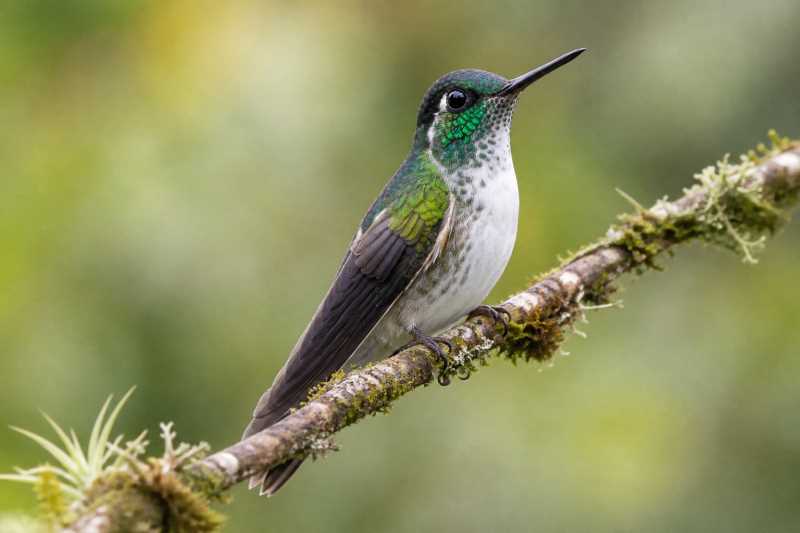
The Green-throated Mountaingem is a medium-sized hummingbird, measuring approximately 11 to 12 centimetres in length. It has a straight, black bill, green upperparts and a conspicuous white stripe behind the eye. The underparts are generally pale, with darker or greenish markings on the sides and flanks. The outer tail feathers are greyish to pale and may be especially noticeable when the bird spreads its tail.
Adult males have an iridescent green to bluish-green throat, which can appear dark in poor light. Their back may show a bronzy tone on the rump, while the breast is largely white. Females are duller overall and have a white throat without the male’s prominent gorget. Immature birds resemble females, although young males may gradually develop coloured throat feathers as they mature.
Range and Habitat
The species is resident in the highlands of southeastern Oaxaca and Chiapas in Mexico, Guatemala, El Salvador and western Honduras. In Honduras, its range is principally west of the Comayagua-Ulúa river valley. It does not occur in Costa Rica or Nicaragua, where the closely related Green-breasted Mountaingem (Lampornis sybillae) is found instead.
The Green-throated Mountaingem inhabits humid evergreen forest, cloud forest and pine-oak woodland, including forest edges and flowering clearings. It is generally recorded from about 900 to 2,700 metres above sea level, although published sources give somewhat wider limits for some parts of its range. The species is non-migratory, although local or seasonal movements between elevations may occur as flowering conditions change.
Geographic variation is recognised within the species. The form L. v. ovandensis occurs in Chiapas and adjacent north-western Guatemala, while other populations extend through Guatemala, El Salvador and western Honduras.
Where to See This Species
Finca El Pilar, Sacatepéquez, Guatemala
Finca El Pilar is a publicly accessible birding and forest venue near Antigua Guatemala. Its trails include pine, oak and cloud-forest habitats, and the Green-throated Mountaingem has been recorded there repeatedly, including at flowering plants and hummingbird-feeding areas. Early morning visits are most suitable, particularly when flowers are abundant.
Nearby accommodation: Antigua Guatemala offers hotels, guest houses, self-catering accommodation and other visitor services.
Reserva de la Biosfera Volcán Tacaná, Chiapas, Mexico
The Volcán Tacaná Biosphere Reserve protects high-elevation forest on the Mexico-Guatemala border and includes the species in its documented bird fauna. Look for the Green-throated Mountaingem in humid montane forest and forest edges, especially along permitted visitor routes and in areas with flowering understorey plants.
Nearby accommodation: Unión Juárez and the wider Tapachula area provide hotels, guest houses, cabins and other accommodation suitable for visiting the reserve.
Parque Nacional Montecristo, El Salvador
Montecristo protects some of El Salvador’s remaining cloud forest and forms part of the wider Trifinio highland landscape shared with Guatemala and Honduras. The Green-throated Mountaingem has been recorded in the park and surrounding protected area. Access may be subject to park regulations, permits and seasonal conditions.
Nearby accommodation: Metapán is the nearest practical town for hotels, guest houses and basic self-catering accommodation, with camping or park-based options subject to local permission.
Behaviour and Diet
The Green-throated Mountaingem feeds mainly on nectar from flowering plants. It may visit flowers at several levels in the forest and often defends productive feeding areas from other hummingbirds. Small insects and spiders supplement the diet and provide important protein, particularly during breeding and when nectar supplies are limited.
Like other hummingbirds, it can hover while feeding and make rapid changes of direction in flight. It is generally encountered alone, although several individuals may gather temporarily where flowers or feeders are especially productive. The species is resident, but movements between elevations may help it track local food supplies.
The female is responsible for nest construction and incubation. The nest is a small cup made from plant fibres, moss and other soft materials, often bound with spider silk and placed on a sheltered branch. Two eggs are typical of hummingbirds, but detailed information about the breeding season and nesting success of this species remains limited.
Identification Tips
- Look for a medium-sized hummingbird with a straight black bill and a bold white stripe behind the eye.
- Adult males show a green or bluish-green iridescent throat contrasting with pale underparts.
- Females and immature birds have a white throat and are less brightly coloured than adult males.
- Pale or greyish outer tail feathers may be visible when the bird fans its tail.
- In suitable highland forest, compare it with the Green-breasted Mountaingem. The Green-throated Mountaingem generally has paler underparts and a cleaner white throat in females, while the Green-breasted Mountaingem has more extensive green or buffy markings below. Their ranges are largely separate, which makes location an important identification clue.
- The iridescent throat may look black or dull in shade, so plumage colour should be assessed in good light rather than from a brief silhouette.
Conservation Status
The Green-throated Mountaingem is classified as Least Concern on the IUCN Red List. Its population size has not been reliably quantified, and the available assessment indicates that the population may be decreasing.
The principal concern is the continuing loss and fragmentation of humid montane and cloud forest through agricultural expansion, logging and other land-use changes. Changes in temperature and rainfall may also affect flowering patterns and the availability of suitable high-elevation habitat. Protecting connected forest, maintaining native flowering vegetation and managing protected areas effectively are important conservation measures.
Frequently Asked Questions
Where can the Green-throated Mountaingem be found?
It occurs in the highlands of southeastern Mexico, Guatemala, El Salvador and western Honduras. It is mainly associated with humid evergreen forest, cloud forest and pine-oak woodland.
Is the Green-throated Mountaingem migratory?
No. It is generally considered a resident species, although individuals may move locally between elevations in response to flowering and other food resources.
How can the male be identified?
The adult male has a green to bluish-green iridescent throat, green upperparts, a straight black bill and a white stripe behind the eye. The throat may look dark when the bird is in shade.
What does the Green-throated Mountaingem eat?
Its main food is nectar from flowers. It also catches or gleans small insects and spiders, which provide additional protein.
Does the female have a green throat?
Usually not. The female has a mainly white throat and is generally duller than the adult male. Immature birds resemble females, although young males may begin to develop coloured throat feathers.
Is the Green-throated Mountaingem threatened?
It is currently classified as Least Concern, but habitat loss and fragmentation remain important concerns because the species has a relatively restricted highland range and depends on forested habitats.
References
- IUCN Red List of Threatened Species
- Comisión Nacional de Áreas Naturales Protegidas
- CAYAYA Birding
Related posts