Introduction
The Golden-bellied Starfrontlet, Coeligena bonapartei, is a hummingbird of Colombia’s eastern Andes. It inhabits humid montane forests, forest edges and highland landscapes where flowering plants provide nectar. The species is endemic to Colombia under current IOC taxonomy, with the Perijá and Golden-tailed forms treated separately by several modern checklists.
Physical Description
The Golden-bellied Starfrontlet is a small to medium-sized hummingbird measuring about 11.4 cm in length. Its bill is relatively long, at approximately 3.3 cm, and the species weighs around 6.5 g in available field descriptions.
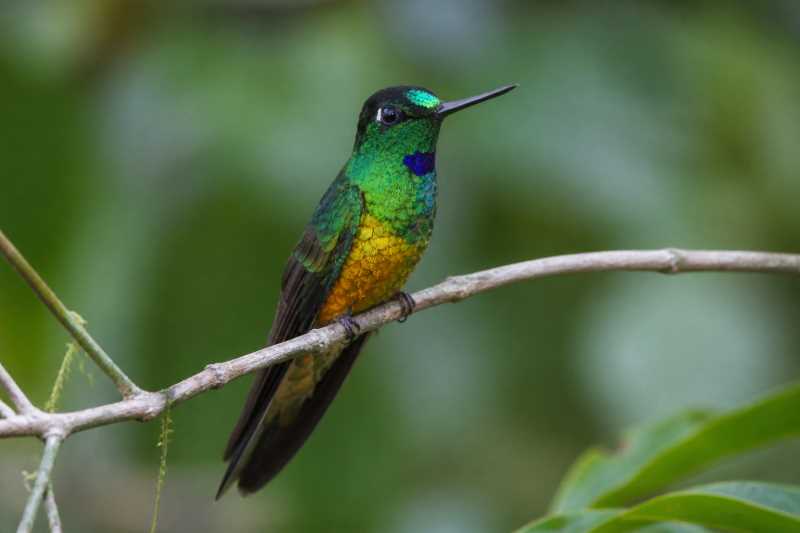
Adult males are distinctive, with a dark or blackish crown, a bright green frontlet above the bill, a green-gold back and glowing golden to coppery underparts. A violet throat patch and a conspicuous buff or rufous patch on the wing can be visible when the bird is in flight.
Females are less brightly coloured. They generally have paler, more buff-toned underparts with green spotting, while the upperparts remain greenish. Young birds and immature males are duller than adults and may lack the full intensity of the male’s frontlet and golden belly.
Range and Habitat
The Golden-bellied Starfrontlet occurs in the eastern Andes of Colombia, particularly from Boyacá northwards through the Bogotá region and adjacent parts of the Eastern Cordillera. It is associated with humid montane forest, high Andean forest, forest margins, regenerating vegetation and open highland areas with scattered shrubs and trees.
Documented elevations include approximately 2,150 to 3,000 metres in Chingaza National Natural Park. The species may also occur at somewhat different elevations elsewhere in its range, depending on local conditions and the distribution of flowering plants.
It is regarded as a resident species rather than a long-distance migrant. Its distribution is geographically restricted, and the remaining forest in the eastern Andes is important for maintaining local populations.
Where to See This Species
Chingaza National Natural Park, Cundinamarca and Meta, Colombia
The Golden-bellied Starfrontlet is listed for Chingaza National Natural Park, where it has been recorded between about 2,150 and 3,000 metres. Look for it in high Andean forest, forest margins and flowering vegetation. The park is publicly accessible, but visitors generally need advance arrangements and an authorised guide.
Nearby accommodation: Guasca, La Calera, Fómeque and other gateway settlements around Chingaza offer hotels, guest houses, rural lodges and self-catering accommodation.
Iguaque Fauna and Flora Sanctuary, Boyacá, Colombia
The species is included among the hummingbirds recorded in Iguaque Fauna and Flora Sanctuary. The sanctuary protects Andean forest and páramo habitats in the Eastern Cordillera, making forest margins and flowering areas suitable places to search. Local access conditions and permitted trails should be confirmed before visiting.
Nearby accommodation: Villa de Leyva is the main practical base, with hotels, guest houses, rural lodges and self-catering accommodation.
Chicaque Natural Park, Cundinamarca, Colombia
Golden-bellied Starfrontlets have been documented at Chicaque Natural Park, a publicly accessible protected natural area south-west of Bogotá. Its humid montane forest, steep wooded slopes and forest-edge habitats provide suitable conditions for the species, particularly where flowering plants are present.
Nearby accommodation: The Bogotá, Soacha and southern Cundinamarca area provides hotels, guest houses, lodges and rural accommodation, with some accommodation available within or close to the park area.
Behaviour and Diet
Golden-bellied Starfrontlets usually forage alone, moving rapidly between flowers and often perching briefly between feeding bouts. Like other hummingbirds, they can defend productive flowers or feeding areas from rivals, although their behaviour may vary according to food availability and habitat conditions.
Nectar forms the main part of the diet. The bird also takes small insects and spiders, which provide protein and other nutrients, especially when feeding young. By carrying pollen between flowers, it contributes to the reproduction of many highland plants.
The species is not known for regular long-distance migration. Breeding information is limited, but the female is responsible for nest construction and most of the care of the young, as is typical of hummingbirds. Males may use display flights and vocal or aerial interactions during courtship and territorial behaviour.
Identification Tips
- Look for a compact hummingbird with a bright green frontlet, a dark crown and strongly contrasting golden or coppery underparts.
- The violet throat patch, green-gold back and buff or rufous wing patch are useful features on a well-seen adult male.
- Females are duller and more buff-coloured below, with green spotting rather than the male’s strongly metallic golden belly.
- The species can be confused with other Coeligena hummingbirds in the eastern Andes. The Golden-bellied Starfrontlet is best separated by its golden underparts, green-gold upperparts and restricted distribution in the Eastern Cordillera.
- Blue-throated Starfrontlet has distinctly different underpart colours, with males showing a more reddish or rose-toned belly. Care is needed in areas where the two species occur near one another, particularly around the Bogotá region.
Conservation Status
The Golden-bellied Starfrontlet is currently classified as Least Concern on the IUCN Red List. No reliable global population estimate is provided here, and a specific population trend should not be assumed.
The principal conservation concern is the continuing loss and fragmentation of Andean forest through agricultural expansion, development and other land-use changes. Protecting remaining montane forest, maintaining habitat connections and managing protected areas are important measures for the species. Local conservation is particularly significant because the bird has a geographically restricted range.
Frequently Asked Questions
Where is the Golden-bellied Starfrontlet found?
It is found in the eastern Andes of Colombia, especially in the Eastern Cordillera from Boyacá southwards through the Bogotá region.
Is the Golden-bellied Starfrontlet endemic to Colombia?
Yes. Under current IOC taxonomy, Coeligena bonapartei is treated as a Colombian endemic. Related forms formerly included in broader treatments are now recognised separately by several modern authorities.
What habitat does the Golden-bellied Starfrontlet use?
It uses humid montane forest, high Andean forest, forest edges and open highland areas with scattered shrubs and flowering plants, generally at middle to high elevations.
What does the Golden-bellied Starfrontlet eat?
It feeds mainly on nectar and also takes small insects and spiders. Nectar supplies energy, while animal prey provides protein and other nutrients.
How can the Golden-bellied Starfrontlet be identified?
Adult males show a bright green frontlet, dark crown, green-gold back, violet throat patch and golden to coppery underparts. Females are paler and more heavily buff-spotted below.
Is the Golden-bellied Starfrontlet threatened?
The species is currently listed as Least Concern, but forest clearance and habitat fragmentation remain important conservation concerns within its restricted Andean range.
References
- International Union for Conservation of Nature, IUCN Red List of Threatened Species
- IOC World Bird List
- Parques Nacionales Naturales de Colombia
Related posts