Introduction
The Grey-bellied Comet (Taphrolesbia griseiventris) is a rare hummingbird endemic to north-central Peru. It is the only species in the genus Taphrolesbia and is associated mainly with dry Andean valleys, rocky canyons and semi-arid montane scrub rather than moist montane forest. The species has a highly localised distribution and is listed as Endangered.
Physical Description
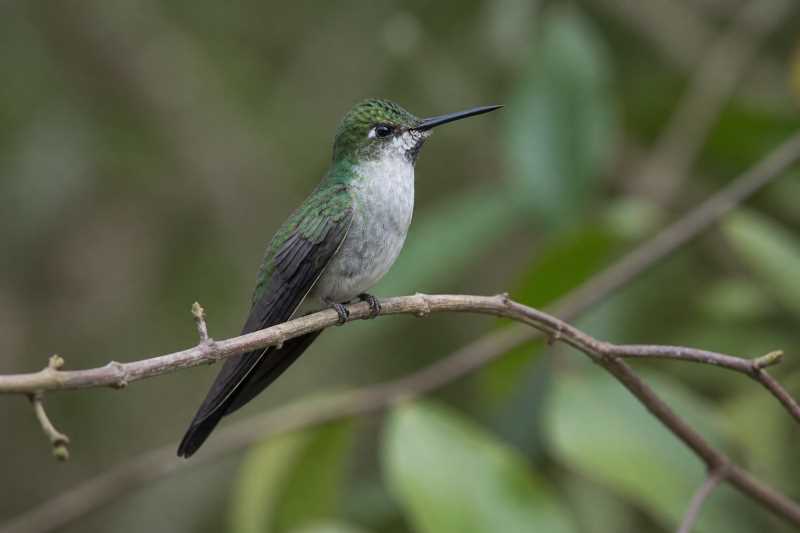
The Grey-bellied Comet is a relatively large hummingbird, measuring about 16 centimetres in length. Both sexes have bronzy-green upperparts, grey underparts and a long, deeply forked tail. The tail feathers show green, blue and coppery tones, with the longest feathers extending well beyond the body.
Adult males have a small, iridescent violet-blue throat patch, or gorget. Females lack the blue gorget and usually show dusky spotting on the throat. The male’s tail is generally longer than the female’s. The bill is black, straight and moderately short compared with the bird’s overall size.
Range and Habitat
The Grey-bellied Comet is endemic to Peru. Its known range is concentrated in the departments of Cajamarca, La Libertad, Ancash and Huánuco, particularly on the western side of the Marañón Valley and in nearby Andean valleys. The Chonta Valley near Cajamarca is the best-known area for recent records.
It generally occurs between about 2,750 and 3,200 metres above sea level, although records from outside this range have been reported. Its habitat consists of semi-arid montane scrub, steep slopes, deep ravines and rocky canyons with flowering shrubs, cacti, agaves and bromeliads. It may also use flowering vegetation around houses, fences and cultivated areas where suitable native plants remain.
The species is considered non-migratory. Its distribution is fragmented, and much of the suitable habitat lies outside formally protected areas.
Where to See This Species
Río Chonta Valley, Cajamarca, Peru
The Río Chonta Valley is the most reliable documented area for looking for the Grey-bellied Comet. It supports the species’ highest concentration of recent records and contains the dry, shrubby slopes, flowering plants and rocky ravines that it favours. The bird is usually uncommon and may require repeated visits, careful observation and local guidance. Sightings are possible near the Chonta Canyon and surrounding valley habitats, particularly where native flowering shrubs and bromeliads remain.
Nearby accommodation: Cajamarca is the practical gateway, with hotels, guest houses, lodges and self-catering accommodation suitable for birdwatchers.
Cañón de Sangal, Cajamarca, Peru
Cañón de Sangal is a documented Grey-bellied Comet locality in the Cajamarca area. Its steep canyon terrain and semi-arid scrub provide suitable habitat, although the species is localised and sightings are not guaranteed. Access conditions and land permissions should be checked locally before visiting.
Nearby accommodation: The city of Cajamarca provides the nearest broad range of hotels, guest houses and other visitor accommodation.
Huascarán National Park, Ancash, Peru
Huascarán National Park is the only formally protected area identified in recent assessments as containing the species, although records there are few and sparse. The Grey-bellied Comet is most likely to be encountered in suitable dry Andean valleys and scrubby habitats within or near the park’s lower-elevation areas, rather than in the highest glacial environments. Local park information and an experienced guide are advisable.
Nearby accommodation: Huaraz is the main gateway, offering hotels, guest houses, lodges, campsites and other accommodation for visitors to the national park.
Behaviour and Diet
The Grey-bellied Comet is usually seen singly. Males are strongly territorial and may chase other hummingbirds away from feeding areas, including larger or similarly conspicuous species. The species is an agile hover-feeder, visiting tubular or otherwise nectar-rich flowers while also taking small insects and other invertebrates.
Recorded food plants include bromeliads and other flowering plants of dry Andean scrub. In the Chonta Valley, the species has shown repeated use of particular flowering plants and apparent fidelity to favoured feeding areas, suggesting that territorial behaviour may be important where nectar is concentrated.
Little is known about courtship. Documented nests have been placed in sheltered positions beneath earth overhangs and dangling roots, including beside road cuttings. As in other hummingbirds, the female is responsible for incubation and care of the young.
Identification Tips
- Look for a large hummingbird with a very long, deeply forked tail.
- The upperparts are bronzy-green, while the underparts are grey.
- An adult male shows a small violet-blue throat patch.
- Females lack the blue throat and may show dusky marks on the throat.
- The straight black bill and unusually long, broad tail are useful structural features.
- The female may resemble a Bronze-tailed Comet, but the Grey-bellied Comet is generally larger and more slender, with a straighter bill and a more deeply forked tail.
- Search semi-arid canyon slopes, flowering scrub, bromeliads and agaves rather than dense humid forest.
Conservation Status
The Grey-bellied Comet is listed as Endangered. Its population is considered to be declining, largely because its already restricted and fragmented habitat is being degraded or lost.
Major threats include the clearing and burning of scrub for agriculture and livestock grazing, cutting native vegetation for fuelwood, fires and expanding development around Cajamarca. Increasing drought and hotter conditions may also reduce the availability of flowering plants and suitable habitat.
Conservation measures include protecting remaining habitat, restoring native shrubs and trees, reducing damaging fires, supporting local communities and improving knowledge of the species’ distribution and ecology. Habitat restoration and small reserve initiatives have been developed in the Chonta Valley, but continued protection is important because much of the species’ known range remains outside secure protected areas.
Frequently Asked Questions
Where is the Grey-bellied Comet found?
It is endemic to north-central Peru, with records from Cajamarca, La Libertad, Ancash and Huánuco. The Chonta Valley near Cajamarca is the best-known area for recent sightings.
What habitat does the Grey-bellied Comet prefer?
It favours semi-arid montane scrub, rocky slopes, deep canyons and dry Andean valleys with flowering shrubs, cacti, agaves and bromeliads.
How can the Grey-bellied Comet be identified?
Look for a large hummingbird with bronzy-green upperparts, grey underparts and a long, deeply forked tail. Males have a small violet-blue throat patch, while females have a plainer, sometimes dusky-spotted throat.
What does the Grey-bellied Comet eat?
Its diet includes nectar from flowering plants, especially plants associated with dry Andean scrub, together with small insects and other invertebrates.
Is the Grey-bellied Comet endangered?
Yes. It is listed as Endangered because its small, fragmented population is threatened by habitat loss, fires, agricultural expansion, grazing, fuelwood collection and other environmental changes.
Is the Grey-bellied Comet migratory?
It is considered non-migratory. Individuals are generally associated with localised feeding territories and suitable flowering habitats.
References
- BirdLife International
- Bird Conservation International
- American Bird Conservancy
Related posts