Introduction
The Hyacinth Visorbearer (Augastes scutatus) is a small hummingbird endemic to Brazil. It is associated mainly with the high-elevation campos rupestres of the Espinhaço Mountain Range in Minas Gerais, where rocky grasslands, shrubs and flowering plants provide its principal habitat.
Physical Description
The Hyacinth Visorbearer is a compact hummingbird measuring approximately 8–9 centimetres in length. It has a short bill, rounded wings and a relatively short tail suited to agile flight among rocky upland vegetation.
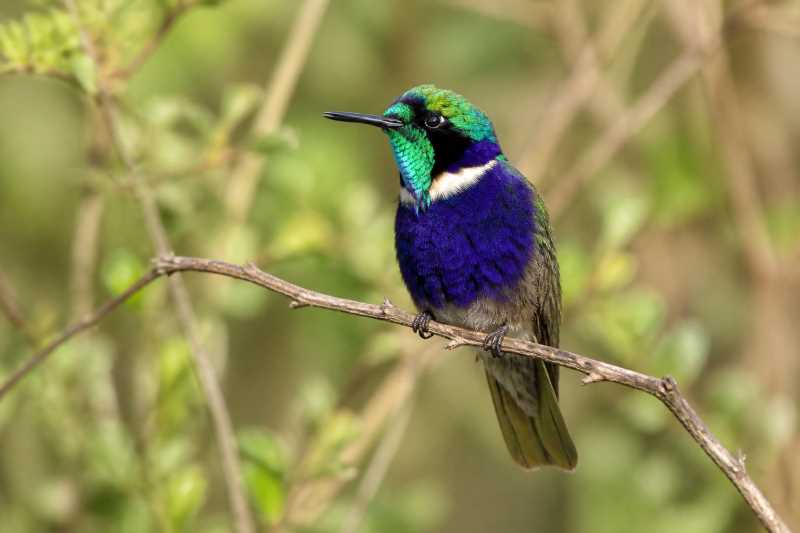
Adult males are particularly striking. The forehead and throat are bright golden-green, the upperparts are bronze-green, the belly is deep blue, and the sides of the neck carry elongated purplish-blue feathers forming a distinctive ruff. A pale cream, whitish or pinkish band separates the green throat from the blue lower breast and belly.
Females are less intensely coloured. They generally lack the male’s sharply defined dark throat border, and the blue on the underparts is more subdued and mottled. The outer tail feathers may show greyish tips. Males are usually slightly larger and have longer wings, tails and bills than females.
Range and Habitat
The species is endemic to Brazil and is concentrated in the Espinhaço Mountain Range of Minas Gerais. It occurs in areas including Serra do Cipó, Serra do Caraça and other highland localities with suitable campos rupestres. Its distribution is restricted and discontinuous, reflecting the naturally fragmented nature of these mountaintop habitats.
Hyacinth Visorbearers are typically found in rocky grassland, open scrub and flowering shrub communities at roughly 900–2,000 metres above sea level. They favour exposed upland vegetation rather than dense forest. The campos rupestres environment is characterised by shallow, nutrient-poor soils, rocky outcrops, strong sunlight, wind and marked temperature variation.
The species is considered resident rather than migratory, although local movements may occur in response to flowering conditions and the availability of food.
Where to See This Species
Serra do Cipó National Park, Minas Gerais, Brazil
Hyacinth Visorbearers have been documented in the campos rupestres of Serra do Cipó, including higher-elevation areas of the national park. Rocky scrub and flowering upland vegetation are the most promising habitats. Early morning visits and careful searching of exposed shrubs and perches are likely to be most productive.
Nearby accommodation: The village of Serra do Cipó, also known as Cardeal Mota, is the main gateway, with guest houses, small hotels, lodges, campsites and self-catering accommodation.
Santuário do Caraça Private Natural Heritage Reserve, Minas Gerais, Brazil
The species has been recorded in the Serra do Caraça region, where high-altitude campos rupestres and montane shrublands provide suitable habitat. It is most likely to be encountered in open upland areas rather than in the reserve’s forested valleys. Local guidance and current access conditions should be checked before visiting.
Nearby accommodation: The Santuário do Caraça has visitor accommodation, while the nearby towns of Catas Altas and Santa Bárbara provide additional guest houses, hotels and self-catering options.
Serra do Rola-Moça State Park, Minas Gerais, Brazil
The state park protects iron-rich grasslands and other upland habitats within the southern Espinhaço region. Government conservation material identifies the Hyacinth Visorbearer among the park’s characteristic endemic birds. Open rocky slopes and campo rupestre vegetation are the most relevant places to search.
Nearby accommodation: Belo Horizonte, Nova Lima and Brumadinho provide the widest choice of hotels, guest houses and self-catering accommodation, with smaller rural lodging options in surrounding communities.
Behaviour and Diet
The Hyacinth Visorbearer is active during the day and uses rapid wingbeats to hover at flowers and move between feeding patches. Males are territorial and may defend flowering shrubs from other hummingbirds. They often return to a few exposed perches from which they vocalise and watch their feeding territory.
Nectar from native shrubs, herbs, vines and other flowering plants forms the main part of the diet. The bird also takes small insects and spiders, which provide protein and other nutrients, particularly during breeding and when nectar supplies are reduced. By visiting flowers, it contributes to pollination within the campos rupestres ecosystem.
Breeding information is limited, but observations indicate that breeding can occur during the dry season. The female builds a small cup-shaped nest and is responsible for incubation and care of the young. Clutches generally contain two eggs. The nest is placed in a sheltered position among vegetation, where it is partly protected from wind and predators.
Identification Tips
- Look for a small, compact hummingbird in rocky highland scrub, usually near flowering plants.
- The adult male has a bright golden-green forehead and throat, a dark throat edge, a pale chest band, a deep blue belly and purplish-blue neck feathers.
- The male’s elongated neck feathers can give the head and upper breast a fringed or ruffed appearance.
- Females are duller, with less sharply defined throat markings and a more mottled blue-grey underside.
- The species is generally seen singly or in pairs, with males often conspicuous when perched on exposed twigs near flowers.
- The similar Hooded Visorbearer (Augastes lumachella) has a different distribution, being associated mainly with the Chapada Diamantina of Bahia. Range and plumage should therefore both be considered when identifying an Augastes hummingbird.
Conservation Status
The Hyacinth Visorbearer is currently assessed as Least Concern on the IUCN Red List. This classification does not mean that the species is free from risk. Its distribution is restricted, and suitable campos rupestres habitat is naturally fragmented.
The principal local threats include habitat loss and degradation caused by mining, road construction, urban expansion, agriculture, invasive vegetation, tourism pressure and inappropriate fire regimes. Mining is particularly significant in parts of the Espinhaço region because it can remove or fragment rocky grassland and iron-rich upland habitats.
Important conservation measures include maintaining protected areas, preventing the conversion of campos rupestres, managing fire appropriately, reducing damage from mining and roads, and protecting native flowering vegetation. Continued surveys are also valuable because the species’ local distribution and abundance are uneven across its range.
Frequently Asked Questions
Where does the Hyacinth Visorbearer live?
It lives in Brazil, mainly in high-elevation campos rupestres and open rocky scrub of the Espinhaço Mountain Range in Minas Gerais.
Is the Hyacinth Visorbearer migratory?
It is generally regarded as a resident species rather than a long-distance migrant. Local movements may occur when flowering conditions change.
What does the Hyacinth Visorbearer eat?
It feeds mainly on flower nectar and also takes small insects and spiders. Its visits to flowers make it an important pollinator of upland plants.
How can the male be recognised?
The male has a golden-green forehead and throat, a pale chest band, a deep blue belly and purplish-blue feathers along the sides of the neck.
Is the Hyacinth Visorbearer endangered?
The species is currently classified as Least Concern globally, although habitat loss, mining, fire and fragmentation remain important local conservation concerns.
References
- BirdLife International
- IUCN Red List of Threatened Species
- Bird Conservation International
Related posts