Introduction
The Spotted Dove (Spilopelia chinensis) is a medium-sized dove native to southern and eastern Asia and introduced to Australia, where it is now a familiar bird of suburbs, parks, gardens and modified rural landscapes. Its soft, repetitive cooing call and distinctive black-and-white spotted collar make it readily recognisable.
Physical Description
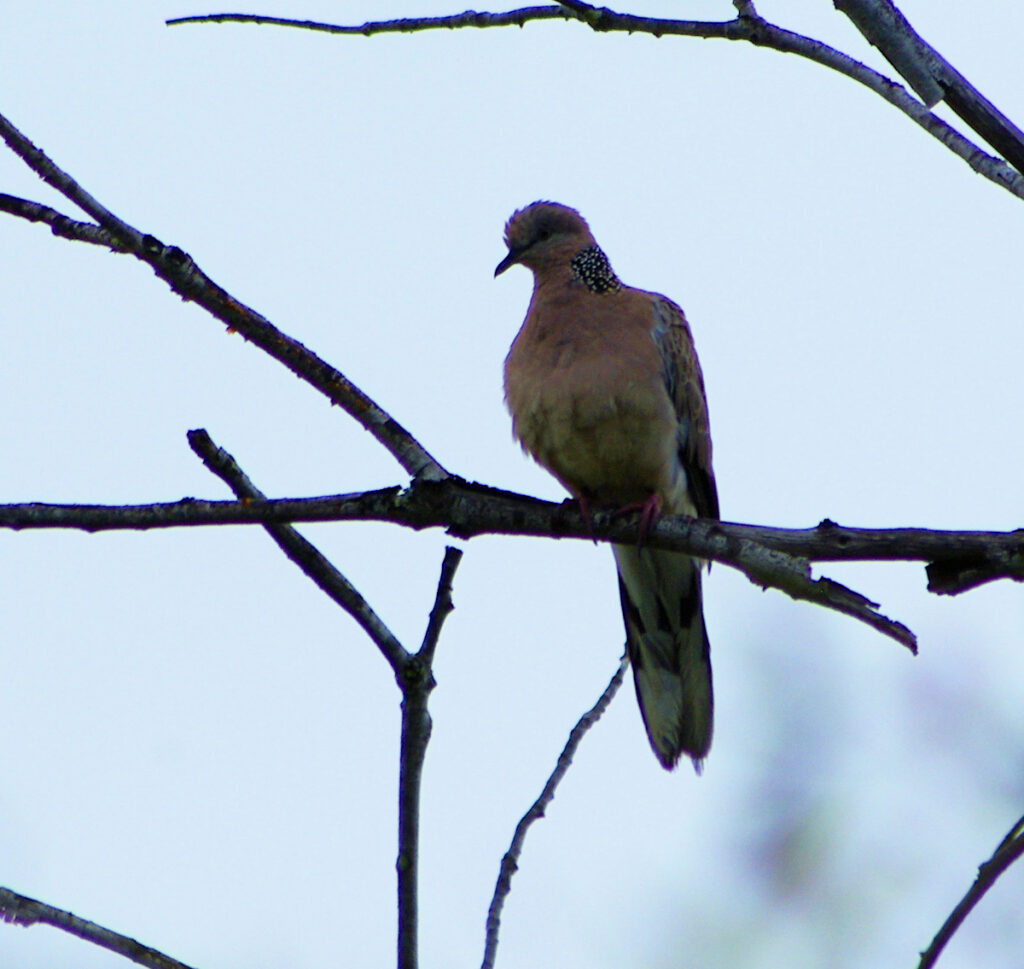
The Spotted Dove is approximately 30–33 centimetres long, with a slender body and a long, graduated tail. Adults are mainly grey-brown above, with darker centres to the back and wing feathers. The head is grey, while the underparts are grey-brown with a soft pink or vinous wash.
The most distinctive feature is the broad black patch on the hind-neck, marked with numerous white spots. The outer tail feathers have conspicuous pale or white tips, especially noticeable when the bird is in flight. The bill is dark and the legs and feet are pinkish.
Males and females are similar in appearance, with no reliable difference in overall plumage for normal field identification. Juveniles are duller and usually have a less contrasting, dark grey neck patch, with the white spotting developing as they mature.
Range and Habitat
The species is native to the Indian subcontinent and much of southern, eastern and south-eastern Asia. It has also been introduced to several regions outside its native range, including Australia.
In Australia, Spotted Doves were introduced during the 1860s and have become established mainly in settled areas. They occur along much of the eastern seaboard, as well as in parts of South Australia and Western Australia. They are most strongly associated with urban and suburban environments, although they also occur around farms, rural properties, open woodland, coastal scrub and disturbed vegetation.
Spotted Doves generally favour habitats that provide open ground for feeding and nearby trees, shrubs or buildings for perching and nesting. They are resident in Australia, although individual birds may move locally in response to food availability and seasonal conditions.
Where to See This Species
Sydney Olympic Park, New South Wales, Australia
Spotted Dove is included on the official fauna species list for Sydney Olympic Park. The park’s wetlands, grassed areas, landscaped grounds and urban edges provide the open feeding areas and shelter favoured by this introduced species. Look for birds on paths, lawns, around picnic areas and near vegetation bordering the parklands.
Nearby accommodation: Sydney Olympic Park and the surrounding Parramatta and inner-west districts offer hotels, serviced apartments, guest houses and other short-stay accommodation.
Kings Billabong Park, Victoria, Australia
Spotted Dove is recorded in the bird checklist for the Mallee Parks, including Kings Billabong Park. The park’s permanent wetlands, walking tracks, open grassy areas and adjoining settled landscapes provide suitable habitat. Early morning is a useful time to search for birds feeding on the ground or calling from trees and shrubs.
Nearby accommodation: Mildura is the nearest practical accommodation centre, with hotels, motels, self-catering accommodation, caravan parks and camping options.
Great Sandy National Park, Queensland, Australia
Spotted Dove is listed among the wildlife recorded in Great Sandy National Park. The species is most likely to be encountered around disturbed edges, campgrounds, open woodland, visitor areas and other locations close to human habitation rather than in the park’s more remote natural habitats.
Nearby accommodation: Rainbow Beach, Tewantin and Noosa provide hotels, holiday units, guest houses, camping areas and other accommodation suitable for visiting the park.
Behaviour and Diet
Spotted Doves are active during the day and are commonly seen alone, in pairs or in small groups. They usually walk across the ground while feeding, occasionally taking seeds from low vegetation, trees or shrubs. They can also gather where food is plentiful.
Their diet consists mainly of seeds, grains and other plant material. In Australia they may also eat fallen fruit, bird seed, bread and food available around farms or animal enclosures. Their use of food around human habitation helps explain their success in urban and suburban environments.
The call is a musical, repetitive series often rendered as “coo-croo” or “cocoo, crooor”. Calling may continue throughout the year, with increased vocal and courtship activity during breeding periods.
Spotted Doves may breed at any time of year in Australia, although breeding activity is often greatest from spring into early summer. The male may perform a steep display flight with loud wing-clapping before gliding down to a perch. Courtship also includes bowing and displaying the spotted neck patch.
The nest is a loose, shallow platform of fine sticks, grass and other plant material. It may be built in a tree, shrub or on a building. Both parents share incubation and care of the young. Two white eggs are usual, although nesting success can be affected by the fragile construction of the nest, predators and disturbance.
Identification Tips
- Look for a slim, long-tailed dove measuring about 30–33 centimetres.
- The black hind-neck patch covered with white spots is the key feature.
- Pale or white tail tips are conspicuous when the bird flies away.
- The overall colour is grey-brown and pinkish rather than strongly patterned across the entire body.
- Spotted Doves are often found walking on lawns, roadsides, paths and open ground near trees or buildings.
- The soft, repeated cooing call can reveal a bird before it is seen.
The Spotted Dove can be confused with other introduced doves in urban areas. It is distinguished from the smaller Zebra Dove by its spotted neck collar and lack of strong barring across the underparts. It differs from the larger, more heavily patterned Oriental Turtle Dove by its smaller size, paler appearance and spotted rather than barred neck markings.
Conservation Status
The Spotted Dove is listed globally as Least Concern on the IUCN Red List. It is widespread and common across much of its native range and has established introduced populations in several countries, including Australia.
In Australia it is a non-native species, with most records associated with urban, suburban and other modified habitats. It is not listed as a threatened species under Australian conservation legislation. Although the species is generally secure, local management may consider its effects as an introduced bird, including competition for food or space and potential damage to crops where large numbers occur.
Frequently Asked Questions
Where is the Spotted Dove found?
The Spotted Dove is native to southern and eastern Asia. In Australia it is an introduced species found mainly in towns, cities, parks, gardens, agricultural areas and other modified habitats, particularly along the eastern coast.
How can you identify a Spotted Dove?
The easiest field mark is the black patch on the hind-neck covered with white spots. The bird is grey-brown and pinkish underneath, has a long tail with pale tips and is usually about 30–33 centimetres long.
What does the Spotted Dove eat?
Spotted Doves mainly eat seeds and grains. They also take fallen fruit, weed seeds, bird seed, bread and other food scraps, particularly in urban and agricultural areas.
What does a Spotted Dove call sound like?
Its call is a soft, musical and repetitive coo, often described as “coo-croo” or “cocoo, crooor”. It may be heard from trees, shrubs, buildings and other elevated perches.
Where does the Spotted Dove build its nest?
It builds a loose platform of fine sticks in trees, shrubs or occasionally on buildings. The nest is often placed in dense foliage, and both parents incubate the eggs and care for the young.
Is the Spotted Dove native to Australia?
No. The Spotted Dove was introduced to Australia during the 1860s and has since become established, especially in urban and suburban areas of the eastern states and in parts of southern Australia.
References
- BirdLife Australia
- IOC World Bird List
- Parks Victoria and Queensland Parks and Wildlife Service
Related posts