Introduction
The Laughing Dove (Spilopelia senegalensis) is a small, long-tailed pigeon native to much of Africa, the Middle East and the Indian subcontinent. It is an introduced species in Australia, where an established population is centred mainly in the settled parts of south-western Western Australia, particularly around Perth. Its soft, bubbling call and distinctive chequered neck patch make it relatively easy to recognise.
Physical Description
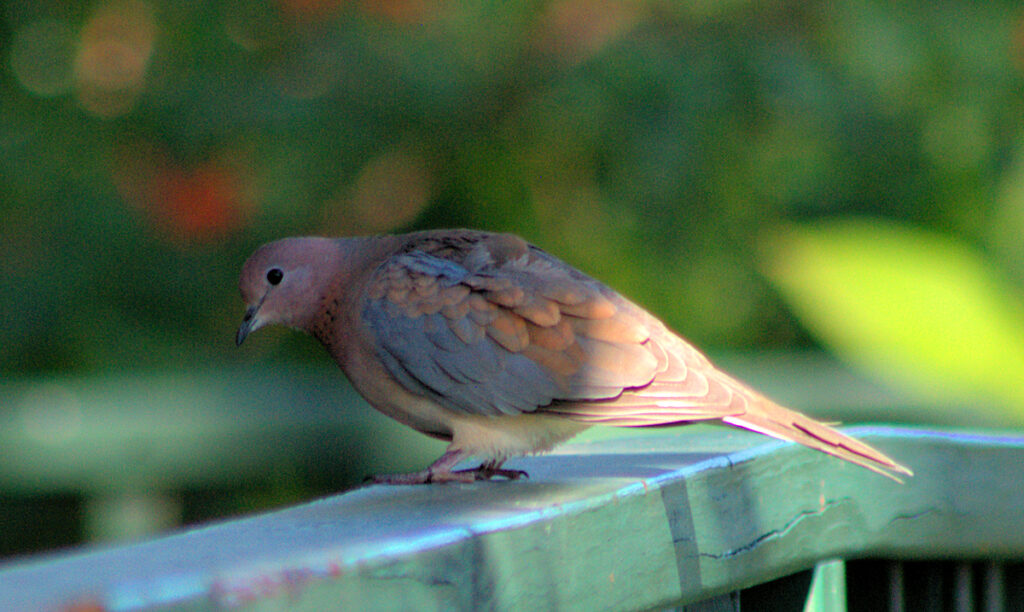
The Laughing Dove is a slim dove measuring approximately 25–27 centimetres in length. It has warm pinkish-brown to buff underparts, a grey-brown back, a blue-grey wing panel and a long, graduated tail with pale outer feathers.
Adults have a distinctive rufous-and-black chequered patch on the sides of the neck. The head and breast are softly pinkish or lilac-brown, while the lower belly is paler. The eyes are reddish to orange-red, and the bill is dark.
Males and females are very similar in appearance and are generally difficult to separate in the field. Young birds are duller and lack, or have less-developed, neck markings. Several geographical forms occur across the species’ broad native range, with differences in size and plumage tone.
Range and Habitat
The species’ native range extends from Senegal and other parts of sub-Saharan Africa across the Middle East and Arabia to India, Pakistan and parts of Central Asia. It is generally resident, although local movements may occur in response to water and food availability.
In Australia, the Laughing Dove was introduced to Perth in 1898 and subsequently became established in Western Australia. Australian records are concentrated in and around the Perth region and other settled parts of south-western Western Australia. The species has not become a widespread bird of eastern Australia, and claims that it is broadly established across South Australia and the Northern Territory should be treated with caution.
Laughing Doves are strongly associated with human-modified environments. They occur in suburban gardens, parks, farms, plantations, open woodland, cultivated areas and other places where trees, bare ground and reliable food or water are available. In their native range, they also use dry scrub, semi-desert, grassland, oases and village landscapes.
Where to See This Species
Kings Park and Botanic Garden, Western Australia, Australia
The official Birds of Kings Park and Botanic Garden guide lists the Laughing Dove as an introduced resident of the park. Look around the gardens, open grassy areas and edges where bushland meets maintained parkland, particularly during quieter morning periods. The species is more likely to be encountered in open, settled parts of the park than in dense bushland.
Nearby accommodation: Perth city and the surrounding inner-western suburbs provide hotels, guest houses, serviced apartments and self-catering accommodation.
Herdsman Lake, Western Australia, Australia
The public Herdsman Lake wildlife area has Laughing Dove included in its local bird list. The combination of open ground, lawns, scattered trees and wetland-edge habitat provides suitable feeding and resting areas. Check the paths, parkland and drier margins rather than concentrating only on the water itself.
Nearby accommodation: Perth’s northern inner suburbs and the central city provide hotels, guest houses, serviced apartments and self-catering accommodation.
Behaviour and Diet
Laughing Doves are usually seen alone, in pairs or in small groups. They spend much of their time walking on the ground while searching for food and may visit open lawns, tracks, cultivated ground and areas beneath trees. Their flight is fast and direct, with the long tail and pale outer feathers visible when they move away.
The call is a repeated series of soft, bubbling notes that can sound slightly like laughter. Calling birds may remain inconspicuous in trees, gardens or other nearby cover.
Seeds and grains form the main part of the diet. The species may also take small fruits and invertebrates, particularly where these are readily available. It commonly feeds close to human habitation and may use spilled grain or food around cultivated areas.
Breeding can occur over an extended period where conditions are favourable. The nest is a simple platform of twigs, usually placed in a tree, shrub or other elevated site. As in many pigeons and doves, both parents contribute to incubation and the care of the young.
Identification Tips
- Look for a small, slim dove with a notably long tail and soft pinkish-brown plumage.
- Check the sides of the neck for the adult’s rufous-and-black chequered patch.
- The pale outer tail feathers are often visible in flight.
- The red or orange-red eye can be noticeable at close range.
- The soft, bubbling call is a useful clue when the bird is hidden.
- In Western Australia, distinguish it from the larger Spotted Dove, which has a more obvious black-and-white spotted collar on the back and sides of the neck.
- The Laughing Dove is smaller and more delicately built than the Spotted Dove, with a longer-looking tail and a less heavily marked overall appearance.
Conservation Status
The Laughing Dove is assessed globally as Least Concern. It has a very large distribution and remains common in many parts of its native range.
In Australia, it is an introduced species rather than a native conservation priority. Its Australian population is concentrated mainly in south-western Western Australia. Available assessments have not demonstrated significant competition with native Australian birds for food or nest sites, although introduced species should still be monitored where local environmental effects are suspected.
The most appropriate conservation approach is to protect native habitats and avoid releasing captive birds. Monitoring established populations is also useful for detecting any future range expansion or ecological effects.
Frequently Asked Questions
Is the Laughing Dove native to Australia?
No. The Laughing Dove is native to Africa, the Middle East and the Indian subcontinent. It was introduced to Australia and became established in Western Australia.
Where is the Laughing Dove found in Australia?
It is found mainly in settled areas of south-western Western Australia, especially around Perth. It is not considered broadly established across the whole of Australia.
How can a Laughing Dove be identified?
Look for a small, long-tailed dove with pinkish-brown plumage, a blue-grey wing panel, pale outer tail feathers and a chequered rufous-and-black patch on the sides of the neck.
What does the Laughing Dove eat?
Its diet consists mainly of seeds and grains, supplemented by small fruits and invertebrates when available. It commonly feeds on the ground in open areas.
Why is it called a Laughing Dove?
The name refers to its soft, bubbling series of calls, which can sound faintly like laughter.
Is the Laughing Dove migratory?
It is generally a resident species. Local movements may occur, but it is not normally regarded as a long-distance migrant.
References
- Cornell Lab of Ornithology, Birds of the World
- BirdLife International and IUCN Red List of Threatened Species
- Botanic Gardens and Parks Authority, Birds of Kings Park and Botanic Garden
Related posts