Introduction
The Bar-shouldered Dove, Geopelia humeralis, is a medium-sized, long-tailed dove native to northern and eastern Australia and southern New Guinea. It is a mostly sedentary species of woodland, open country, mangroves and urban areas, and is often encountered on the ground in pairs or small groups. (australian.museum)
Physical Description
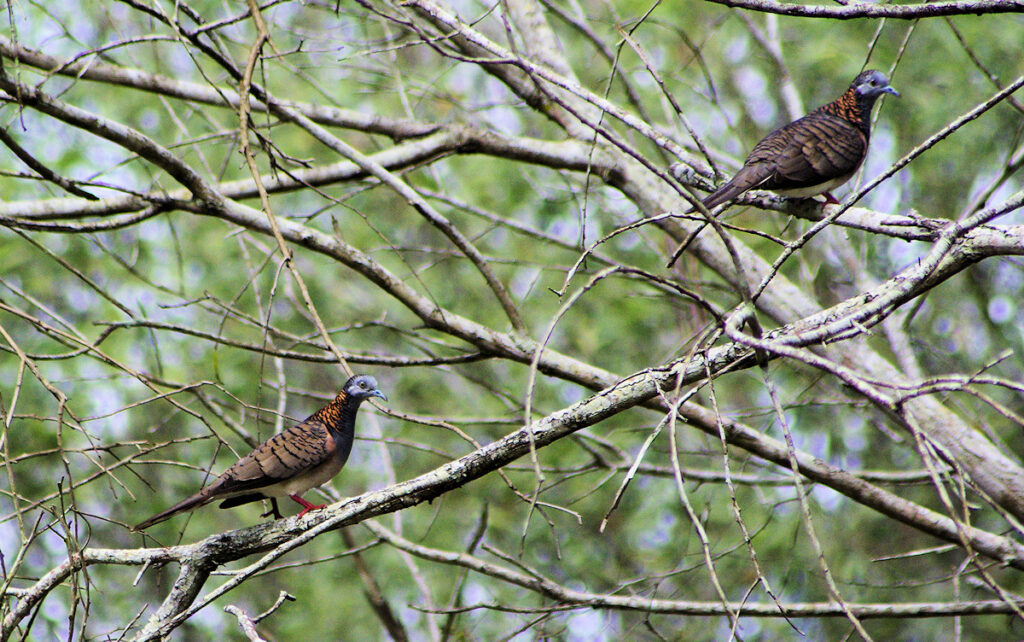
Bar-shouldered Doves measure approximately 27–30 centimetres in length. Adults have a blue-grey head, neck and upper breast, a reddish-bronze patch on the hindneck with dark barring, and a pale lower body. A pinkish bar across the lower breast is another useful feature. The wings and back are marked with darker barring, while the eye is reddish and surrounded by a blue-grey eye-ring. (australian.museum)
Males and females are similar in appearance. Young birds are generally duller and lack the strongly developed reddish-bronze hindneck patch and barring seen in adults. The northern subspecies Geopelia humeralis hedlandi is paler than other forms and is associated with the Pilbara region. (australian.museum)
Range and Habitat
The species occurs across humid and well-wooded parts of northern and eastern Australia, from near Onslow in Western Australia to the south coast of New South Wales near Bega. It also occurs in southern New Guinea. In Australia, it is especially familiar in the Top End and around towns such as Darwin and Cairns. (australian.museum)
Bar-shouldered Doves favour woodland with a grassy understorey, nearby open areas and reliable water. They also use mangroves, coastal vegetation, gardens, parklands and other urban habitats. Although the species can occur inland, it is often associated with waterside vegetation. The species is considered sedentary, with no evidence of major seasonal movements. (australian.museum)
Where to See This Species
Sandy Camp Road Wetlands, Queensland, Australia
Sandy Camp Road Wetlands near Brisbane is a realistic place to look for Bar-shouldered Doves. Recent birding records document the species at the site, where a mixture of wetland margins, open grass, shrubs and woodland provides suitable foraging and cover. Look on the ground near vegetation edges, particularly during quieter periods of the day. (ebird.org)
Nearby accommodation: Brisbane provides a wide range of hotels, guest houses, apartments and self-catering accommodation.
East Point Reserve, Northern Territory, Australia
East Point Reserve in Darwin supports Bar-shouldered Doves in parkland and rainforest habitats. The City of Darwin’s biodiversity surveys list the species as common at the reserve, making it one of the more dependable public places to look in the Darwin area. (darwin.nt.gov.au)
Nearby accommodation: Darwin is the nearest practical base, with hotels, apartments, guest houses, caravan parks and other visitor accommodation.
Behaviour and Diet
Bar-shouldered Doves are usually seen singly, in pairs or in small parties. They spend much of their feeding time on the ground, walking through short grass and open areas near protective cover. They mainly eat seeds from grasses, herbs and sedges, along with rhizomes and other plant material. They also need regular access to drinking water. (australian.museum)
Their call is distinctive and may be rendered as a repeated “cook coo cook coo”, sometimes followed by a bubbling, descending note. Breeding can occur throughout the year in northern Australia, while breeding in southern parts of the range is concentrated mainly between August and November. (australian.museum)
The nest is a thin platform of twigs and roots, usually placed in a fork or on a branch in a dense shrub, tree or garden. Two eggs are normally laid. Both parents incubate the eggs and feed the young, which receive crop milk, a nutritious secretion produced by the parent birds. Incubation lasts about 14 days, and the young remain in the nest for approximately 21 days. (australian.museum)
Identification Tips
Look for a medium-sized dove with a long tail, blue-grey head and breast, pale underparts and a reddish-bronze, darkly barred patch on the hindneck. The pinkish lower-breast bar and reddish eye surrounded by a blue-grey eye-ring are useful additional features.
The Bar-shouldered Dove is larger and more heavily built than the Diamond Dove. It can be distinguished from the Peaceful Dove by its larger size, reddish-bronze hindneck patch and more substantial appearance. The Peaceful Dove has more obvious black-and-white barring on the neck and is generally smaller. (australian.museum)
Conservation Status
The Bar-shouldered Dove is currently assessed as Least Concern. It remains common across much of its range and has adapted well to some modified environments, including agricultural landscapes, gardens and urban parklands. No major population decline is established in the sources consulted. (device.report)
The species nevertheless depends on suitable woodland, grass cover, water sources and nesting vegetation. Maintaining native vegetation around wetlands, waterways and urban reserves helps preserve feeding and breeding habitat. In the Northern Territory, native wildlife is protected and permits may be required for activities involving wild birds. (nt.gov.au)
Frequently Asked Questions
Where can Bar-shouldered Doves be found?
They occur in northern and eastern Australia, from the Pilbara and Top End through Queensland to eastern New South Wales, as well as in southern New Guinea.
What habitat does the Bar-shouldered Dove prefer?
It favours woodland with grassy ground cover, open areas near vegetation, mangroves, coastal habitats, gardens and urban parklands, usually close to water.
What does the Bar-shouldered Dove eat?
Its diet consists mainly of seeds from grasses, herbs and sedges, together with rhizomes and other plant material gathered from the ground.
Do Bar-shouldered Doves migrate?
They are generally sedentary. There is no evidence of major seasonal migration, although local movements may occur in response to food and water availability.
How many eggs does a Bar-shouldered Dove lay?
The usual clutch is two eggs. Both parents incubate the eggs and care for the young after hatching.
How can a Bar-shouldered Dove be identified?
Look for its blue-grey head and breast, pale lower body, reddish-bronze barred hindneck patch, pinkish lower-breast bar, reddish eye and long tail.
References
- Australian Museum
- IUCN Red List of Threatened Species
- City of Darwin
Related posts