Introduction
Allen’s Hummingbird (Selasphorus sasin) is a small Pacific Coast hummingbird recognised for its coppery-orange and green plumage, rapid hovering flight and energetic territorial behaviour. It breeds mainly in coastal Oregon and California. Some populations migrate to western Mexico, while the southern subspecies, S. s. sedentarius, is resident in southern California and on the Channel Islands.
Physical Description
Allen’s Hummingbird is approximately 7.5 to 9 cm long. It has a slender, straight bill, a compact body and a short, pointed tail.
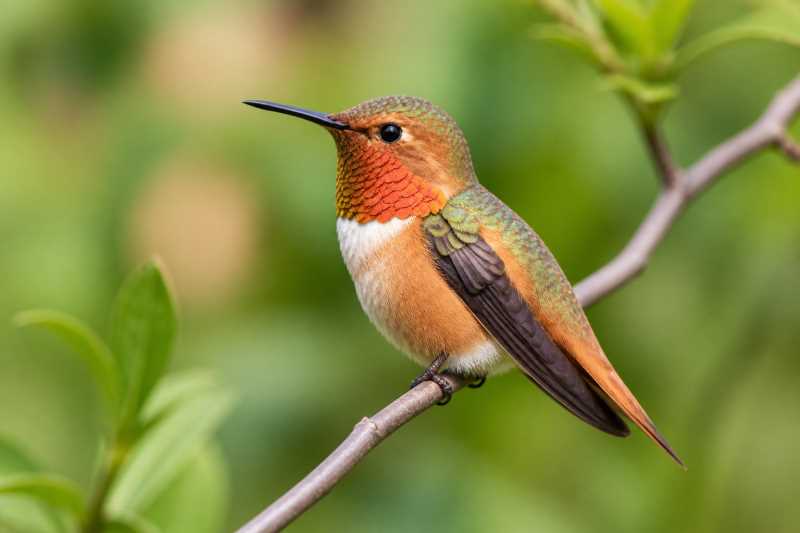
The adult male has a green back and crown, rufous flanks, rump and tail, and an iridescent orange-red gorget. The female is mainly green above, with rufous colouring concentrated on the flanks, rump and tail. Her throat is pale or lightly spotted rather than brightly coloured. Juveniles resemble females, although young males gradually develop colour in the throat and may be difficult to separate from female or immature Rufous Hummingbirds.
The resident Channel Islands subspecies is generally larger than mainland birds, with relatively longer wings, tail and bill.
Range and Habitat
Allen’s Hummingbird breeds in a narrow coastal belt from southern Oregon through much of coastal California, extending southwards into the Los Angeles region. During migration, it may occur more widely through California and parts of the south-western United States. The migratory nominate subspecies winters mainly along the Pacific coast of central Mexico.
The subspecies Selasphorus sasin sedentarius is largely non-migratory. It occurs on the Channel Islands, except Santa Barbara Island, and has expanded onto the southern California mainland, particularly around Los Angeles and Orange counties.
Breeding habitat includes coastal scrub, chaparral, riparian woodland, mixed evergreen woodland, oak woodland, eucalyptus and cypress groves, forest edges and well-planted gardens. Males often occupy open territories, while females select denser vegetation for nesting. The species is generally associated with low elevations near the coast, although local habitat use varies across its range.
Where to See This Species
Channel Islands National Park, California, United States
The Channel Islands support the resident subspecies S. s. sedentarius. The birds occur on most islands within the national park, particularly in coastal scrub, mixed shrubland and wooded canyon habitats. They can be present throughout the year, although access to individual islands requires advance planning and transport arrangements.
Nearby accommodation: Ventura is the main mainland gateway, with hotels, guest houses, campsites and other visitor accommodation. Camping is also available on some islands subject to park regulations and reservations.
Presidio of San Francisco, California, United States
The Presidio provides documented habitat for breeding Allen’s Hummingbirds. Look in dune scrub, dense woodland, eucalyptus, Monterey pine and Monterey cypress habitats, as well as around flowering ornamental plants. The species is reported in spring, summer and autumn and may be found around sheltered, vegetated areas such as El Polin Spring.
Nearby accommodation: San Francisco offers a wide range of hotels, guest houses, hostels and self-catering accommodation close to the park.
Henry Cowell Redwoods State Park, California, United States
Allen’s Hummingbird is included on the park’s bird list. The combination of redwood forest, riparian vegetation, woodland edges and flowering plants provides suitable cover and feeding habitat. Quiet observation around forest margins and streamside vegetation is most productive, particularly during the breeding and migration seasons.
Nearby accommodation: Felton and Santa Cruz are practical bases, with hotels, guest houses, cabins, campsites and self-catering accommodation available in the surrounding area.
Behaviour and Diet
Allen’s Hummingbirds feed mainly on nectar from flowering plants. They also take small insects and spiders, which provide protein and other nutrients. Individuals may visit flowers while hovering, or perch nearby before making short feeding flights.
Males are strongly territorial and may chase other hummingbirds, insects and occasionally much larger birds from feeding or breeding areas. A male commonly perches on an exposed branch before performing a display flight consisting of rapid pendulum-like movements, a steep ascent and a high-speed dive. The dive may produce a sharp sound from the tail feathers.
The female builds the nest and provides all parental care. The small cup-shaped nest is made from plant fibres and other soft materials, bound with spider silk and often decorated with lichen. It is usually placed in a shrub, vine or tree in dense vegetation. Two white eggs are normally laid, and the chicks leave the nest at approximately three weeks of age. The female continues feeding the fledglings for a period after they leave the nest.
Identification Tips
- Look for a small hummingbird with a green back, rufous sides and a short, pointed tail.
- Adult males show a brilliant orange-red throat that can appear dark or dull when not catching the light.
- Females and juveniles have green upperparts, rufous sides or tail bases, and a pale or spotted throat.
- In suitable coastal habitat, a male perched conspicuously above scrub or woodland may be an Allen’s Hummingbird.
- Rufous Hummingbirds are the principal identification challenge. Females and juveniles of the two species can be extremely difficult to separate, and some individuals are best recorded as an unidentified Selasphorus unless tail and structural details are clearly visible.
- Geographic location and season can help, but they should not replace close examination. In southern California, resident Allen’s Hummingbirds are more likely, while migrating birds farther north may require particularly careful identification.
Conservation Status
Allen’s Hummingbird is classified as Least Concern on the IUCN Red List. The species has a restricted coastal range, and some populations face habitat loss and fragmentation caused by urban development, vegetation clearance and changes to flowering resources. These pressures are especially relevant where coastal scrub and riparian habitats are reduced.
Maintaining native flowering plants, protecting nesting cover, conserving coastal scrub and riparian woodland, and reducing pesticide use can benefit local populations. Population patterns may differ between the migratory mainland subspecies and the resident southern California subspecies, so broad conclusions about trends should be treated cautiously.
Frequently Asked Questions
Where does Allen’s Hummingbird live?
It breeds mainly along the Pacific coast from southern Oregon through California. Some birds migrate to western Mexico, while the southern resident subspecies remains year-round in southern California and on the Channel Islands.
What does an Allen’s Hummingbird look like?
The male has a green back, rufous sides and an iridescent orange-red throat. Females and juveniles are mostly green above, with rufous in the flanks and tail, and lack the male’s bright gorget.
What does Allen’s Hummingbird eat?
It feeds primarily on flower nectar and supplements this diet with small insects and spiders. Insects are especially important as a source of protein during breeding.
When is the best time to see Allen’s Hummingbird?
Spring and summer are generally productive in the breeding range, while migration can provide additional opportunities in coastal California. Resident birds in southern California and on the Channel Islands may be seen throughout the year.
How can Allen’s Hummingbird be distinguished from a Rufous Hummingbird?
Adult males are usually easier to identify, but females and juveniles can be nearly identical. Green on the back, structural details of the tail and bill, location, season and close views are useful, although some birds cannot be identified confidently in the field.
References
- Cornell Lab of Ornithology
- National Park Service
- IUCN Red List of Threatened Species
Related posts