Introduction
The Black Swan, Cygnus atratus, is a large waterbird native to Australia, including Tasmania. It is also established in New Zealand, where its presence reflects both deliberate introductions and natural colonisation. The species is recognised for its predominantly black plumage, bright red bill and conspicuous white flight feathers. Unlike many waterfowl, Black Swans are largely nomadic, moving between wetlands as water levels, rainfall and food availability change. (ww.worldbirdnames.org)
Physical Description
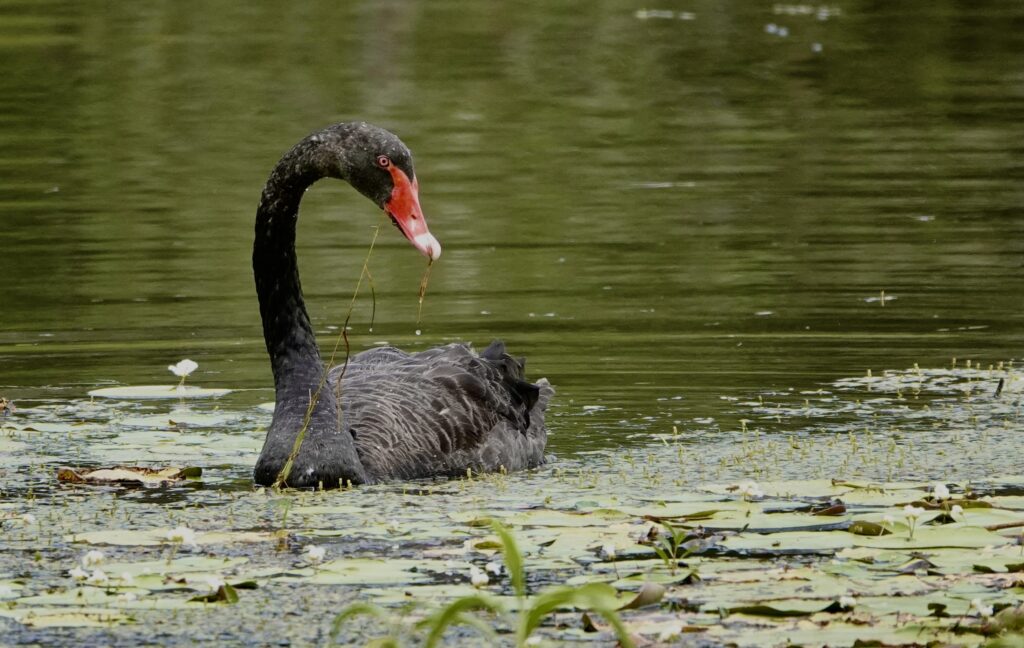
Adult Black Swans measure approximately 110–140 centimetres in length, with a wingspan of about 160–200 centimetres. Males are generally larger than females, although the sexes are similar in colour and pattern. Adult plumage is mainly black, sometimes with a brownish wash, while the primary flight feathers are white and become especially obvious when the bird flies or raises its wings.
The bill is bright red, with a pale or white terminal band and tip. The eyes are reddish, and the legs and feet are dark grey. The folded wings may show curled or upturned tertial feathers, particularly in displaying birds. Juveniles are mottled grey-brown rather than black and have a duller bill. Complete adult plumage is reached at approximately three years of age. (absa.asn.au)
Range and Habitat
Black Swans occur widely across Australia, particularly in the south-east and south-west, Tasmania and suitable inland wetlands following periods of heavy rain. They inhabit freshwater lakes, rivers, lagoons, billabongs, swamps, estuaries and sheltered coastal waters. They may also graze on adjoining pasture when aquatic vegetation is inaccessible or depleted.
The species is highly mobile rather than conventionally migratory. Individuals and flocks may travel considerable distances in response to drought, flooding, changing water levels and the availability of submerged plants. In New Zealand, Black Swans are widespread and common, especially on larger inland and coastal lakes. They were introduced during the nineteenth century, and evidence also indicates natural immigration from Australia. Escaped or released birds may occur elsewhere, but these records should not be confused with the species’ native range. (nzbirdsonline.org.nz)
Behaviour and Diet
Black Swans are social birds and may gather in large flocks on productive lakes, estuaries and coastal waters. Pairs often remain recognisable within flocks, and family groups may associate with other birds. They communicate with bugling or trumpeting calls, wing noises and defensive hissing. Courtship and social displays can include head movements, mutual calling, synchronised swimming and wing-raising.
The species is primarily herbivorous. Its diet includes submerged freshwater plants such as Ruppia, Egeria, Elodea, Potamogeton and Myriophyllum, as well as seagrasses such as Zostera in suitable estuarine habitats. Black Swans feed by dipping or plunging their long necks underwater. They also graze on grasses and other vegetation along wetland margins and nearby pasture.
Breeding can occur at different times of year across the range, depending on rainfall, water conditions and food supply. Pairs usually build a nest close to water, sometimes in shallow water or on a small island. Both sexes help with nest construction and incubation. A typical clutch contains four to ten eggs, most often five or six, and incubation generally lasts about 35–45 days. The downy cygnets are mobile soon after hatching and are cared for by both parents. (nzbirdsonline.org.nz)
Identification Tips
Look for the following combination of features:
- A large, long-necked swan with predominantly black plumage.
- Bright red bill with a pale or white band and tip.
- White flight feathers that are highly visible in flight or during wing displays.
- Reddish eyes and dark grey legs.
- Juveniles that appear grey-brown and lack the strong adult colour contrast.
The Black Swan is unlikely to be confused with other regularly occurring Australian swans. In New Zealand, its black body, white flight feathers and red bill readily distinguish it from introduced white swans. At a distance, the species may appear entirely black when resting on water, so the bill colour and body shape are useful confirmation features.
Conservation Status
The Black Swan is currently assessed as Least Concern globally. Its broad distribution, large and adaptable populations and ability to use a wide range of wetlands support this assessment. A reliable global population estimate is not required for identification and is not stated here because figures vary between sources and regions.
Local populations can nevertheless be affected by wetland drainage, habitat modification, drought, reduced water quality, disturbance and the loss of submerged aquatic vegetation. Conservation priorities include protecting wetlands, maintaining environmental water flows, reducing pollution and managing important breeding and feeding areas. In New Zealand, regional management may also be required where high concentrations of swans create conflicts with agriculture or wetland objectives. (datazone.birdlife.org)
Frequently Asked Questions
Where is the Black Swan found?
The Black Swan is native to Australia, including Tasmania, and is widespread in suitable wetlands across the continent. It is also established throughout much of New Zealand, where both introduced and naturally arriving birds have contributed to present-day populations.
What does a Black Swan eat?
Black Swans mainly eat submerged aquatic plants, algae and seagrasses. They also graze on grasses and other vegetation along wetland margins, particularly when aquatic food is unavailable.
Are male and female Black Swans different?
The sexes have similar plumage, but males are usually larger, with a longer and heavier bill and a longer neck. These differences are most useful when a pair is observed closely or side by side.
How long do Black Swan eggs take to hatch?
Incubation usually lasts about 35–45 days. Both parents participate in incubation and care for the cygnets after hatching.
Can Black Swans fly?
Yes. Despite their large size, Black Swans are strong fliers. Their white flight feathers become especially conspicuous when they take off or fly over water.
Are Black Swans endangered?
No. The species is currently classified as Least Concern globally. Local wetland degradation, drought, pollution and disturbance can still affect regional populations and breeding success.
References
- BirdLife Australia. 2023. Handbook of Australian, New Zealand and Antarctic Birds Online. BirdLife Australia. Available at: https://hanzab.birdlife.org/ (accessed 8 September 2026).
- BirdLife International. n.d. Black Swan, Cygnus atratus, species profile. BirdLife DataZone. Available at: https://datazone.birdlife.org/species/factsheet/black-swan-cygnus-atratus (accessed 8 September 2026).
- Gill, F., Donsker, D. and Rasmussen, P. (eds). 2026. IOC World Bird List, version 15.2. International Ornithologists’ Union. Available at: https://www.worldbirdnames.org/ (accessed 8 September 2026).
- Hardy, J. W. 2021. Black Swan, Cygnus atratus: Bird in the Hand, Second Edition, New Zealand species. Australian Bird Study Association. Available at: https://absa.asn.au/wp-content/uploads/2021/12/Black-Swan-BIH2-NZ.pdf (accessed 8 September 2026).
- Marchant, S. and Higgins, P. J. (eds). 1990. Handbook of Australian, New Zealand and Antarctic Birds. Volume 1: Ratites to Ducks, Part A. Melbourne: Oxford University Press.
- Williams, M. J. 2013, updated 2023. “Black Swan | Kakīānau.” In Miskelly, C. M. (ed.), New Zealand Birds Online. Available at: https://www.nzbirdsonline.org.nz/species/black-swan (accessed 8 September 2026).
Related posts