Introduction
The Palawan Peacock-Pheasant (Polyplectron napoleonis) is a ground-dwelling pheasant endemic to the island of Palawan in the Philippines. Also known locally as the tandikan, it is recognised for the male’s iridescent plumage and conspicuous eye-like markings. The species is restricted to forest habitats and is considered Vulnerable because of habitat loss, hunting and capture for trade.
Physical Description
The Palawan Peacock-Pheasant is a medium-sized bird, reaching approximately 50 centimetres in length. It has a relatively compact body, strong legs and a long, graduated tail suited to life on the forest floor.
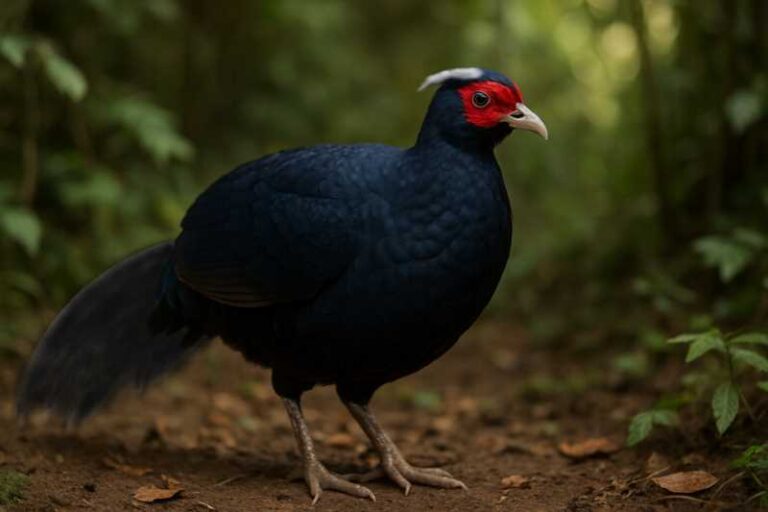
Adult males are dark bluish-black or brownish-black, with an iridescent blue-green crest and glossy plumage. The tail is marked with metallic blue and green ocelli, or eye-like spots, which become especially conspicuous when the tail is fanned during courtship. The face also has contrasting pale markings that help distinguish the species.
Females are smaller and much duller, with mottled brown plumage that provides camouflage among leaf litter, roots and dense undergrowth. Young birds are less vividly marked than adult males and generally resemble the more cryptic female plumage during early development.
Range and Habitat
The Palawan Peacock-Pheasant is endemic to Palawan, Philippines, and is not naturally migratory. Its distribution is fragmented across suitable forest on the island, with records from lowland and foothill areas and from some forested mountain sites.
It occurs mainly in primary and secondary forest with dense understorey, including forest on flat or gently rolling ground. Historical accounts describe the species from near sea level to approximately 600 metres, with some more recent habitat assessments recording suitable habitat at elevations approaching 800 metres. Although it can persist in secondary forest, extensive clearing, logging and other disturbance reduce the quality and continuity of its habitat.
Where to See This Species
Puerto Princesa Subterranean River National Park, Palawan, Philippines
The Puerto Princesa Subterranean River National Park is a documented site for the Palawan Peacock-Pheasant and protects extensive forest on the western coast of Palawan. The species is associated with the park’s relatively intact forest and dense understorey, but it is elusive and sightings are not guaranteed. Quiet forest edges and trails may offer the best opportunities, particularly with an experienced local guide.
Nearby accommodation: Sabang is the practical gateway settlement, with lodges, guest houses and small hotels serving visitors to the national park. Puerto Princesa offers a wider choice of hotels and other accommodation.
Behaviour and Diet
The Palawan Peacock-Pheasant is primarily terrestrial and spends much of its time moving quietly through dense vegetation and leaf litter. It is generally difficult to observe because it keeps to cover and may retreat before a person approaches.
Its diet is omnivorous. Reported food items include seeds, fruits and other plant material, together with invertebrates such as insects, worms and slugs. Foraging takes place mainly on or close to the forest floor.
Males use their ornamental plumage in courtship displays, including fanning the tail and showing the iridescent ocelli. Information on nesting and breeding in the wild remains limited, so detailed claims about clutch size, nesting dates and mating system should be treated cautiously.
Identification Tips
- Look for a compact, pheasant-like bird walking through dense forest undergrowth rather than flying through the canopy.
- An adult male shows a dark glossy body, an iridescent blue-green crest and prominent eye-like markings on the tail.
- The female is smaller and predominantly mottled brown, making her considerably harder to detect.
- A male displaying with its tail spread is distinctive, but the species is more often encountered briefly or heard moving through vegetation.
- Do not confuse the species with introduced domestic fowl or other pheasants in captivity. In its natural range, its combination of dark iridescent plumage, crest and blue-green tail ocelli is distinctive.
Conservation Status
The Palawan Peacock-Pheasant is classified as Vulnerable on the IUCN Red List of Threatened Species. Its population is considered to be declining, although a precise current population estimate should not be assumed without referring to the latest assessment.
The main threats are the loss and fragmentation of forest, logging, agricultural expansion, mining and hunting. Capture for the illegal wildlife trade is also a concern. Habitat degradation can isolate local populations and reduce access to food, cover and breeding areas.
Important conservation measures include protecting remaining lowland and foothill forest, improving management of protected areas, preventing hunting and trapping, monitoring populations and supporting local enforcement. The Puerto Princesa Subterranean River National Park and other protected forests provide important habitat, but continued protection and field surveys remain necessary.
Frequently Asked Questions
Where is the Palawan Peacock-Pheasant found?
It is endemic to Palawan in the Philippines. The species occurs in scattered areas of suitable forest, particularly lowland, foothill and some lower mountain forests.
Is the Palawan Peacock-Pheasant endangered?
The species is classified as Vulnerable, rather than Endangered, on the IUCN Red List. It is nevertheless at risk from habitat loss, hunting and capture for trade.
What does the Palawan Peacock-Pheasant eat?
It eats a mixture of plant and animal food, including seeds, fruits, other plant material, insects, worms and slugs.
How can a male Palawan Peacock-Pheasant be identified?
The male has dark glossy plumage, an iridescent blue-green crest and a tail decorated with metallic blue-green ocelli. These markings are most obvious when the tail is fanned during display.
Can the Palawan Peacock-Pheasant fly?
Yes. Although it spends much of its time on the ground, it can fly, particularly when escaping danger or moving through forest. It usually remains secretive and close to cover.
Where is a realistic place to look for this species?
Puerto Princesa Subterranean River National Park is a documented site. Visitors should search quietly in suitable forest with a local guide, while recognising that this elusive bird is not guaranteed to appear.
References
- IUCN Red List of Threatened Species
- IOC World Bird List
- Puerto Princesa Subterranean River National Park
Related posts