Introduction
The Bolivian Red Howler (Alouatta sara) is a fascinating species of New World monkey that inhabits the lush forests of Bolivia. Known for their distinctive vocalizations, these primates play a crucial role in their ecosystem. As a member of the Alouatta genus, the Bolivian Red Howler is closely related to other howler monkeys, characterized by their loud calls that can be heard over long distances. This article delves into the unique aspects of the Bolivian Red Howler, covering its physical description, habitat, behavior, and conservation status.
Physical Description
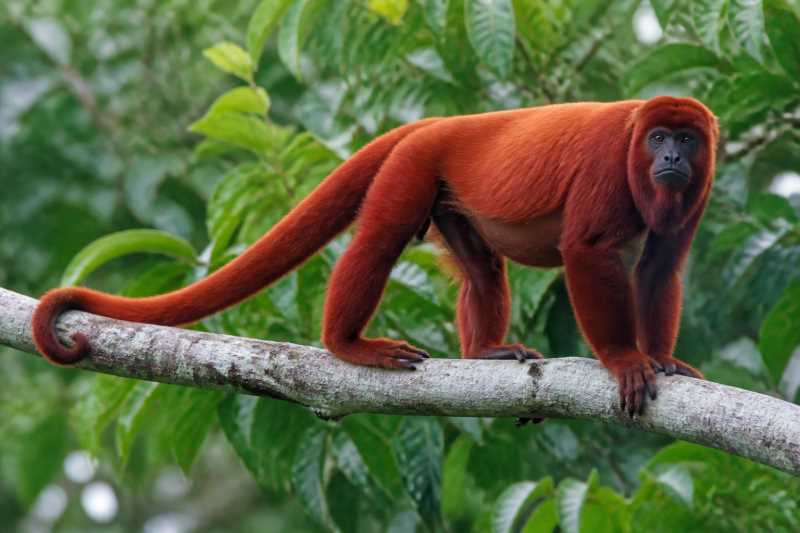
The Bolivian Red Howler is a large primate, with males typically weighing between 6 to 9 kilograms and females slightly smaller at 4.5 to 7 kilograms. Their bodies are robust and stocky, with a prehensile tail that is often as long as their head and body combined, approximately 40 to 70 centimeters. This tail is an essential tool for grasping branches as they navigate their arboreal habitat.
Their fur is a vibrant reddish-brown, which provides excellent camouflage among the leaves and branches of the forest canopy. The males and females are similar in coloration, although males tend to be slightly larger. One of the most striking features of the Bolivian Red Howler is their large throat sac, which is an adaptation for their impressive vocalizations. This sac allows them to produce deep, resonating calls that can travel up to three miles in dense forest.
Range and Habitat
Alouatta sara is primarily found in the tropical and subtropical forests of Bolivia, although their range extends slightly into neighboring regions of Brazil and Peru. They inhabit a variety of forest types, including rainforests, dry forests, and gallery forests along rivers. These monkeys prefer the upper canopy, where they can move effortlessly among the branches and find abundant food sources.
The dense forest canopy provides not only food but also protection from predators. It is essential for their survival, as it offers a complex three-dimensional environment where they can forage, rest, and socialize. The presence of continuous forest tracts is crucial for maintaining viable populations of Bolivian Red Howlers.
Behavior and Diet
Bolivian Red Howlers are social animals, living in groups that typically consist of 5 to 10 individuals, though larger groups have been observed. These groups are usually composed of several females, their offspring, and a few males. The social structure is relatively flexible, with individuals occasionally moving between groups.
Their diet is primarily folivorous, meaning they mainly consume leaves. However, they are also known to eat fruits, flowers, and nuts when available. This diverse diet is essential for obtaining the necessary nutrients and energy, as leaves alone often provide insufficient nutrition. The Bolivian Red Howler’s digestive system is highly specialized for breaking down tough cellulose found in leaves, thanks to an enlarged colon and specialized gut flora.
Howlers are most active during the early morning and late afternoon, spending the hottest parts of the day resting in the shade to conserve energy. Their vocalizations serve multiple purposes, including territorial defense and communication between group members. The iconic howls are most frequently heard at dawn and dusk, as groups establish their presence and boundaries.
Identification Tips (Field Recognition Cues)
Identifying the Bolivian Red Howler in the wild involves recognizing several key features:
- Vocalizations: Listen for their loud, resonant howls, which are a signature of their presence.
- Coloration: Look for the distinct reddish-brown fur that blends well with the forest canopy.
- Size and Shape: Note the robust, stocky build and long, prehensile tail used for grasping branches.
- Throat Sac: Observe the prominent throat sac in males, used to amplify their calls.
- Behavior: Watch for group dynamics and movement in the upper canopy, where they spend most of their time.
Conservation Status (With Threats and Protections)
The International Union for Conservation of Nature (IUCN) currently lists the Bolivian Red Howler as Near Threatened. The primary threats to this species include habitat destruction and fragmentation due to agricultural expansion, logging, and infrastructure development.
Conservation efforts are focused on habitat preservation and restoration, as well as establishing protected areas to ensure the survival of this species. Organizations are also working to raise awareness about the importance of conserving primate habitats and the ecological roles these animals play.
In Bolivia, some national parks and reserves provide sanctuary for the Bolivian Red Howler, offering protection from hunting and habitat destruction. Continued research and monitoring are vital to understanding population trends and implementing effective conservation strategies.
Frequently Asked Questions
What do Bolivian Red Howlers eat?
Bolivian Red Howlers primarily eat leaves, but they also consume fruits, flowers, and nuts when available. Their diet is adapted to their arboreal lifestyle and the resources available in their forest habitats.
How do Bolivian Red Howlers communicate?
These monkeys communicate through a series of loud howls that can be heard over long distances. These vocalizations serve to establish territory, coordinate group movements, and maintain social bonds.
Where can I see Bolivian Red Howlers?
They are primarily found in the forests of Bolivia, particularly in protected areas such as national parks and reserves. Observing them often requires visiting dense forest habitats where they reside in the upper canopy.
What threats do Bolivian Red Howlers face?
The main threats include habitat destruction and fragmentation due to human activities such as agriculture, logging, and infrastructure development. Conservation efforts aim to mitigate these threats through habitat protection and restoration.
Are Bolivian Red Howlers endangered?
They are currently classified as Near Threatened by the IUCN, indicating that they face significant risks but are not yet considered endangered. Conservation efforts are crucial to prevent further decline.
Related posts