The Veery (Catharus fuscescens): An Enigmatic Songbird of the Americas
The Veery (Catharus fuscescens) is a modestly adorned yet melodiously gifted bird, captivating ornithologists and bird enthusiasts alike with its ethereal song and intriguing migratory patterns. As a member of the thrush family, the Veery is closely related to other notable songbirds such as the American Robin and the Wood Thrush. This article explores the Veery’s habitat, behavior, migratory journey, and the conservation challenges it faces, underscoring the ecological significance of this remarkable avian species.
Habitat and Distribution
The Veery predominantly inhabits deciduous and mixed forests across North America. Its breeding range extends from southern Canada through the northern United States, often favoring moist, densely vegetated areas such as wetlands, riparian zones, and forest edges. During the breeding season, these environments provide an abundance of insects and fruits, which are crucial components of the Veery’s diet.
In the non-breeding season, Veeries migrate to South America, with significant populations wintering in the Amazon Basin regions of Brazil and surrounding countries. This intercontinental journey is one of the most fascinating aspects of the Veery’s life cycle, highlighting its remarkable adaptability and navigational skills.
Physical Characteristics
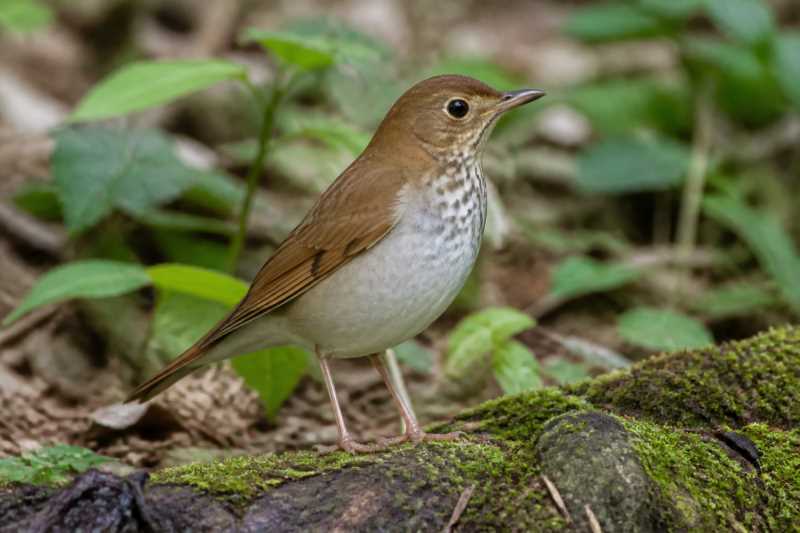
Veeries are medium-sized thrushes, measuring approximately 16-18 centimeters in length with a wingspan of 28-30 centimeters. They typically weigh around 30 grams. The species is characterized by its warm reddish-brown upperparts, which contrast with its white underparts. The breast is subtly spotted with light brown, and the bird’s overall appearance is less striking than some of its thrush relatives. However, its understated plumage serves as effective camouflage in its leafy habitat.
Vocalizations and Behavior
One of the Veery’s most distinguishing features is its song, which consists of a series of ethereal, downward-spiraling phrases. The song is often described as both haunting and enchanting, contributing to the bird’s allure and making it a sought-after subject for birdwatchers and audio recordists.
Veeries are primarily ground foragers, feeding on a diet that includes a variety of insects, spiders, and small fruits. During the breeding season, their diet shifts more towards protein-rich insects, which are essential for feeding their young. The birds employ a methodical foraging strategy, hopping through leaf litter and using their keen eyesight to spot prey.
Breeding and Nesting
The Veery’s breeding season occurs from late spring to mid-summer. Males typically arrive at breeding grounds ahead of females to establish territories, which they defend vigorously through song and displays. Once paired, the female constructs a nest close to the ground, often in a shrub or small tree. The nest is a cup-like structure made of grasses, twigs, and leaves, lined with softer materials.
A typical clutch consists of 3-5 pale blue eggs, which the female incubates for about 10-14 days. Both parents participate in feeding the nestlings, which fledge approximately 10-12 days after hatching. Veeries may produce one or two broods per season, depending on environmental conditions and food availability.
Migration and Navigation
The Veery is renowned for its long-distance migratory journey, which spans thousands of miles between its breeding and wintering grounds. This journey is fraught with challenges, including adverse weather conditions, habitat loss, and predation.
Recent studies have shed light on the Veery’s remarkable navigational abilities. Research suggests that these birds utilize the Earth’s magnetic field as a guide, along with visual landmarks and celestial cues. The exact mechanisms of their navigation remain a subject of scientific inquiry, with ongoing research aiming to uncover the secrets behind their impressive migratory feats.
Conservation Status and Challenges
Currently, the Veery is classified as a species of Least Concern by the International Union for Conservation of Nature (IUCN). However, like many migratory songbirds, it faces several threats that could impact its populations. Habitat loss due to deforestation, urbanization, and agricultural expansion poses significant challenges both in North America and its South American wintering grounds.
Climate change also represents a looming threat, potentially altering the availability of food resources and suitable habitats. As temperatures rise, the timing of insect emergence may become misaligned with the Veery’s breeding season, affecting reproductive success.
Conservation efforts aimed at protecting the Veery focus on preserving and restoring critical habitats along its migratory routes. International cooperation is crucial, as the bird’s survival depends on the health of ecosystems across multiple countries and continents.
Conclusion
The Veery is an extraordinary avian species, captivating in both its simplicity and complexity. Its haunting song and remarkable migratory journey make it a symbol of the intricate connections that exist within the natural world. As we deepen our understanding of the Veery, we are reminded of the importance of conserving the delicate ecosystems that support not just this species, but the myriad forms of life that share its habitat.
In a world where biodiversity faces unprecedented challenges, the Veery serves as a poignant reminder of nature’s resilience and the enduring wonder of the avian realm.
Related posts