Introduction
The Golden Langur (Trachypithecus geei) is a fascinating primate species distinguished by its striking golden fur and unique behaviors. Revered for its beauty and rarity, the Golden Langur is primarily found in the forests of Assam, India, and Bhutan. First described in the mid-20th century, this species has since become a symbol of wildlife conservation in the region. As an arboreal animal living in some of the world’s most biodiverse forests, the Golden Langur plays a crucial role in its ecosystem, contributing to seed dispersal and the overall health of its habitat.
Physical Description
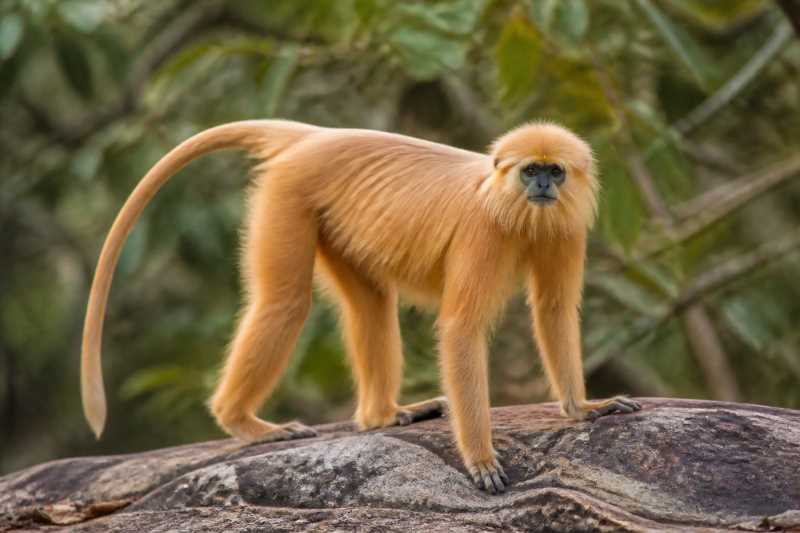
Golden Langurs are medium-sized primates with a distinct appearance that makes them easily recognizable. They have a long tail, often exceeding the length of their body, which aids in balance as they navigate the forest canopy. Their fur is a rich golden color, which can vary in hue from cream to a deep, vibrant gold depending on age and geographic location. The face of a Golden Langur is black with a distinct lack of fur, providing a striking contrast to its golden coat. Adult males and females are similar in size, typically measuring around 50 cm in body length, with tails adding another 70 to 90 cm. They weigh between 9 to 12 kg, making them one of the larger species within the genus Trachypithecus.
Range and Habitat
The Golden Langur is found in a relatively small geographic area in the foothills of the Himalayas, primarily in the state of Assam in India and the neighboring regions of Bhutan. Their range is bounded by four major river systems: the Manas River to the east, the Sankosh River to the west, the Brahmaputra River to the south, and the Himalayan foothills to the north. These langurs inhabit subtropical and tropical evergreen forests, where they thrive in the dense canopy. They are also found in deciduous forests and riverine areas, which provide a rich abundance of food and shelter.
Behavior and Diet
Golden Langurs are diurnal and arboreal, spending the majority of their time in the treetops. They are social animals, living in groups that can range from 8 to 50 individuals. These groups are typically multi-male and multi-female, with a complex social hierarchy. Communication within groups is facilitated through vocalizations, facial expressions, and body postures. Their diet primarily consists of leaves, fruits, seeds, and flowers. As folivores, they rely heavily on leaves, particularly those of the Ficus species, to meet their nutritional needs. This diet requires a specialized digestive system capable of breaking down cellulose.
Identification Tips (field recognition cues)
Identifying Golden Langurs in the field can be an exhilarating experience for wildlife enthusiasts. Key identification tips include:
- Coloration: Look for their distinctive golden fur, which varies from light cream to deep gold.
- Tail: Note the long, prehensile tail used for balance and movement in the canopy.
- Facial Features: Observe the black, hairless face that contrasts sharply with their golden coat.
- Behavior: Watch for their agile movements and acrobatic leaps between trees, often in groups.
- Vocalizations: Listen for their distinctive calls which are used to communicate within groups.
Conservation Status (with threats and protections)
The Golden Langur is currently classified as Endangered by the International Union for Conservation of Nature (IUCN). Several threats contribute to this status, including habitat destruction due to logging, agriculture, and human settlement expansion. Additionally, inbreeding and genetic isolation due to fragmented habitats pose significant risks. Conservation efforts are underway to protect this species, including habitat restoration projects and the establishment of protected areas such as wildlife sanctuaries and national parks. Cross-border conservation initiatives between India and Bhutan are crucial, as the species’ range spans both countries.
Frequently Asked Questions
1. What is the significance of the Golden Langur in its ecosystem? Golden Langurs play a vital role in their ecosystem by promoting seed dispersal, which aids in forest regeneration. Their diet helps control plant growth, maintaining a balanced ecosystem.
2. How do Golden Langurs communicate? Golden Langurs communicate through a combination of vocalizations, facial expressions, and body postures. These communication methods are essential for maintaining social structure within groups.
3. What are the primary threats to the Golden Langur population? The main threats include habitat destruction due to deforestation, agricultural expansion, and human encroachment, as well as genetic isolation from fragmented habitats.
4. Are there any successful conservation programs for Golden Langurs? Yes, several conservation programs focus on habitat restoration, protected area establishment, and cross-border initiatives between India and Bhutan to ensure the survival of this species.
5. When is the best time to observe Golden Langurs in the wild? The best time to observe Golden Langurs is during the early morning or late afternoon when they are most active in the forest canopy.
Related posts