Introduction
In the vast and vibrant ecosystems of Central and South America, the Sharp-tailed Streamcreeper (Lochmias nematura) quietly thrives. This elusive bird, belonging to the family Furnariidae, is a fascinating subject for ornithologists and bird enthusiasts alike. Known for its distinctive behavior and habitat preferences, the Sharp-tailed Streamcreeper represents a remarkable example of avian adaptation and ecological niche specialization.
Taxonomy and Classification
The Sharp-tailed Streamcreeper is classified under the order Passeriformes, which encompasses more than half of all bird species. Within this order, it belongs to the family Furnariidae, a diverse group of birds commonly referred to as ovenbirds due to the unique, oven-like shape of their nests. The genus Lochmias is monotypic, meaning it contains only one species, Lochmias nematura. This singular position in its genus highlights the distinctiveness of the Sharp-tailed Streamcreeper within the avian world.
Physical Characteristics
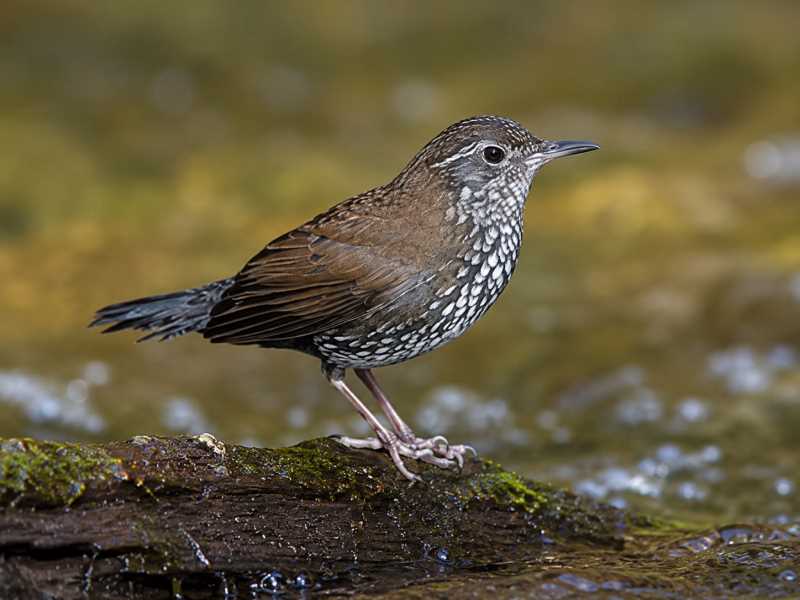
The Sharp-tailed Streamcreeper is a small bird, measuring approximately 15 to 17 centimeters in length. Its plumage is predominantly brown, providing excellent camouflage against the earthy tones of its preferred habitats. The bird’s back and wings are a rich, rufous-brown color, while the underparts are streaked with lighter brown and white. This streaking helps break up the bird’s outline, further aiding in concealment from predators.
One of the most distinctive features of the Sharp-tailed Streamcreeper is its sharp, pointed tail, from which it derives its common name. This tail is adapted to provide balance and support as the bird maneuvers through its environment. The Streamcreeper’s bill is relatively long and slightly curved, ideal for probing into crevices and under rocks in search of food.
Habitat and Distribution
The Sharp-tailed Streamcreeper is primarily found in the humid forested regions of Central and South America, ranging from southern Mexico through to northern Argentina. It exhibits a strong preference for lowland and foothill forests, particularly those with dense undergrowth and a proximity to water bodies such as streams and rivers.
These birds are known to inhabit elevations ranging from sea level to approximately 2,000 meters, though they are most commonly found at lower altitudes. Their choice of habitat is closely tied to their foraging behavior, as they rely heavily on the presence of running water to find their preferred prey.
Behavior and Ecology
The Sharp-tailed Streamcreeper is predominantly insectivorous, feeding on a diet comprised mainly of insects and other small invertebrates. It displays a unique foraging behavior, often seen hopping along stream banks and probing into crevices with its bill. This behavior is not only a testament to its adaptability but also a critical part of its ecological role, as it helps control insect populations in its habitat.
These birds are generally solitary or found in pairs, and they are known for their secretive nature. They tend to remain hidden in dense vegetation, making them a challenging subject for observation and study. Despite their elusive nature, they are known to be vocal, often using a series of sharp, high-pitched calls to communicate with one another.
Reproduction and Life Cycle
Breeding season for the Sharp-tailed Streamcreeper typically coincides with the rainy season in its habitat, ensuring that food resources are abundant for raising young. The bird constructs a dome-shaped nest made of twigs, leaves, and moss, often situated in a concealed location close to water.
Females lay a clutch of two to three eggs, which are incubated for approximately two weeks. Both parents participate in feeding and caring for the chicks, which fledge after about 15 to 20 days. The cooperative nature of their parenting is crucial for the survival of the young, as it maximizes the feeding opportunities and protection from predators.
Conservation Status
Currently, the Sharp-tailed Streamcreeper is classified as a species of Least Concern by the International Union for Conservation of Nature (IUCN). This status is largely due to its wide distribution and presumed large population. However, like many forest-dependent species, the Streamcreeper faces potential threats from habitat destruction and fragmentation, particularly due to deforestation and land conversion for agriculture.
Conservation efforts aimed at preserving the natural habitats of the Sharp-tailed Streamcreeper are essential for ensuring its continued survival. Protecting riverine forests and maintaining the integrity of stream ecosystems are crucial steps in safeguarding this species’ future.
Cultural and Ecological Significance
The Sharp-tailed Streamcreeper, though not as well-known as some of its avian counterparts, plays an important role in its ecosystem. By controlling insect populations, it contributes to the health and balance of the forest environment. Additionally, as a bioindicator, the presence and health of Streamcreeper populations can provide valuable insights into the condition of their habitats.
Culturally, birds like the Sharp-tailed Streamcreeper hold a special place in the hearts of local communities and birdwatchers. They are often seen as symbols of the rich biodiversity found within Central and South American forests, and their presence is a testament to the resilience and complexity of these ecosystems.
Conclusion
The Sharp-tailed Streamcreeper is a remarkable example of avian adaptation and ecological specialization. Its unique behaviors, specialized habitat preferences, and role within its ecosystem make it a fascinating subject for study and conservation. As we continue to learn more about this elusive bird, it is imperative that we also take steps to protect the vital habitats it depends on, ensuring that future generations can enjoy the beauty and mystery of the Sharp-tailed Streamcreeper.
References
1. del Hoyo, J., Elliott, A., & Christie, D. (Eds.). (2003). _Handbook of the Birds of the World, Vol. 8: Broadbills to Tapaculos_. Lynx Edicions.
2. Remsen, J. V., & Sharpe, C. J. (2020). Sharp-tailed Streamcreeper (_Lochmias nematura_), version 1.0. In J. del Hoyo, A. Elliott, J. Sargatal, D. A. Christie, & E. de Juana (Eds.), _Birds of the World_. Cornell Lab of Ornithology.
3. BirdLife International. (2020). _Lochmias nematura_. The IUCN Red List of Threatened Species 2020.
Related posts