Introduction
The Chinese Francolin, Francolinus pintadeanus (Scopoli, 1786), is a medium-sized ground-dwelling game bird in the pheasant family, Phasianidae. It is also known as the Burmese Francolin in some sources. The species is resident across parts of southern China and mainland South-east Asia, where it occupies open, grassy and lightly wooded habitats.
Physical Description
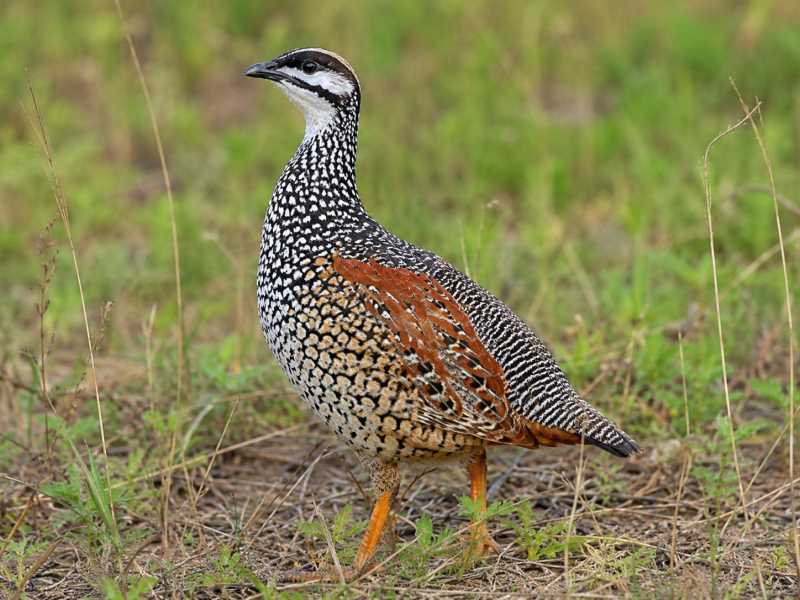
The Chinese Francolin is about 30–34 cm long. It has a compact body, short strong legs and a relatively short tail. The plumage is intricately patterned, with dark grey, brown, chestnut, buff and white markings. The male has a distinctive head pattern, including a dark surround to the white cheeks and rusty-brown colouring on the sides of the crown. The neck, mantle, chest and flanks are dark with conspicuous pale spotting, while the rump and upper tail-coverts are finely barred.
The legs are generally yellowish-orange rather than bright red. The female is duller overall, with more buff-coloured underparts and darker barring. She lacks some of the male’s chestnut wing colouring and has a less strongly contrasting head pattern. Young birds are less sharply marked than adults and develop the adult plumage progressively.
Range and Habitat
The Chinese Francolin occurs from extreme north-eastern India through Myanmar, northern and central Thailand, Laos, Vietnam and Cambodia to southern China. In China, it is recorded in areas including Yunnan, Guangxi, Hainan, Guangdong and Fujian. Two commonly recognised subspecies are F. p. pintadeanus in south-eastern China and F. p. phayrei across much of the western and southern part of the range, although the treatment of geographic forms can vary between taxonomic sources.
It is a resident rather than a migratory species. The preferred habitat is open country with sufficient cover, including grassland, scrub, open-canopy woodland, forest edges, hillsides and some agricultural landscapes. Dense undergrowth provides shelter and nesting cover, while open ground allows the birds to feed and move. The species can decline locally when open grassland develops into closed scrub or forest, or when planting and land conversion remove suitable habitat.
Behaviour and Diet
Chinese Francolins are mainly terrestrial and are usually encountered singly, in pairs or in small family groups. They forage on the ground, often remaining concealed in grass or scrub. Feeding is most evident during the cooler parts of the day, particularly in the morning and late afternoon. They may roost close to their feeding area and can become less active during wet weather.
The diet includes seeds, grains, berries, other plant material, insects and their larvae. Grasshoppers, ants and other small invertebrates are important animal foods, especially when birds are feeding young. The species may also take small reptiles and other minor prey where available. Foraging involves walking through cover and scratching or probing the ground to uncover food.
The male’s loud advertising call is particularly frequent during the breeding season, which varies geographically but commonly falls in the warmer or wetter months. The nest is a shallow scrape on the ground, usually concealed in grass or other vegetation. Reported clutch sizes vary, with four or five eggs given in detailed species accounts. Incubation lasts about 21 days. The chicks are precocial and leave the nest soon after hatching, remaining under the care of an adult while they forage.
Identification Tips
- Look for a compact, short-tailed game bird in grassland, scrub or open woodland.
- The male’s black-and-white facial pattern, rusty crown sides and pale spotting on the dark chest and flanks are useful field marks.
- The female is more subdued, with buff underparts and heavier dark barring.
- Yellowish-orange legs, a finely patterned back and a habit of keeping low in vegetation help distinguish it from larger pheasants.
- When flushed, it usually flies low and rapidly for a short distance before dropping back into cover.
- Its repeated, far-carrying call may reveal a bird that remains hidden. In Hong Kong, males call particularly often from March to July.
Conservation Status
The Chinese Francolin is classified as Least Concern on the IUCN Red List, and available assessments indicate a stable global population trend. A global population estimate has not been established, so numerical abundance should not be inferred from the species’ broad range.
The principal conservation concern is the loss or degradation of suitable open habitat. Agricultural expansion, deforestation, tree planting and the natural succession of grassland into dense scrub or forest can reduce feeding and nesting areas. Hunting may also affect local populations in areas where francolins are treated as game birds, although the scale of this pressure is not consistent across the range.
Maintaining a mosaic of grassland, open woodland and shrubland, managing vegetation succession and protecting remaining habitat are important conservation measures. Local monitoring is also useful because a species that remains widespread overall may still decline substantially in particular regions.
Frequently Asked Questions
Where does the Chinese Francolin live?
It occurs from north-eastern India through Myanmar, Thailand, Laos, Vietnam and Cambodia to southern China, including Hainan. It generally favours lowland and foothill habitats with grass, scrub and open woodland.
Is the Chinese Francolin migratory?
No. It is considered a resident species, although individuals may make short local movements between feeding, nesting and cover habitats.
What does the Chinese Francolin eat?
Its diet includes seeds, grains, berries, plant shoots, insects, larvae, grasshoppers and ants. Small reptiles and other invertebrates may also be taken when available.
How can the Chinese Francolin be identified?
The male has a strong black-and-white facial pattern, rusty-brown crown sides, pale spots on dark underparts and yellowish-orange legs. Females are duller and more heavily barred, with buff underparts.
Where does the Chinese Francolin nest?
It nests on the ground, usually in a shallow scrape concealed by grass or other vegetation. The chicks are precocial and leave the nest soon after hatching.
Is the Chinese Francolin endangered?
Globally, it is currently classified as Least Concern. Local populations can nevertheless be affected by habitat loss, vegetation succession, tree planting, agricultural change and hunting.
References
- BirdLife International. 2024. Francolinus pintadeanus, Chinese Francolin. BirdLife International DataZone, taxon ID 22678725. https://datazone.birdlife.org/ (accessed 8 September 2026).
- Carey, G. J. 2023. Chinese Francolin Francolinus pintadeanus, version 1.0. In The Avifauna of Hong Kong. Hong Kong Bird Watching Society. https://cms.hkbws.org.hk/avifauna/species/0030/003700 (accessed 8 September 2026).
- International Union for Conservation of Nature. n.d. Chinese Francolin Francolinus pintadeanus. The IUCN Red List of Threatened Species, taxon ID 22678725. https://www.iucnredlist.org/species/22678725/263658131 (accessed 8 September 2026).
- Kirk, G. and Kirwan, G. M. 2020. Chinese Francolin Francolinus pintadeanus, version 1.0. In Birds of the World, edited by J. del Hoyo, A. Elliott, J. Sargatal, D. A. Christie and E. de Juana. Cornell Lab of Ornithology, Ithaca, New York. https://doi.org/10.2173/bow.chifra1.01.
- MDPI Animals. 2025. Nest Predators and Reproductive Success in the Chinese Francolin (Francolinus pintadeanus) Across Two Nature Reserves of Tropical Hainan Island, China. Animals 15(17): 2489. https://www.mdpi.com/2076-2615/15/17/2489 (accessed 8 September 2026).
- IOC World Bird List. 2025. IOC World Bird List, version 15.2: Chinese Francolin Francolinus pintadeanus. International Ornithologists’ Union. https://www.worldbirdnames.org/new/ioc-lists/ (accessed 8 September 2026).
Related posts