Introduction
The Whiskered Treeswift (Hemiprocne comata) is a small, distinctive forest bird of South and Southeast Asia. It is the smallest member of the treeswift family, Hemiprocnidae, and is recognised by its elongated white facial markings, glossy plumage, deeply forked tail and graceful, perch-based insect-catching flights.
Physical Description
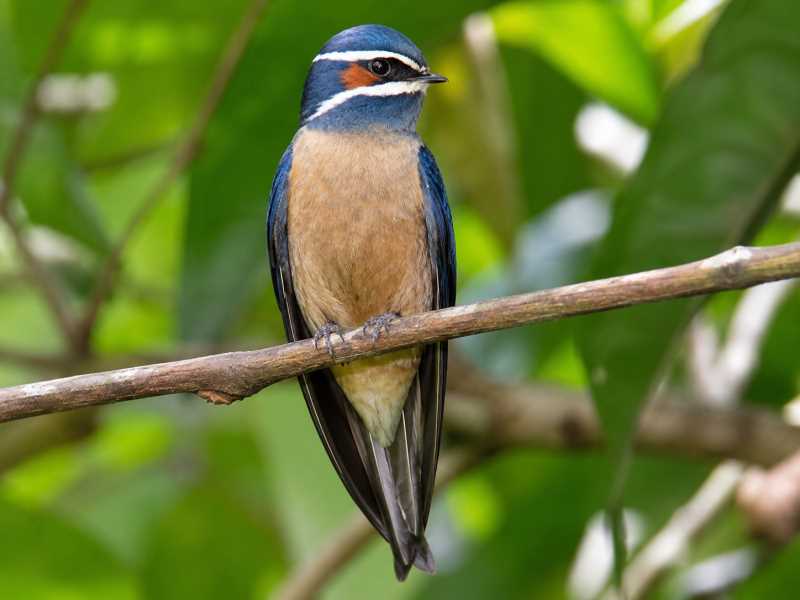
The Whiskered Treeswift is approximately 15–17 centimetres long. It has a short bill, a slight crest, long pointed wings and a deeply forked tail. The upperparts and wings are glossy blue-green to dark metallic blue, while the back and much of the underparts are brownish or bronze. The lower belly and undertail are paler.
Its most diagnostic feature is the pair of narrow white facial stripes. One extends above the eye and another forms the prominent white moustache or whisker-like marking below the eye. Adult males have rich chestnut ear-coverts, whereas females usually have darker, less colourful ear-coverts. Juveniles are duller and generally show less clearly defined facial markings.
The long wings and forked tail give the species a swift-like appearance, but treeswifts have stronger feet and regularly perch on exposed branches. Unlike true swifts, they can remain perched for extended periods.
Range and Habitat
The Whiskered Treeswift is a resident species distributed from southern Myanmar and peninsular Thailand through Malaysia, Singapore, Sumatra and Borneo, and across parts of the Philippines. Two commonly recognised geographic forms are associated with the mainland and Sundaic region, and the Philippines.
It is primarily associated with evergreen and other mature forest, including lowland forest and, locally, mature mangroves. It may also use forest edges, clearings, plantations and other partly open areas where suitable perches and flying insects are available. Most records are from low elevations, although it can occur in hilly and lower montane habitats.
The species is generally regarded as resident rather than migratory. It is most often encountered where forest openings, tracks, rivers or clearings provide room for short aerial sorties from favoured perches.
Where to See This Species
Kaeng Krachan National Park, Phetchaburi Province, Thailand
Kaeng Krachan National Park supports extensive lowland and hill evergreen forest and has documented records of Whiskered Treeswift. Look along forest roads, clearings and open edges, where birds may sit on bare branches before flying out to catch insects.
Nearby accommodation: Kaeng Krachan town and the surrounding park gateway area offer guest houses, small hotels, campsites and forest lodges.
Khao Sok National Park, Surat Thani Province, Thailand
Whiskered Treeswift is included in the park’s recorded wildlife, and the combination of mature evergreen forest, rivers and canopy openings provides suitable habitat. Early morning and late afternoon are sensible periods to check exposed branches and open stretches above trails or waterways, although the species may be seen throughout the day.
Nearby accommodation: Khlong Sok village is the main gateway, with guest houses, hotels, lodges, campsites and self-catering accommodation.
Khao Luang National Park, Nakhon Si Thammarat Province, Thailand
The park’s forested landscapes and documented bird records make it another legitimate place to search for the species. Focus on forest edges, open sections of trail and areas where tall trees provide prominent perches above the canopy.
Nearby accommodation: Lan Saka and Nakhon Si Thammarat provide practical bases with hotels, guest houses, resorts and other visitor accommodation.
Behaviour and Diet
Whiskered Treeswifts feed mainly on flying insects, including beetles, flies and other small arthropods. They commonly sit on a dead or exposed branch and make short, rapid flights to seize prey in the air, often returning to the same or a nearby perch.
They are usually seen singly or in pairs and are less conspicuously social than many true swifts. Their characteristic flight is therefore often a series of brief sorties rather than continuous high-speed flying. The species is generally resident, and pairs may remain in the same broad area throughout the year.
Breeding information is limited, but treeswifts are monogamous and both adults participate in parental care. The nest is a tiny, shallow half-saucer made from materials such as feathers, bark and plant fibres, cemented with saliva to a slender exposed branch. A clutch consists of a single egg. Because the nest is extremely small, the incubating adult straddles it rather than sitting fully inside it, and the young may later rest on a nearby branch while being fed.
Identification Tips
- Look for a small, long-tailed bird with a deeply forked tail and long pointed wings.
- The elongated white stripe above the eye and white moustache-like marking below it are the key field marks.
- Adult males show chestnut ear-coverts. Females have darker ear-coverts and usually appear less richly coloured.
- The species often perches conspicuously on dead or bare branches before making a short flight after an insect.
- The Whiskered Treeswift is smaller and more strongly marked on the face than the Grey-rumped Treeswift. The latter usually appears greyer and lacks the Whiskered Treeswift’s distinctive white facial streamers and male chestnut ear-coverts.
Conservation Status
The Whiskered Treeswift is currently classified as Least Concern on the IUCN Red List. It remains widespread and is still recorded from a broad range of forested areas, but forest clearance, degradation and conversion of mature habitat may reduce local populations. Protecting remaining evergreen forest, maintaining connected habitat and managing forest edges sustainably are important conservation measures.
The species is not known to have a reliable global population estimate, and detailed information on long-term population trends remains limited.
Frequently Asked Questions
What is the scientific name of the Whiskered Treeswift?
The scientific name is Hemiprocne comata. It belongs to the family Hemiprocnidae, the treeswifts.
Where does the Whiskered Treeswift live?
It occurs in southern Myanmar, Thailand, Malaysia, Singapore, Sumatra, Borneo and the Philippines. It mainly inhabits mature evergreen and other moist forests, with some use of mangroves, plantations, clearings and forest edges.
Is the Whiskered Treeswift migratory?
No. It is generally considered a resident species, although local movements may occur and individual records can be irregular in areas where the species is scarce.
What does the Whiskered Treeswift eat?
It feeds mainly on flying insects, including beetles, flies and other small arthropods captured during short flights from exposed perches.
How does the Whiskered Treeswift build its nest?
The nest is a very small half-saucer attached with saliva to a slender exposed branch. It is made from materials such as feathers, bark and plant fibres, and the female lays a single egg.
How can I identify a Whiskered Treeswift?
Look for the elongated white markings above and below the eye, the deeply forked tail, glossy dark wings and habit of perching on exposed branches. An adult male also has chestnut ear-coverts, while the female’s ear-coverts are darker.
References
- IOC World Bird List
- IUCN Red List of Threatened Species
- National Parks Board, Singapore
Related posts