The Enigmatic Long-tailed Broadbill: A Jewel of the Forests
The Long-tailed Broadbill (Psarisomus dalhousiae) is a captivating avian species that commands attention with its vibrant plumage and unique morphology. Found primarily in the dense, humid forests of South and Southeast Asia, this bird is an icon of tropical biodiversity and a subject of fascination among ornithologists and bird enthusiasts alike.
Taxonomy and Distribution
Belonging to the family Eurylaimidae, the Long-tailed Broadbill is a member of the broadbill family, characterized by their wide bills and striking coloration. The species was first described by James Scott Bowerbank in 1835 and is named in honor of Christina Broun Ramsay Dalhousie, the wife of the 9th Earl of Dalhousie.
This species has a broad but fragmented distribution across the Indian subcontinent, Bhutan, Nepal, Myanmar, Thailand, Laos, Vietnam, and parts of Malaysia, with isolated populations in southern China and Indonesia. It thrives in subtropical and tropical moist lowland forests and montane forests, generally at elevations ranging from 300 to 2000 meters.
Physical Characteristics
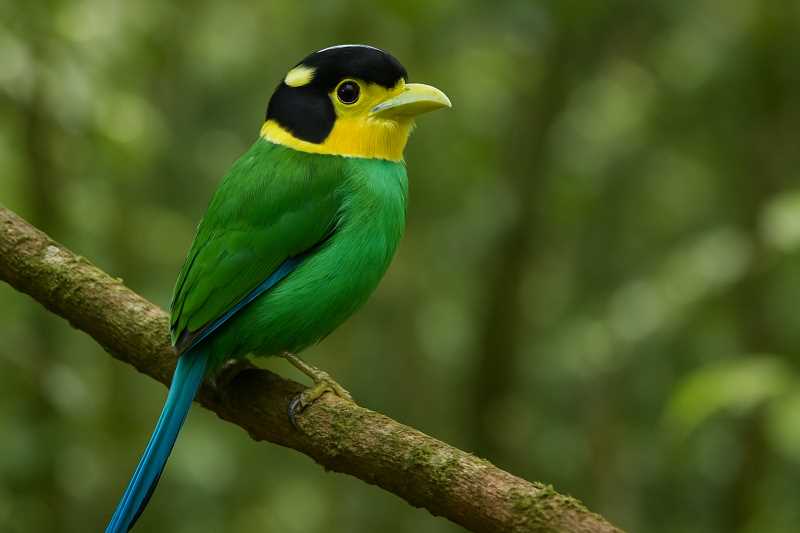
The Long-tailed Broadbill is unmistakable with its striking appearance. It measures about 25-28 centimeters in length, including its elongated tail. Its most distinguishing feature is its glossy green plumage, contrasted by a vivid yellow face and throat. The bird’s crown is adorned with a black cap, and it has a bright blue patch on its wings, adding to its kaleidoscope of colors.
The broad, flat bill, from which the bird derives its name, is typically yellow with a black tip, perfectly adapted for its insectivorous diet. The species exhibits little sexual dimorphism, meaning males and females look remarkably similar, which is somewhat unusual in the bird world where males often boast more vibrant colors.
Behavior and Ecology
The Long-tailed Broadbill is a social bird, often seen in small flocks. Its vocalizations are a series of high-pitched notes, which serve as a means of communication within these groups. This species is predominantly insectivorous, feeding on insects, larvae, and small invertebrates found in the forest canopy. Occasionally, it may also consume fruits and seeds, showcasing a degree of dietary flexibility.
Its foraging behavior is a spectacle to behold, as it nimbly navigates through the dense foliage, often hanging upside down in pursuit of prey. The bird’s agility and acrobatic prowess are crucial for survival in the competitive forest environment.
Reproduction and Nesting
Breeding season for the Long-tailed Broadbill varies across its range but typically occurs during the warmer months when food is abundant. The species is monogamous, forming long-term pair bonds. Nesting is a cooperative endeavor, with both sexes participating in the construction of the nest, which is a large, spherical structure made of twigs, leaves, and other plant materials, often suspended from a tree branch.
The female lays a clutch of 3-6 eggs, which both parents incubate for about 18-20 days. After hatching, the altricial chicks are cared for by both parents, who tirelessly provide them with food until they fledge, approximately 20-25 days post-hatching.
Conservation Status
The Long-tailed Broadbill is currently listed as a species of Least Concern by the International Union for Conservation of Nature (IUCN). However, its habitat is under continuous threat from deforestation and habitat fragmentation. The ongoing loss of forest cover in its range, due to agricultural expansion, logging, and infrastructure development, poses a significant threat to its populations.
Conservation efforts are crucial to ensure the survival of this and other forest-dependent species. Protecting large swathes of forest habitat, promoting sustainable land-use practices, and raising awareness about the ecological value of forest ecosystems are vital steps towards preserving the biodiversity of these regions.
Cultural and Ecological Significance
Beyond its ecological role as an insect predator, the Long-tailed Broadbill holds cultural significance in many of the regions it inhabits. It has inspired folklore and art, symbolizing beauty and the richness of the natural world. Its presence in a forest is often considered an indicator of ecological health, as it requires pristine environments to thrive.
Moreover, as a popular subject for birdwatchers and nature photographers, the Long-tailed Broadbill contributes to ecotourism, providing economic incentives for conservation. By drawing attention to the beauty and diversity of forest ecosystems, this bird plays a part in fostering a greater appreciation for nature and the need to protect it.
Conclusion
The Long-tailed Broadbill is more than just a visually stunning bird; it is a vital component of the forest ecosystems it inhabits. Its vibrant presence is a reminder of the intricate web of life that exists within our planet’s forests and the importance of conserving these natural habitats for future generations. Through a combination of scientific research, conservation efforts, and public engagement, we can ensure that this avian gem continues to grace our forests with its beauty.
In conclusion, the Long-tailed Broadbill is a testament to the wonders of evolution and biodiversity. Its captivating appearance and fascinating behaviors make it a true jewel of the forests, deserving of admiration and protection.
Related posts